In This Article
Waterproof trousers vs overtrousers is really a question about where your waterproofing lives. Overtrousers are a separate shell you pull on over your usual legwear when the rain arrives. Standalone waterproof trousers are built to be worn alone, all day, as your main layer. One is a safety net; the other is a wardrobe decision.
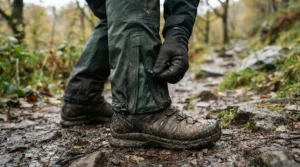
Britain’s weather doesn’t do “predictable”. A sunny car park in Ambleside can turn into a horizontal-rain situation by the first stile. So the choice matters more than it sounds. Pick overtrousers and you carry a small, cheap insurance policy that you may use only a handful of times a year. Pick standalone trousers and you commit to a pricier, all-day garment that never needs a roadside wardrobe change.
Before comparing, it helps to know the one number that appears on almost every spec sheet. Hydrostatic head measures how much water pressure a fabric can resist, so a 5,000mm rating holds back a five-metre column of water. It’s useful, but it’s only one piece of the puzzle, as we’ll see.
This guide is built from spec sheets, retailer listings and published tester reports, not from personal wear-testing. Below you’ll find seven real products, honest analysis of each, and practical guidance on layering systems, zips, care and cost. Prices appear as ranges because they change constantly, so always check the current price before you buy.
Quick Comparison: Waterproof Trousers vs Overtrousers at a Glance
| Feature | Standalone waterproof trousers | Overtrousers |
|---|---|---|
| Where the waterproofing sits | Built into the trouser you wear all day | A separate shell worn over other trousers |
| When you wear them | Whenever you’re out, rain or not | Only when the weather turns |
| Packability | Not packable; they’re your trousers | Very good; typically 200-550g |
| Putting on over boots | Not applicable; they’re already on | Depends on zip length (ankle-to-hip is easiest) |
| Breathability | Often better in membrane-free designs | Varies widely with fabric and price |
| Typical price band | Mid-£100s | £30-£120 for most, more for premium |
| Best For | Regular hillwalkers in changeable weather, e.g. Páramo Cascada II | Occasional walkers and backup layers, e.g. Quechua MH500, Rab Downpour Eco Pants |
Looking at the table, the real split is frequency of use. If you’re out most weekends and rain is more “when” than “if”, standalone trousers like the Páramo Cascada II remove the faff of stopping to change. If rain is an occasional guest, overtrousers such as the Quechua MH500 give you protection for a fraction of the cost, and they live in your rucksack until needed. Neither is universally better; the right answer depends on how you walk.
💬 Just one click — help others make better buying decisions too!😊
Top 7 Waterproof Trousers and Overtrousers: Expert Analysis
The seven pairs below cover budget, mid-range and premium, and both sides of the waterproof trousers vs overtrousers divide. Each analysis rests on published specs and aggregated tester and reviewer feedback, with price ranges rather than exact prices.
1. Rab Downpour Eco Pants — lightest full-zip all-rounder
Feather-light is the headline here: roughly 260-280g depending on whose scales you trust, so they vanish into the lid of a rucksack. The shell is recycled 2.5-layer Pertex Shield Revolve, a mono-polymer fabric Rab says can be recycled again in future, finished with a fluorocarbon-free DWR. Retailer spec sheets quote a 20,000mm hydrostatic head. That’s double the 10,000mm of the Regatta Highton, which means you’re covered for hours of sustained rain, not just a passing shower. The men’s version has full-length zips, so you can pull the trousers on over walking boots without unlacing anything.
Based on the spec comparison, these suit walkers who want one pair that handles a wet October on the fells as comfortably as a June cloudburst. The catch is a stripped-back feature list. The women’s pair reviewed by OutdoorGearLab has no pockets or fly and only knee-length zips, so check which version you’re buying. Careful scrambling is wise too, because lightweight fabric and sharp crampons aren’t friends.
Reviewers consistently describe them as light, packable and very waterproof. Live For The Outdoors named them its best overall pick, while one retailer reviewer wished for long-term durability reports after six months of use.
Pros:
- ✅ Very light and packable at roughly 260-280g
- ✅ High 20,000mm waterproof rating
- ✅ Recycled, fluorocarbon-free fabric
Cons:
- ❌ Minimal features; pockets limited or absent
- ❌ Light fabric needs care around crampons and rock
Price: around £90-£100 range, which is strong value for regular walkers.
2. Quechua MH500 — best budget over-trousers
Value is the whole story. Live For The Outdoors picked the Quechua MH500 as its best budget buy, and the women’s version is listed in UK sizes 2-18. The pair weighs 309g in a men’s-sized medium, and the design includes an elasticated waistband and a full fly for a snug but flexible fit. That fly is a useful extra on a budget garment, because it makes a toilet stop on a wet hillside slightly less of an ordeal.
Here’s what the spec sheet won’t tell you, but the review context suggests: these are aimed at hikers who want dependable rain protection without paying premium prices. They aren’t the lightest option, and the waterproof rating is less prominently quoted than on rivals, so check the current listing for the figure before relying on them in heavy, sustained rain. For occasional ramblers, dog walkers and anyone who keeps a pair in the car boot “just in case”, that’s rarely a dealbreaker.
Reviewers and testers repeatedly frame them as a sensible, no-nonsense purchase rather than a technical masterpiece. I couldn’t verify a large pool of independent long-term durability reports, so treat longevity claims with caution.
Pros:
- ✅ Excellent value for dependable rain protection
- ✅ Elasticated waist and full fly for comfort
- ✅ Easy to pack in a rucksack
Cons:
- ❌ Heavier than premium ultralight shells
- ❌ Waterproof rating less clearly quoted than rivals
Price: around £40, which makes them a smart, low-risk starter pair. Availability on amazon.co.uk may vary.
3. Regatta Highton — cheapest sensible way in
Regatta’s Isotex 10,000 fabric, made from recycled plastic bottles, is the star. The ratings give you 10,000mm waterproofing, a stretchy feel and a weight of around 221g, which is genuinely light for the money. The trousers have two zipped side pockets and ankle-to-knee zips. That last detail matters: shorter zips mean you may still wrestle with chunkier boots, a limitation we’ll unpack in the section on putting overtrousers on over boots.
The honest take is that the Regatta Highton is a “good for most days” pair. Ten thousand millimetres handles typical three-season British rain. It’s not designed for a Cairngorms winter or for scrambling on abrasive granite. Stretch in the fabric helps with walking comfort, which is a rare treat in budget overtrousers.
Trail magazine’s testers rated the affordability, recycled materials and stretch, but flagged that these aren’t the most durable and could be easier to put on. That’s consistent with the zip length and thin fabric. Treat them as a well-priced shell for lowland and moderate hill use rather than an expedition garment.
Pros:
- ✅ Very affordable with a 10,000mm waterproof rating
- ✅ Light at roughly 221g, with stretchy fabric
- ✅ Recycled fabric and two zipped pockets
Cons:
- ❌ Not the most durable for rough terrain
- ❌ Short ankle-to-knee zips can be fiddly over boots
Price: around £28-£35 range, great value for casual and lowland walkers.
4. Berghaus Deluge 2.0 — tough two-layer with free repairs
Toughness is what sets this pair apart. The Berghaus Deluge 2.0 uses a two-layer Hydroshell fabric with a polyamide shell, and retailers list the weight at roughly 350-390g depending on size. It has an elasticated waist with a drawcord, articulated legs and three-quarter side zips with snap closures. Those snaps are handy for venting and for a no-fuss change, though you’ll want the zips fully open before you step into them over boots.
Analytically, this is the pair for people who find cheap overtrousers flimsy. A thicker two-layer build tends to shrug off brambles and rock better, and the lining reduces that clammy cling against the legs. The price is bulk. One tester said they pack down to about the size of a camping mat, and noted the absence of pockets, adjustable ankle cuffs and a stuff sack.
Reviewers describe the Berghaus Deluge 2.0 as reliable and comfortable in wet weather, with a sturdy feel, though it can run warm. Berghaus also offers free repairs, which strengthens the long-term value case considerably.
Pros:
- ✅ Durable, thicker fabric for rough weather
- ✅ Free repairs from Berghaus
- ✅ Snap-closure side zips for venting
Cons:
- ❌ Bulky and heavier than most alternatives
- ❌ Can feel warm in mild conditions
Price: around £75-£80 range, solid value if you want toughness over lightness.
5. Montane Pac Plus — Gore-Tex Paclite Plus at a fair weight
Gore-Tex Paclite Plus is the draw. The Montane Pac Plus uses 30-denier Paclite Plus fabric, fully seam-taped, with articulated knees, a diamond gusset and an elasticated drawcord waist. It adds three-quarter-length two-way YKK side zips with an internal storm flap, plus press-stud ankle adjustment and compatibility with Montane braces. The women’s listing quotes around 200g. The tougher XT variant, tested by Live For The Outdoors, is quoted at roughly 325g with a 28,000mm hydrostatic head.
In practice, this is a “fast and light mountain days” garment. Two-way zips let you vent from the bottom or the top, which is a handy trick when you’re hiking uphill in drizzle. Brace compatibility is a quiet bonus for scrambling and winter days when you need the waist to behave under a harness or pack belt.
Testers praised the XT version’s durability, good looks and very high waterproof rating, while noting it’s pricey and that sustainability could be better. Aggregated sentiment on the standard Montane Pac Plus is mostly positive, but I couldn’t verify a large independent review pool, so weigh that accordingly.
Pros:
- ✅ Gore-Tex Paclite Plus; fully taped seams
- ✅ Two-way three-quarter zips for flexible venting
- ✅ Articulated knees and brace compatibility
Cons:
- ❌ Premium pricing against budget alternatives
- ❌ Three-quarter zips need care over chunky boots
Price: around £120 range, a fair premium for proven fabric and mountain-ready features.
6. Patagonia Triolet — premium winter workhorse
Overbuilt in the best sense, the Patagonia Triolet is a Gore-Tex membrane trouser in recycled polyester with a PFC-free DWR. The men’s medium weighs about 546g, which is serious weight for a shell. That heft buys you thick, protective winter-weight fabric, which is why one review ranks it among the best rain pants for snow.
Here’s the honest analysis. For three-season hillwalking, Live For The Outdoors found the Patagonia Triolet a bit overkill, and described it as hot and clammy when the zips are fully closed. The heavy-duty feel is impressive, but if you only walk in drizzle, you’re paying for protection you’ll rarely use. If you’re a winter mountaineer, ski tourer or someone who spends long hours in wet snow, the sums look better.
Reviewers consistently note the build quality and eco credentials, but the biggest sticking point is cost. The same testers called it “astronomically expensive” for waterproof over-trousers. That’s a verdict worth taking seriously before you reach for your card.
Pros:
- ✅ Heavy-duty Gore-Tex build for harsh weather
- ✅ Strong sustainability credentials
- ✅ Excellent for snow and winter conditions
Cons:
- ❌ Very expensive for most walkers
- ❌ Heavy and hot when fully zipped up
Price: in the mid-£300s, hard to justify unless you work or play in winter conditions.
7. Páramo Cascada II — standalone trousers, no membrane
A different philosophy entirely. The Páramo Cascada II isn’t an overtrouser at all; it’s a standalone trouser using Nikwax Analogy, a membrane-free system in 100% polyester that Páramo describes as directional, pumping liquid water away from the body. It has three-quarter-length reversed side zips with poppered storm flaps, a contoured shape, a zipped fly with press-stud closure, and a double layer of pump liner in the seat, thigh and knee areas.
Based on the spec comparison, this is the garment for walkers tired of the stop-start of pulling shells on and off. Ventilation is generous, and because they’re your trousers, you aren’t carrying a second layer. Live For The Outdoors called them a great pair for hillwalking in changeable conditions.
Two caveats appear repeatedly. Reviewers note polyester is less abrasion-resistant than nylon, and some forum users report snug knees, so sizing up or trying the trimmer Páramo Velez Adventure may help. One OutdoorsMagic editor reports owning a pair for more than a decade, which suggests proper care pays off.
Pros:
- ✅ Wear-all-day comfort without a membrane
- ✅ Extensive venting through side zips
- ✅ Renewable by washing and re-treating with Nikwax
Cons:
- ❌ Polyester is less abrasion-resistant than nylon
- ❌ Some wearers report snug knees; size up
Price: around £160-£200 range, with a high upfront cost offset by daily wear.
Top 7 at a Glance
| Product | Type | Approx. weight | Waterproofing | Price range | Best For |
|---|---|---|---|---|---|
| Rab Downpour Eco Pants | Overtrousers | 260-280g | 20,000mm HH | £90-£100 | Regular walkers wanting light, high protection |
| Quechua MH500 | Overtrousers | 309g (M) | Check current listing | Around £40 | Occasional walkers on a budget |
| Regatta Highton | Overtrousers | ~221g | 10,000mm | £28-£35 | Casual lowland use |
| Berghaus Deluge 2.0 | Overtrousers | ~350-390g | Hydroshell 2L | £75-£80 | Tough terrain, long-term value |
| Montane Pac Plus | Overtrousers | 200-325g (by version) | Gore-Tex Paclite Plus | Around £120 | Fast-and-light mountain days |
| Patagonia Triolet | Overtrousers | 546g (M) | Gore-Tex membrane | Mid-£300s | Winter and snow |
| Páramo Cascada II | Standalone trousers | Not quoted in sources | Nikwax Analogy (no membrane) | £160-£200 | All-day wear in changeable weather |
The Rab Downpour Eco Pants stand out for protection per gram, while the Regatta Highton and Quechua MH500 dominate on price. The Berghaus Deluge 2.0 trades weight for toughness and repairability. At the top end, the Patagonia Triolet suits genuine winter use, and the Páramo Cascada II is the odd one out because it removes the need to carry a second layer at all.
✨ Don’t Miss These Carefully Chosen Picks!
🔍 Take your wet-weather walking to the next level with these carefully selected products. Click on any highlighted item to check current pricing and availability. The right pair will help you enjoy every soggy mile with confidence! 🥾
Standalone Waterproof Trousers vs Shell Layer: What’s the Real Difference?
Think of it like a coat. A shell layer is your emergency overcoat: a thin, waterproof membrane garment that goes over everything else when needed. Standalone waterproof trousers are more like a good wool jumper that happens to be rain-proof. The difference with standalone waterproof trousers vs shell layer comes down to when and how long you wear them.
A shell layer typically relies on a membrane or laminate. That gives high hydrostatic head figures but can trap perspiration inside during hard uphill work. Standalone designs like the Páramo Cascada II use a membrane-free fabric system, so the trousers feel closer to conventional walking trousers. The biggest question for any such trouser, according to OutdoorsMagic’s review of the Páramo Velez Adventure trousers, is whether it can genuinely replace waterproof overtrousers.
| Option | Rain protection | Breathability | Packability | Best For |
|---|---|---|---|---|
| Overtrousers like Rab Downpour Eco Pants | High (20,000mm HH) | Good for the price | Excellent | Walkers wanting a light backup layer |
| Standalone trousers like Páramo Cascada II | High, membrane-free | Often superior in reviews | Not applicable | All-day wear in changeable weather |
| Water-resistant walking trousers | Light showers only | Very good | Not applicable | Dry-weather walks with low rain risk |
The table shows the trade-off clearly. Water-resistant trousers are comfortable but give up when rain turns serious, while overtrousers give the strongest barrier but add a layer. Standalone designs sit in the middle: more breathable than most shells, but less compact. If you wear trousers daily on the hills anyway, standalone often wins on comfort.
Layering Systems: Where Your Trousers Fit
Layering systems for your legs are simpler than for your torso, but they still matter. A typical three-part setup runs from base layer, to walking trousers, to a waterproof shell. Páramo recommends its own base layers beneath Nikwax Analogy clothing, which tells you that moisture management under the waterproof layer genuinely affects comfort.
With overtrousers, you’re stacking a waterproof barrier on top of whatever trousers you chose that morning. That’s flexible, but it also means perspiration from your legs has to pass through two garments. Decathlon’s own guidance makes the point that dampness inside a waterproof is often condensation of sweat, not rain getting in. Match your trousers to your effort level: a steady stroll tolerates a modest breathability rating, while a steep climb demands more.
Mesh-lined overtrousers feel more comfortable because condensation sits away from your skin, but they can be heavier and snag as you pull them on over boots. Lightweight 2.5-layer fabrics tend to show more condensation, while 3-layer fabrics breathe better but cost more. In winter, you may add insulating layers underneath, so size your overtrousers generously. A shell that’s too snug over thermal leggings is a miserable shell indeed.
Ease of Putting on Over Boots
Zip length decides everything. Full-length zips from ankle to hip are the most convenient, while shorter ankle-to-knee zips can still require some wrestling. That’s the core of ease of putting on over boots, and it’s easy to overlook until you’re balancing on one leg in a hailstorm.
Looking at our seven, the men’s Rab Downpour Eco Pants offer full-length zips, while the Berghaus Deluge 2.0 runs from mid-thigh to ankle with snap closures. The Montane Pac Plus and Páramo Cascada II both have three-quarter-length zips. The Regatta Highton has ankle-to-knee zips, which is why reviewers flagged that it could be easier to put on.
A few practical tricks help. Open the zips fully before you step in, and sit on a rock or your pack rather than standing. Slide the trouser leg over the boot toe-first and keep the boot straight so the hem doesn’t catch on the lacing hooks. Chunky winter boots and crampon-ready footwear need longer zips than trail shoes, so match your zip length to your footwear before you buy.
Versatility for Multiple Activities
Versatility for multiple activities is where overtrousers quietly shine. A light shell fits over walking trousers for hillwalking, cycling kit for a wet commute, or old jeans for a muddy dog walk. Standalone trousers, by contrast, are specialised: they’re brilliant for hillwalking but less obviously useful over cycling shorts.
Activity intensity matters. OutdoorsMagic’s testers highlighted the Rab Phantom Pants as an ultralight option and a good fit for running, because heavy shells would feel cumbersome. For slow, low-effort activities like fishing or spectating, a thicker pair such as the Berghaus Deluge 2.0 handles the standing-around chill. For snow, the Patagonia Triolet is the specialist, though it’s overkill for a drizzly walk.
For one-pair-does-everything buyers, the honest compromise is a mid-weight shell with long zips, such as the Rab Downpour Eco Pants. It’s light enough for the rucksack, protective enough for sustained rain, and easy to fit over different trousers. If your activities are mostly hillwalking in changeable weather, a standalone pair like the Páramo Cascada II removes the decision entirely.
How to Choose Between Waterproof Trousers vs Overtrousers: A Waterproof Trouser Buying Guide Comparison
What should you check first? Start with how often you’ll be out in wet weather, then work through these steps. Live For The Outdoors publishes a useful guide to the key features of waterproof trousers that echoes much of this advice.
- Decide your frequency. Rarely wet? Overtrousers are cheaper. Regularly wet? Standalone trousers save time and hassle.
- Check the hydrostatic head. Around 10,000mm suits most three-season walking; 20,000mm and above suits sustained rain and winter days.
- Match zips to footwear. Full-length zips for chunky boots; shorter zips are fine for trail shoes.
- Weigh breathability against price. Three-layer fabrics breathe better but cost more; 2.5-layer is the sweet spot for most.
- Think packability. A garment that spends most of its life in your pack should be light and compact.
- Inspect durability features. Look for scuff patches at the ankle and sturdy fabric if you scramble.
- Set a budget and calculate cost per use. A cheap pair worn rarely may cost more per outing than a pricier one worn weekly.
This waterproof trouser buying guide comparison boils down to one principle: buy for your most common wet day, not your most extreme one.
When to Choose Overtrousers: A Decision Framework
Here’s when to choose overtrousers, in plain “if this, then that” terms:
- If rain is occasional, choose overtrousers because you’ll pay once for protection you rarely use, and the pair lives in your rucksack.
- If you want one shell for several activities, choose overtrousers because they fit over cycling kit, jeans or walking trousers.
- If weight matters, choose a light option like the Rab Downpour Eco Pants because it disappears into a pack.
- If you’re on a tight budget, choose the Quechua MH500 or Regatta Highton because both give real protection at low cost.
- If you’re heading into winter mountains, choose the Patagonia Triolet because heavy-duty protection is worth the weight there.
- If you walk most weekends in changeable weather, pause and consider standalone trousers like the Páramo Cascada II, because stopping to change layers gets old fast.
A simple priority checklist helps too. Rank these four from most to least important: price, weight, durability and all-day comfort. If price and weight top your list, overtrousers win. If all-day comfort sits first, standalone trousers pull ahead. Choose according to your top two priorities and you’ll rarely regret the purchase.

Practical Usage Guide: Putting On, Packing and Caring for Waterproof Trousers
Getting the most from any pair starts before the first rainstorm. Here is a simple routine for the first 30 days:
- Test the fit at home. Put them on over your usual walking trousers and boots, then squat and lift your knee. If they bind, size up.
- Practise the pull-on. Open the zips fully and sit down. Do it twice so it’s automatic when you’re cold and wet.
- Pack smart. Keep overtrousers at the top of your pack or in a lid pocket. If you have to dig for them in a downpour, you’ll get wet anyway.
- Vent early. Open zips when you warm up, before sweat builds. Condensation is easier to prevent than to cure.
For care, the DWR finish wears off over time. When water stops beading and begins to soak the surface, it’s time to restore it. Live For The Outdoors recommends Granger’s products, with Nikwax as an equally effective alternative. Wash with a technical cleaner first, then apply a wash-in or spray-on reproofer. Dry the garment as the care label instructs.
A common first-month mistake is tossing wet trousers into a stuff sack and leaving them there. Hang them to dry as soon as you’re home, because trapped moisture shortens fabric life. Treat the zips gently too, as a snagged zip is the most common fault in lightweight shells.
Real-World Scenarios: Matching Waterproof Trousers vs Overtrousers to Your Life
Three profiles show how the waterproof trousers vs overtrousers decision plays out in daily life.
The weekend dog walker (budget around £40, flat local trails, a few wet days a month). Low frequency and low intensity point to overtrousers. The Quechua MH500 or Regatta Highton gives dependable protection at minimal cost, and either pair can live in the boot of the car. Zip length isn’t critical because you’re wearing trail shoes or wellies.
The regular Lake District hillwalker (budget £90-£120, weekly outings, big weather swings). Here, protection per gram matters. The Rab Downpour Eco Pants offers a 20,000mm rating at low weight, while the Montane Pac Plus adds two-way zips and a Gore-Tex fabric. Alternatively, if stopping to change grates, the Páramo Cascada II lets you stay dressed for everything.
The winter mountaineer (higher budget, snow and wind, crampons). Durability and warmth dominate. The Patagonia Triolet is built for this role, and it’s one of the few cases where the premium price makes sense. For milder winter days, the Berghaus Deluge 2.0 offers toughness at a lower price.
The takeaway is that the “best” pair depends on environment and frequency. Match the garment to your typical outing, not an imagined worst case.
Common Mistakes When Buying Waterproof Trousers
Chasing the biggest number. A sky-high hydrostatic head means little if seams leak, zips fail or the fabric can’t breathe. Ratings are one factor, not the verdict.
Ignoring zip length. Many buyers discover too late that their boots won’t fit through a short ankle zip. Test the pull-on before you commit.
Buying too snug. Overtrousers need room for your base trousers, thermal layers and boots. If they pinch at the knee when you bend, they’ll be miserable on a long day.
Overlooking durability. If the material tears the first time you scramble over abrasive rock, it’s no longer waterproof. Reinforced ankle panels matter for rougher terrain.
Skipping aftercare. Neglecting DWR maintenance is the quickest way to turn a good shell into a soggy one.
Underestimating the stakes. Being wet isn’t just unpleasant; it’s a genuine health risk. The NHS lists getting cold in wet clothes as a cause of hypothermia, and good waterproof legwear is part of staying safe in poor weather. If you suspect hypothermia, follow NHS guidance and call 999.
Long-Term Cost & Maintenance
Cost per use is the honest way to compare. As a purely illustrative example, a pair costing around £40 worn 20 times works out at about £2 per outing, while a premium pair costing in the mid-£300s needs many winter days to compete. Reliability, repairability and care all feed into that figure.
| Product | Price range | Value angle | Best For |
|---|---|---|---|
| Regatta Highton | £28-£35 | Lowest entry cost; less durable | Casual use |
| Quechua MH500 | Around £40 | Low cost for dependable protection | Occasional walkers |
| Berghaus Deluge 2.0 | £75-£80 | Free repairs extend lifespan | Rougher terrain |
| Rab Downpour Eco Pants | £90-£100 | Light, high protection | Frequent walkers |
| Páramo Cascada II | £160-£200 | Renewable with Nikwax; replaces two garments | All-day wear |
| Patagonia Triolet | Mid-£300s | Highest cost; winter specialist | Mountaineers |
The table suggests that the Berghaus Deluge 2.0 and Páramo Cascada II have the strongest long-term angles. Berghaus offers free repairs, and Páramo says its garments are renewable by washing and re-treating with Nikwax. Cheap pairs make sense for light use, but a one-off failure mid-hike can cost far more than the saving. Match the price to how much weather you actually face.

FAQ
❓ Do I need waterproof trousers or overtrousers for a day on the fells?
❓ Can you wear overtrousers over jeans?
❓ How do you know when waterproof trousers need reproofing?
❓ Are membrane-free trousers like the Páramo Cascada II really waterproof?
❓ Is a higher hydrostatic head always better?
Conclusion
So, which wins in the waterproof trousers vs overtrousers debate? Neither, outright. Overtrousers are the flexible, affordable, packable option, ideal if rain is an occasional guest and you want a layer that works over almost anything. Standalone waterproof trousers are the comfort play, best for regular walkers who’d rather stay dressed for the weather than stop and change.
Within our seven, the Rab Downpour Eco Pants is the best all-round overtrouser for most walkers, with the Quechua MH500 and Regatta Highton covering tight budgets. The Berghaus Deluge 2.0 suits rough terrain, the Montane Pac Plus brings Gore-Tex quality at a sensible weight, and the Patagonia Triolet is a winter specialist whose price demands honest justification. The Páramo Cascada II is the standout standalone option for all-day wear.
Whatever you choose, remember the basics: check the zips against your boots, size for your layers, and look after the DWR. A well-chosen pair makes a wet day on the hill feel like a minor adventure rather than a character-building exercise.
✨ Ready to Stay Dry Out There?
🔍 Click any highlighted product above to check current pricing and availability, then pick the pair that suits your walking style. Your legs (and your mood) will thank you on the next soggy summit! 🥾🌧️
Recommended for You
- Kids’ Waterproof Trousers: 7 Best Tough Picks For UK Rain (2026)
- Festival vs Hiking Overtrousers: 7 Best Picks To Stay Dry (2026)
- Waterproof Trousers For Work: 7 Best Picks For UK Trades (2026)
Disclaimer: This article contains affiliate links. As an Amazon Associate, I earn from qualifying purchases. If you purchase products through these links, we may earn a small commission at no additional cost to you.
✨ Found this helpful? Share it with your friends! 💬🤗
