
In This Article
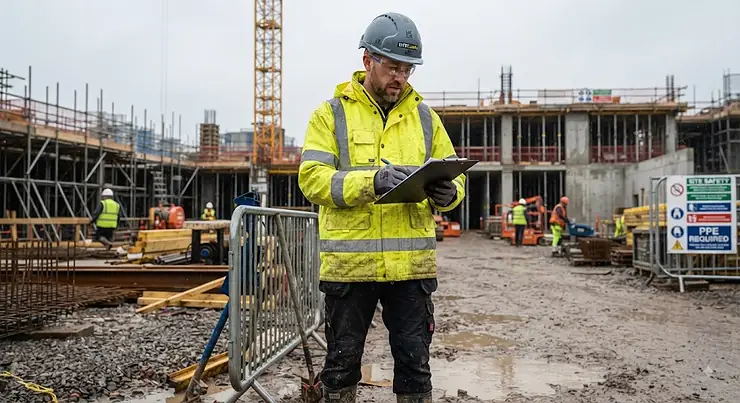
Rain doesn’t wait for a convenient moment. It arrives sideways, at 6:45am, exactly when you’re wrestling a ladder off the roof rack, and it has a special talent for finding the one seam on your jacket that isn’t taped. If you’ve ever stood on a site in November wearing something that claimed to be a hi vis waterproof jacket but turned out to be neither, you’ll know why this matters more than most workwear decisions.
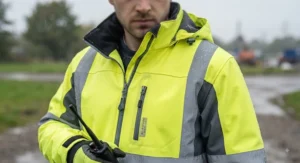
A genuine hi vis waterproof jacket does two separate jobs at once, and it’s worth remembering they’re not the same job. The “hi vis” part is about being seen by a driver, a forklift operator, or a signaller in fading light. The “waterproof” part is about you still being able to feel your fingers by lunch. Cheap garments often fake one to sell the other — a jacket soaked in fluorescent dye with a coating that peels off after three washes, or a genuinely waterproof shell with reflective tape so thin it fails the standard within a season.
This guide walks through seven real jackets currently sold in the UK, from budget security-guard staples to proper Class 3 rail-spec builds, with honest analysis of what the spec sheets actually mean once you’re stood in a downpour. We’ll also cover EN ISO 20471, the standard that governs all of this, plus how to choose, how to maintain your gear, and where people typically go wrong. As an Amazon Associate, we earn from qualifying purchases made through links on this page.
Quick Comparison Table: Hi Vis Waterproof Jacket at a Glance
| Jacket | Class | Waterproof Rating | Best For |
|---|---|---|---|
| Portwest PW3 T400 Winter Jacket | EN ISO 20471 Class 3 | EN 343, 15,000mm | All-round winter site wear |
| Portwest PW365 3-in-1 | Class 3 | Taped seams, EN 343 | Variable weather, layering |
| Scruffs High Visibility Waterproof Jacket | Class 3 | 3,000mm+ taped seams | Budget-conscious tradespeople |
| Pulsar PR502 Storm Coat | Class 3 | EN 343, 4:1 | Rail and trackside work |
| Protec WP1 Security Jacket | Class 3 | PU coated, taped seams | Static security and gatehouse roles |
| Portwest PW3 Extreme Rain Jacket | Class 1 body / high breathability | High mmH2O, pit zips | Physically active outdoor roles |
| Elka Visible Xtreme 2-in-1 | Class 3 | Taped seams, detachable lining | Long winter shifts in harsh cold |
A quick scan of that table tells its own story: class and waterproof rating don’t always move together. The Portwest PW3 Extreme Rain Jacket, for instance, trades some visibility area for serious breathability, which matters enormously if your job involves actual physical graft rather than standing still. Meanwhile the Protec WP1 and Pulsar PR502 Storm Coat sit at the top for pure conspicuity, which suits static or roadside roles where being spotted matters more than moving freely. None of these figures should be read in isolation — a Class 3 jacket with a poor waterproof rating will leave you dry-looking but soaked, and vice versa.
💬 Found a jacket you like the look of already? Check today’s price and availability before it sells out in your size.🤗
Top 7 Hi Vis Waterproof Jacket Options: Expert Analysis
1. Portwest PW3 T400 Winter Jacket — best all-rounder for cold, wet UK winters
The Portwest PW3 T400 Winter Jacket is the one you’ll see on more UK sites than any other, and there’s a reason for that beyond brand recognition. Portwest has been manufacturing workwear since 1904, and the T400’s fabric — 300D Oxford weave, PU coated, with a 170g wadding fill — reads like a jacket built by people who’ve actually stood in British rain rather than a lab in a warmer climate.
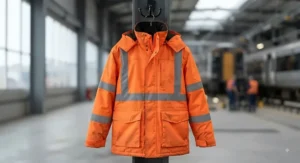
Here’s what the numbers mean in practice: the shell is certified to EN 343 Class 3:1 with a 15,000mm waterproof rating, which sits comfortably above the point where most site rain will trouble you — anything above roughly 10,000mm is considered heavy-duty. It’s also certified to EN ISO 20471 Class 3 and, in orange, to the rail-specific RIS-3279-TOM standard, so if you split your time between a construction site and trackside access, one jacket covers both without swapping kit.
Based on the spec comparison with cheaper alternatives, what most buyers overlook here is the quilted 170g fill — it’s not just warmth for warmth’s sake, it adds a genuine layer of insulation that means you’re not reaching for a separate mid-layer jacket underneath, which in turn keeps your movement freer when you’re up a ladder. Reviewers consistently note that the fit runs true to size and that the taped seams hold up well after repeated wet-weather use, though a handful mention the jacket feels bulky under a harness — worth trying before you commit if you’re regularly working at height.
Pros:
- ✅ Genuine EN 343 15,000mm waterproof rating, not marketing fluff
- ✅ Dual rail (RIS-3279-TOM) and general Class 3 certification in one jacket
- ✅ Quilted insulation reduces need for extra mid-layers
Cons:
- ❌ Bulkier fit that can restrict movement under a harness
- ❌ Limited breathability for high-exertion roles
Expect to pay in the mid-£40s to low-£60s range depending on size and colourway; for a jacket that covers both general site work and rail access in one purchase, the value case is strong.
2. Portwest PW365 3-in-1 — best for changeable weather and layering flexibility
British weather rarely commits to one mood for a full shift, and the Portwest PW365 3-in-1 is built around that reality rather than fighting it. It’s genuinely three garments in one: a Class 3 waterproof outer shell, a detachable brushed-back inner sweatshirt, and the combination of both — meaning you can strip back to just the fleece on a mild afternoon and zip the shell back on the moment the sky turns.
The outer shell uses a durable 300D Oxford weave with a PFAS-free water-resistant finish where water beads away from the fabric surface, and sealed, taped seams to prevent water penetration. Practically speaking, that PFAS-free detail matters more than it sounds — older durable water repellent (DWR) treatments used “forever chemicals” that are gradually being phased out across the industry, so this is a jacket built with where environmental regulation is heading, not where it’s been. The reflective tape is Portwest’s HiVisTex Pro segmented tape, certified to EN ISO 20471 after 50 wash cycles — a detail worth flagging because reflective tape is precisely the part of a jacket most likely to degrade first, and a “survives 50 washes” claim is a genuinely useful, verifiable spec rather than vague marketing.
What most buyers overlook about a 3-in-1 design is the storage: seven pockets including a concealed mobile phone pocket, a detachable ID pocket, and radio loops mean you’re not fumbling for your phone with wet gloves on. Aggregated feedback from tradespeople who’ve used the PW365 tends to highlight the versatility as the standout feature, with the main criticism being that the inner fleece alone isn’t warm enough for genuinely cold snaps — it’s designed as a layering system, not a standalone winter coat.
Pros:
- ✅ Three wearing configurations for genuinely changeable weather
- ✅ PFAS-free water-repellent finish, ahead of tightening regulations
- ✅ Seven pockets plus radio loops for hands-free organisation
Cons:
- ❌ Inner fleece alone isn’t warm enough for deep winter
- ❌ More expensive than a single-layer equivalent
At around £55-£75 depending on retailer and size, it’s pitched squarely at mid-range — but factor in that you’re effectively buying two garments, which changes the value maths considerably.
3. Scruffs High Visibility Waterproof Jacket — best budget-conscious Class 3 option
If your priority is genuine Class 3 compliance without a premium price tag, the Scruffs High Visibility Waterproof Jacket earns its place through straightforward competence rather than flashy extras. Scruffs has built its reputation on practical, no-nonsense trade gear, and this jacket is a fair reflection of that philosophy.
The fabric is 100% polyester 300D Oxford with a PU coating, waterproof to 3,000mm, and certified to EN ISO 20471:2013 + A1:2016 Class 3 alongside EN 343:2019 Class 3, 1, X. On paper, that 3,000mm figure is the most modest waterproof rating in this line-up — it’ll comfortably shrug off drizzle and moderate rain, but in a genuine downpour lasting several hours, expect dampness to creep through at pressure points like the shoulders where a rucksack strap sits. What the spec sheet won’t tell you, but the design does, is that it compensates for this with practical warmth features: full padding with fleece-lined pockets and a concealed hood for discreet storage when you don’t need it flapping about.
This is a jacket for the buyer who’s weighing cost-per-wear rather than chasing the highest waterproof number on the sheet. For site work where you’re mostly under cover or moving between short outdoor bursts, the trade-off makes sense; for a full day exposed on a motorway verge, one of the higher-rated options above will serve you better.
Pros:
- ✅ Genuine EN ISO 20471 Class 3 certification at a lower price point
- ✅ Fleece-lined pockets add practical warmth
- ✅ Concealed hood keeps the silhouette tidy when stowed
Cons:
- ❌ Lower 3,000mm waterproof rating than premium rivals
- ❌ Less seam reinforcement at high-friction points
Typically priced under £50, this is the pick for buyers who need certified compliance on a tighter budget rather than the last word in weatherproofing.
4. Pulsar PR502 Storm Coat — best for rail and trackside work
Rail work brings its own rulebook, and the Pulsar PR502 Storm Coat is built specifically with that in mind rather than being a general-purpose jacket wearing a rail badge. Pulsar has carved a niche supplying rail-compliant PPE, and the Storm Coat reflects a design brief focused on long exposure in genuinely miserable trackside conditions — think exposed embankments at 4am in February, not a dash from van to site cabin.
It’s built to Class 3 hi-vis with EN 343 4:1 rain protection in rail-compliant orange, which addresses a subtlety a lot of buyers miss: not every fluorescent orange is the correct rail orange. RIS-3279-TOM specifies a particular shade and reflective layout, and buying a “close enough” hi-vis jacket for trackside work can get you turned away at a site induction. Based on the spec comparison, the 4:1 EN 343 rating puts this firmly among the more serious waterproof/breathability combinations in this list — the “4” is the maximum waterproofness class and the “1” reflects a lower breathability score, which is a reasonable trade for a coat designed for standing rather than heavy manual exertion.
Here’s what most buyers overlook about rail-spec coats specifically: they’re usually cut longer than standard site jackets, covering more of the thigh, because trackside roles often involve extended standing exposure rather than constant movement. If you’re regularly on or near the railway, this length difference is a genuine functional advantage, not just a style choice.
Pros:
- ✅ Correct rail-compliant orange shade for RIS-3279-TOM sites
- ✅ Maximum EN 343 waterproofness class (4:1)
- ✅ Longer cut suited to extended standing exposure
Cons:
- ❌ Lower breathability rating limits comfort during active tasks
- ❌ Narrower colour choice due to rail compliance requirements
Priced in the £50-£70 range at most safety suppliers, it’s a specialist buy — don’t reach for this one unless rail or trackside access is genuinely part of your role.
5. Protec WP1 Security Jacket — best for static security and gatehouse roles
Security work has a different weather problem to construction: you’re often standing still for hours rather than moving around generating body heat, which changes what “warm enough” actually means. The Protec WP1 Security Jacket is built with that stillness in mind.
The construction is PU-coated 300D polyester with stitched and taped seams, plus 190g quilted padding for warmth, and retro-reflective bands running over the shoulders and around the body and arms so you’re visible from all directions, including when bending down. That last detail — visibility while bending — is easy to dismiss until you consider how much of a static security role involves crouching to check a vehicle boot or a delivery gate in low light; a jacket with reflective tape only across the chest loses much of its purpose the moment you lean over.
It also carries hi-vis security badging front and back so staff can be clearly identified at all times, which is a practical touch for gatehouse and access-control roles where the public need to instantly recognise who’s in charge of the barrier. What the spec sheet doesn’t fully convey is how much the quilted padding matters for genuinely static roles — without movement to keep you warm, insulation does more of the work than a breathable shell ever could.
Pros:
- ✅ 360-degree reflective coverage including while bending
- ✅ Front and back security badging for instant identification
- ✅ Heavier 190g padding suited to standing roles
Cons:
- ❌ Less breathable design not ideal for active labouring
- ❌ Bulkier fit than mobility-focused alternatives
Generally available in the £35-£50 bracket, it’s a sensible, purpose-built choice specifically for security and access-control work rather than general trades.

6. Portwest PW3 Extreme Rain Jacket — best for physically active outdoor roles
Not every hi vis waterproof jacket needs to double as a winter coat, and the Portwest PW3 Extreme Rain Jacket makes a deliberate case for prioritising movement and breathability over maximum insulation. If your role involves genuine physical exertion — lifting, climbing, constant movement — a heavily padded jacket can leave you sweating just as wet as the rain would have.
The build uses a durable 300D stretch Oxford PU-coated, stain-resistant fabric, with a detachable ergonomically shaped hood, multiple secure pockets, and waterproof front and underarm pit zips specifically for enhanced breathability. Those pit zips are the standout feature here, and it’s worth explaining why they matter more than they sound: a fully sealed waterproof shell traps sweat just as effectively as it blocks rain, so venting options at the underarm let you dump excess heat mid-task without compromising the waterproofing elsewhere on the garment. Reviewers who work strenuous outdoor roles consistently flag the breathability as the reason they choose this over heavier alternatives, with the main trade-off being reduced warmth on genuinely cold, low-activity days.
On paper this means the PW3 Extreme Rain Jacket occupies a slightly different niche to the padded winter coats elsewhere in this line-up — it’s less about maximum thermal protection and more about staying dry and comfortable while you’re actually working hard.
Pros:
- ✅ Underarm pit zips genuinely reduce sweat build-up
- ✅ Stretch fabric supports freer movement
- ✅ Detachable hood adapts to changing conditions
Cons:
- ❌ Less insulation for static or low-activity roles
- ❌ Premium stretch fabric pushes it toward the higher price band
Expect a price in the £55-£80 range; it’s the right call for anyone whose job is more “constant graft” than “standing at a gate.”
7. Elka Visible Xtreme 2-in-1 — best for harsh winter and long outdoor shifts
For genuinely brutal winter conditions — think exposed utility work, long shifts in driving sleet, or roles where you simply can’t retreat indoors to warm up — the Elka Visible Xtreme 2-in-1 is built around endurance rather than convenience. Elka has a long-standing reputation in Scandinavian and UK workwear circles for cold-weather durability, and this jacket reflects that heritage.
According to supplier specifications, it’s built to Class 3 hi-vis standard with taped seams and a detachable lining and hood, designed specifically for long outdoor shifts. The 2-in-1 detachable lining system mirrors the logic of the Portwest PW365 above but leans further toward cold-weather endurance than everyday versatility — this is a jacket you reach for in December and January, not a light spring shower. Here’s what most buyers overlook: taped seams alone don’t guarantee comfort in genuinely harsh cold; it’s the combination of a robust outer shell and a substantial detachable liner that lets the jacket flex between “damp fifteen degrees” and “freezing and sideways rain” without you needing two separate coats.
Because Elka jackets sit at a slightly more premium end of the workwear market, the honest analytical take is that this one suits buyers who prioritise longevity and genuine cold-weather performance over chasing the lowest upfront price — the kind of purchase decision better made on total years of service than on the sticker price alone.
Pros:
- ✅ Detachable lining built for genuinely harsh cold
- ✅ Taped seams throughout for sustained wet-weather use
- ✅ Reputation for long-service durability in Scandinavian-style builds
Cons:
- ❌ Higher price point than most rivals in this list
- ❌ Overkill for milder or indoor-adjacent roles
Priced at the premium end, typically £80 and upward, it’s best viewed as a long-term investment for anyone whose job genuinely lives outdoors through a British winter.
Top 7 Hi Vis Waterproof Jacket: Full Comparison
| Jacket | Fabric | Class | Waterproof | Standout Feature | Price Range |
|---|---|---|---|---|---|
| Portwest PW3 T400 Winter Jacket | 300D Oxford, PU coated | Class 3 | EN 343, 15,000mm | Rail + general dual certification | Mid-£40s–£60s |
| Portwest PW365 3-in-1 | 300D Oxford, PFAS-free finish | Class 3 | Taped seams, EN 343 | Three-way wear versatility | £55-£75 |
| Scruffs High Visibility Waterproof Jacket | 300D Oxford, PU coated | Class 3 | 3,000mm | Budget Class 3 compliance | Under £50 |
| Pulsar PR502 Storm Coat | Rail-spec fabric | Class 3 | EN 343, 4:1 | Correct rail-compliant orange | £50-£70 |
| Protec WP1 Security Jacket | 300D polyester, PU coated | Class 3 | Taped seams | 360° reflective coverage | £35-£50 |
| Portwest PW3 Extreme Rain Jacket | 300D stretch Oxford | Body Class 1 | High mmH2O rating | Underarm pit zips | £55-£80 |
| Elka Visible Xtreme 2-in-1 | Heavy-duty shell + liner | Class 3 | Taped seams | Detachable cold-weather lining | £80+ |
Looking at the table as a whole, the pattern that emerges is that Class 3 has become close to the baseline expectation for serious UK workwear, with most manufacturers now building to it by default rather than treating it as a premium tier. The genuine differentiator between these seven jackets isn’t the class rating so much as how each one balances waterproofing against breathability and warmth — the Portwest PW3 Extreme Rain Jacket trades some coverage for movement, while the Elka Visible Xtreme 2-in-1 goes the other way entirely. Buyers should treat the “Best For” column as the real decision-making tool here, not the price column alone.
Benefits vs Traditional Waterproof Workwear
| Factor | Hi Vis Waterproof Jacket | Standard (Non-Hi-Vis) Waterproof Jacket |
|---|---|---|
| Visibility in low light | Fluorescent + retroreflective tape, tested to EN ISO 20471 | None — relies on general colour only |
| Legal/site compliance | Meets PPE at Work Regulations for at-risk roles | Not compliant for most construction/rail sites |
| Weather protection | Equal or better, often with taped seams as standard | Varies widely by brand |
| Typical cost | Slightly higher due to reflective tape and testing | Marginally cheaper on average |
| Best For | Construction, rail, roadside, logistics, security | Casual outdoor use, dog walking, non-work settings |
The extra cost of a certified hi vis waterproof jacket over a plain waterproof coat is usually modest — often £10-£20 — and it buys you something a standard jacket simply cannot offer: legal compliance on a site where visibility is a genuine risk factor. Under the Personal Protective Equipment at Work Regulations 1992, employers must assess risks and provide the right equipment free of charge, so if you’re self-employed or a limb (b) worker sourcing your own kit, buying certified rather than “hi-vis coloured” gear isn’t optional box-ticking — it’s the difference between compliant and non-compliant PPE.
Practical Usage Guide: Getting the Most From Your Jacket
Buying the right jacket is only half the job — how you use and maintain it in the first month determines whether it performs for two years or two months. Start by checking the fit with your usual mid-layers on underneath, not just a t-shirt in the shop; a jacket that’s snug in October will feel restrictive by January once you’ve added a fleece. On first use, pay attention to the cuffs and hem adjusters — tightening these properly stops rain being funnelled up your sleeves, which is a surprisingly common first-week mistake.
Maintenance matters more than most buyers expect. Reflective tape loses effectiveness when it’s abraded, clogged with dirt, or washed incorrectly, and HSE guidance is clear that employers must maintain high visibility clothing in a clean state and good working order. Wash according to the care label — usually a lower temperature cycle without fabric softener, which coats and dulls both the fluorescent fabric and the reflective tape over time. Avoid tumble drying on high heat, as this can degrade the PU coating and cause it to crack or peel prematurely.
A common first-30-days mistake is storing a wet jacket balled up in a van overnight — this accelerates mildew and can compromise the waterproof coating’s integrity far faster than regular wear would. Hang it to dry fully before it goes back in the bag, and periodically check the taped seams for any lifting, particularly around high-movement points like the shoulders and underarms.
Real-World Scenario: Matching the Jacket to the Job
Consider three genuinely different working days and how the jacket choice shifts. First, a self-employed groundworker doing mixed outdoor labour across several sites a week, budget-conscious but needing genuine compliance — the Scruffs High Visibility Waterproof Jacket fits this profile well, giving certified Class 3 coverage without the premium price of a rail-spec coat they don’t strictly need.
Second, a rail maintenance technician working scheduled trackside access, often in fixed positions for extended periods through winter — the Pulsar PR502 Storm Coat or Portwest PW3 T400 Winter Jacket (given its RIS-3279-TOM certification) are the sensible picks, since correct rail-orange shade and maximum waterproofing outrank breathability when you’re mostly standing still.
Third, a utilities engineer doing physically demanding installation work outdoors through all seasons, moving constantly and needing to avoid overheating under the shell — the Portwest PW3 Extreme Rain Jacket with its pit zips, or the Portwest PW365 3-in-1 for its adaptable layering, both serve this scenario better than a heavily padded static-role coat ever would.

How to Choose a Hi Vis Waterproof Jacket
Working out which jacket suits your role doesn’t need to be complicated if you approach it in order:
- Identify your required class first. Check your site’s induction pack or ask your safety officer whether Class 2 or Class 3 is mandated — this narrows the field immediately.
- Match the waterproof rating to your exposure time. Brief outdoor bursts can tolerate a lower mmH2O rating; all-day exposure needs 10,000mm or above.
- Weigh activity level against insulation. Static roles benefit from heavier padding; physically active roles need breathability features like pit zips.
- Check for sector-specific standards. Rail work needs RIS-3279-TOM compliance in the correct orange shade, not just general Class 3.
- Consider layering versatility. A 3-in-1 or 2-in-1 design earns back its higher cost across a full year of variable weather.
- Inspect seam construction, not just fabric. Taped seams are what actually stop water ingress — a waterproof fabric with untaped seams will still leak.
- Factor in wash-cycle durability of the reflective tape. Look for tape rated to survive a specific number of industrial washes, as this is where cheaper jackets fail first.
What is EN ISO 20471?
EN ISO 20471 is the key standard governing high-visibility clothing, specifying the requirements and test methods to ensure wearers are easily visible in hazardous situations such as construction sites, road work, and low-light conditions. It replaced the older EN 471 standard and defines three classes based on the combined area of fluorescent background material and retroreflective tape, with Class 3 offering the highest level of conspicuity.
Understanding which class your role legally requires is the single most important factor in choosing a compliant jacket — and it’s worth checking directly with the EN ISO 20471 standard, which sets requirements for fluorescent fabric and reflective tape to ensure visibility in daylight, low-light, and night-time conditions rather than relying on a supplier’s marketing description alone. You can read more detail on classifications and history via Wikipedia’s overview of high-visibility clothing.
Common Mistakes When Buying Hi Vis Waterproof Jackets
The most frequent error is buying on colour alone — a bright yellow or orange jacket with no certification label isn’t legally hi-vis, it’s just a bright jacket, and a fair number of budget garments online fall into exactly this trap. Second, buyers often overlook the difference between “water-resistant” and genuinely “waterproof” — the former is a light DWR coating that wears off within weeks, while the latter involves taped seams and a tested mmH2O rating.
A third common mistake is ignoring sector-specific requirements. General Class 3 doesn’t automatically mean rail-compliant, since RIS-3279-TOM specifications for rail-industry high-visibility clothing suitable for use on UK railways are published separately by the Rail Safety and Standards Board. Fourth, sizing mistakes are common when buyers don’t account for layering — order true-to-size without a mid-layer and you’ll find it uncomfortably tight by winter. Finally, many buyers underestimate maintenance requirements, assuming a jacket needs no special care simply because it’s “workwear” — when in fact incorrect washing is one of the fastest ways to void a reflective tape’s certified performance.
Hi Vis Waterproof Jacket for Different Trades
Different trades genuinely need different features, even within the same Class 3 bracket. Groundworkers and general labourers benefit most from durability and pocket practicality — features like reinforced elbows and secure phone storage matter more day-to-day than marginal breathability gains. Rail and highways workers should prioritise correct-shade certification and maximum waterproofing, since standing exposure near live traffic is the defining risk. Security and static roles are better served by warmth and all-directional reflective coverage, since there’s less body heat generated through movement to keep them comfortable. Utilities and installation engineers, who move constantly and often work in awkward positions, get the most value from stretch fabric and ventilation zips that a static-role jacket simply doesn’t need.
Long-Term Cost and Maintenance
A £45 jacket that needs replacing every eight months isn’t necessarily cheaper than an £80 jacket that lasts three winters — the maths only works in the budget option’s favour if you’re doing genuinely light or seasonal outdoor work. When comparing cost-per-wear, factor in the reflective tape’s rated wash-cycle survival (some are tested to 25 washes, others to 50 or more), since a certified jacket that loses its Class 3 status after a season of regular washing has effectively become non-compliant workwear you’re still paying to launder.
Basic maintenance extends lifespan meaningfully: reapplying a compatible DWR treatment when water stops beading on the surface, storing jackets dry and on a hanger rather than balled up, and checking seams and zips before each winter season rather than waiting for a failure mid-shift. None of this is complicated, but it’s routinely skipped, and it’s the single biggest factor separating a jacket that lasts two years from one that lasts five.
Safety, Regulations and Compliance Guide
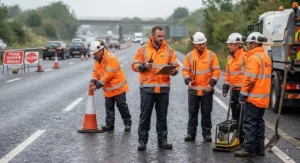
UK employers have clear legal obligations here. The Personal Protective Equipment at Work Regulations 1992, updated in 2022, require employers to assess risks, provide the right equipment free of charge to workers including limb (b) contractors, and ensure adequate training is delivered. On construction sites specifically, high-visibility clothing should be worn wherever vehicles or plant are operating, including by drivers when they leave their vehicle, with a tabard often sufficient for routine site use but full jacket and trouser coverage required for higher-risk roles like temporary traffic management.
For rail access specifically, always confirm RIS-3279-TOM compliance rather than assuming general Class 3 certification covers it. You can review current guidance directly from the Health and Safety Executive’s construction PPE FAQ, which sets out when and where high-visibility clothing is legally expected on UK sites.
What to Expect: Real-World Performance
Spec sheets rarely tell you what a jacket feels like at hour six of an outdoor shift. In practice, taped-seam jackets rated above 10,000mm genuinely do keep you dry through sustained UK rain — the failure point tends to be at pressure areas like shoulders under a rucksack strap, rather than the main body of the fabric. Breathability matters more than most first-time buyers expect; a jacket that’s technically waterproof but non-breathable will leave you damp from sweat rather than rain by mid-morning if your role involves real exertion. Reflective tape, meanwhile, tends to be the first thing to visibly age — a jacket can look structurally fine while its Class 3 certification has quietly lapsed due to abrasion, which is why periodic visual checks matter more than most workers realise.
Buyer’s Decision Framework
If your site mandates Class 3 and involves rail access, choose a rail-compliant jacket like the Pulsar PR502 Storm Coat because general Class 3 certification alone won’t satisfy trackside induction requirements. If you’re budget-constrained but still need genuine compliance, choose the Scruffs High Visibility Waterproof Jacket because it holds full Class 3 certification without premium extras you may not need. If your role is physically demanding with lots of movement, choose the Portwest PW3 Extreme Rain Jacket because ventilation will matter more to your comfort than maximum insulation. If you face genuinely harsh, prolonged winter exposure, choose the Elka Visible Xtreme 2-in-1 because its detachable liner system is built specifically for that endurance case.
✨ Not sure which one fits your trade? Compare current prices across all seven picks above before you decide.🤗
Frequently Asked Questions
❓ What class of hi vis jacket do I need for construction?
❓ Is a hi vis jacket waterproof by default?
❓ How often should I replace a hi vis waterproof jacket?
❓ Can I wash a hi vis waterproof jacket in a normal washing machine?
❓ What's the difference between EN ISO 20471 and RIS-3279-TOM?
Conclusion
Choosing the right hi vis waterproof jacket really comes down to being honest about how you actually spend your working day. A static security role and a physically demanding installation job have almost opposite requirements, even though both might technically need “Class 3” on the label — one wants warmth and all-round reflective coverage, the other wants ventilation and freedom of movement. The seven jackets covered here span that full range, from the budget-friendly but genuinely compliant Scruffs option through to the endurance-focused Elka Visible Xtreme.
What ties them together is that none of them fake compliance — every one carries verifiable EN ISO 20471 and, where relevant, EN 343 or RIS-3279-TOM certification, which is worth insisting on regardless of which jacket you eventually choose. Cheap uncertified alternatives might look the part in a product photo, but they won’t hold up to inspection on a site induction or, more importantly, in the moment a driver needs to spot you in the rain. Match the jacket to your actual working conditions, check the class your role legally requires, and treat maintenance as part of the purchase rather than an afterthought — do that, and whichever jacket you choose from this list should serve you well through several UK winters.
Recommended for You
- Women’s Golf Rain Jacket: 7 Brilliant Picks for 2026 (Under £80 to Premium)
- 7 Best Mens Golf Waterproof Jacket Picks for 2026
- Golf Rain Jacket 2026: 7 Best Waterproof Picks
Disclaimer: This article contains affiliate links. As an Amazon Associate, I earn from qualifying purchases. If you purchase products through these links, we may earn a small commission at no additional cost to you.
✨ Found this helpful? Share it with your friends! 💬🤗
