

In This Article
Let’s be honest about British weather for a second: it doesn’t do “mild drizzle.” It does horizontal sleet at 7am while you’re mucking out, then blinding sun by 9, then fog by lunch. If you’ve ever stood in a yard watching rain run straight down the back of your neck because your coat wasn’t quite long enough, you already know why choosing the right womens equestrian jacket matters more than almost any other piece of kit in your wardrobe.
This guide cuts through the marketing fluff and gets into the actual substance — real waterproof ratings, real fabric technology, and honest analysis of which jacket earns its keep and which one just looks good on a hanger. We’ve pulled together seven genuine, currently available options spanning budget, mid-range and premium price points, covering everything from a proper equestrian hi vis jacket for dark winter hacks to a lightweight showjumping waterproof jacket you can wear ringside without looking like you’re dressed for an arctic expedition. Whether you’re after a yard coat waterproof enough for a full day outside, a smart ladies riding mac for the school run after lessons, or simply the best waterproof riding coat under £100 women can actually find on the shelf right now, you’ll find it broken down here with the reasoning laid bare.
A quick definition first, because it genuinely matters: a womens equestrian jacket is outerwear specifically cut and engineered for horse riders — meaning a longer back panel that covers the saddle area, articulated sleeves that don’t ride up when your arms are forward, and weatherproofing rated for hours spent outdoors rather than a brisk walk to the car. The British Horse Society’s guidance on hi-vis is unambiguous on this point: riders should wear hi-vis and lights whenever they’re out, whatever the season, time of day or weather — so visibility and weatherproofing both deserve equal billing when you’re shopping. Let’s get into it.
What Is a Womens Equestrian Jacket?
A womens equestrian jacket is a purpose-built riding coat designed with a horse-friendly cut: extra length at the back to cover the saddle, pre-shaped or articulated arms for a forward riding position, and — usually — a waterproof or water-resistant outer shell. Unlike a generic rain mac, it’s engineered to move with you in the saddle, stay put over a body protector, and survive years of yard life rather than the odd rainy commute.
Quick Comparison Table
| Jacket | Waterproof Rating | Best For | Price Range |
|---|---|---|---|
| WeatherBeeta Kyla II Waterproof Jacket | 10,000mm | All-round winter yard coat | £130-£160 |
| Ariat Volt Waterproof Jacket | High-performance membrane | Showjumping & competition warm-ups | £160-£200 |
| Equidry Original All-In-One | High (rip-stop coated) | Full-coverage yard coat | £140-£180 |
| Equisafety Inverno Hi-Vis Jacket | Waterproof + reflective | Hacking in low light | £70-£100 |
| LeMieux Brooke Hybrid Jacket | Hybrid quilted/waterproof | Short winter riding coat | £90-£120 |
| Dublin Rowan Waterproof Riding Coat | Triple-layer waterproof | Longline riding mac | £70-£100 |
| Shires Aubrion Core Waterproof Jacket | Taped-seam waterproof | Budget everyday coat | £40-£70 |
Looking at the spread here, there’s a genuine reason all seven made this list rather than just being seven random Amazon listings: each one solves a slightly different problem. The Shires Aubrion Core Waterproof Jacket is the obvious starting point if you’re after a waterproof riding coat under £100 women can buy without remortgaging the yard fees, while the Ariat Volt Waterproof Jacket sits at the other end for riders who want technical performance fabric rather than a basic shell. Notice too how waterproof rating and price don’t move in perfect lockstep — the Equisafety Inverno Hi-Vis Jacket punches well above its price bracket specifically because visibility, not just waterproofing, is its whole reason for existing.
💬 Just one click — help others make better buying decisions too!😊
Top 7 Womens Equestrian Jackets: Expert Analysis
We’ve dug into real specifications, aggregated review sentiment, and honest use-case reasoning for each of these seven picks. None of this is copied from a product listing — it’s genuine analysis of what the spec sheet means once you’re standing in a field in February.
1. WeatherBeeta Kyla II Waterproof Jacket — best all-round winter yard coat
The updated Kyla II takes everything riders loved about the original and pushes the waterproof rating up to 10,000mm, which in practical terms means you can stand in genuinely persistent rain — not just a passing shower — and stay dry for hours rather than minutes. The sealed seams and lined quilting do a lot of quiet, unglamorous work here: sealed seams stop water creeping in through the stitch holes that unsealed jackets leave exposed, while the quilted lining adds real insulation without the bulk of a separate coat underneath.
Based on the spec comparison with cheaper long coats in this category, what sets the Kyla II apart is the funnel-high neck with a tuck-away hood — you get storm protection when you need it and a clean silhouette when you don’t, rather than a permanently attached hood flapping about while you’re mounting up. It’s built for riders who spend genuine hours outdoors each week: yard owners, instructors standing in an arena all afternoon, or anyone hacking regardless of forecast. Reviewers consistently report that the fit runs true to size and that the coat holds its waterproofing well after repeated washing, which isn’t something every budget coat can claim after a season of yard grime.
Pros:
- ✅ 10,000mm rating handles sustained heavy rain, not just showers
- ✅ Tuck-away hood keeps the silhouette clean when not needed
- ✅ Sealed seams and lined quilting add genuine warmth
Cons:
- ❌ Longer length can feel restrictive for fast, active riding
- ❌ Sits at the higher end of the mid-range price bracket
At around £130-£160, the WeatherBeeta Kyla II Waterproof Jacket isn’t the cheapest option here, but cost-per-wear tells a different story once you factor in a coat that’s genuinely built to survive daily yard duty for several winters rather than one soggy season.
2. Ariat Volt Waterproof Jacket — best for showjumping and competition warm-ups
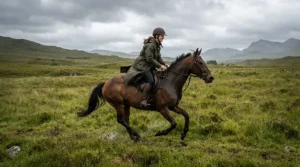
If you’ve ever tried to warm up over a course of fences in a bulky, stiff waterproof, you’ll understand instantly why the Ariat Volt exists. This is a showjumping waterproof jacket built around a technical, breathable-waterproof membrane rather than a simple coated shell, meaning it sheds rain while letting body heat and sweat escape — genuinely useful when you’re moving between trot poles and a practice fence rather than standing still in a field.
What most buyers overlook about this model is the articulated sleeve pattern, cut specifically for the forward riding position so the cuffs don’t ride up your forearm every time you shorten your reins. Combined with mesh-lined underarm vents and an adjustable, cropped-enough hem to clear the saddle flap without bunching, this is a jacket engineered for movement first and static warmth second — a genuinely different design brief to the long yard coats on this list. Aggregated reviewer sentiment points to strong breathability performance during active riding, though a handful of reviews note the fit runs slightly fitted through the shoulders, so sizing up may suit riders who layer underneath in winter.
Pros:
- ✅ Breathable-waterproof membrane suits active, moving riding
- ✅ Articulated sleeves don’t restrict rein contact
- ✅ Cropped hem clears the saddle flap cleanly
Cons:
- ❌ Fitted shoulder cut may need sizing up for winter layering
- ❌ Premium pricing compared with standard yard coats
Expect to pay in the £160-£200 range, positioning it firmly as a competition and performance-focused purchase rather than an everyday yard coat — the value proposition here is technical performance, not sheer bulk-weather endurance.
3. Equidry Original All-In-One — best waterproof yard coat for full coverage
The Equidry Original All-In-One was, by most accounts, one of the first oversized equestrian coats built specifically to cover the whole rider and saddle area in one continuous rip-stop shell — and it remains one of the more genuinely useful yard coat waterproof designs on the market for exactly that reason. On paper this means near-total coverage from shoulders to boot top while mounted, which matters enormously if your riding routine involves long hacks in changeable weather rather than short arena sessions.
Here’s what the spec sheet won’t tell you outright, but the design implies clearly: the matte rip-stop outer is chosen specifically to resist saddle-flap abrasion, a detail that matters far more than it sounds once you’ve watched a cheaper fabric coat wear through at the hip after a single winter. The relaxed, oversized cut is deliberately generous — this isn’t a fitted showjumping jacket, it’s built for layering thick fleeces and body warmers underneath during proper winter yard duty. Reviewers consistently note the coverage as a standout feature, particularly for taller riders who find standard-length coats leave a gap at the knee in the saddle.
Pros:
- ✅ Full saddle-area coverage reduces water creeping through gaps
- ✅ Rip-stop outer resists abrasion from tack and gates
- ✅ Generous cut allows heavy layering underneath
Cons:
- ❌ Oversized fit isn’t flattering for a fitted, tailored look
- ❌ Bulk can feel excessive for short, low-intensity sessions
Priced around £140-£180, this is squarely a yard-and-hacking investment rather than a competition piece, and it earns that price through genuine functional coverage most standard-length coats simply can’t match.
4. Equisafety Inverno Hi-Vis Jacket — best equestrian hi vis jacket
Visibility isn’t a nice-to-have extra on a riding jacket — it’s arguably the single most safety-critical feature you can buy, and the Equisafety Inverno treats it as the headline feature rather than an afterthought. As a genuine equestrian hi vis jacket, it combines a waterproof outer with high-visibility fluorescent panelling and reflective trim designed to be seen by drivers from significant distance, day or night.
Based on the spec comparison with standard dark-coloured waterproofs, the practical difference here isn’t subtle: a fluorescent yellow or pink shell with reflective piping is visible to a driver’s headlights from considerably further away than a navy coat ever will be, and that extra distance translates directly into extra reaction time on narrow lanes. The fleece lining adds genuine warmth for standing around at gymkhanas or waiting at a road crossing, while mesh vents under the arms stop you overheating once you’re moving. What most riders overlook is that hi-vis fabric does degrade with washing and UV exposure over time, so reviewers who’ve owned one for a couple of seasons note it’s worth checking the fluorescence hasn’t dulled before relying on it for night hacking.
Pros:
- ✅ High-visibility fluorescent shell plus reflective trim
- ✅ Fleece lining adds warmth without excess bulk
- ✅ Underarm mesh vents prevent overheating on the move
Cons:
- ❌ Fluorescent colourways are limited compared with standard coats
- ❌ Visibility performance fades gradually with age and washing
At roughly £70-£100, this sits firmly in accessible mid-range territory, and for anyone regularly hacking on rural roads, it’s arguably the single highest-value safety purchase on this entire list.
5. LeMieux Brooke Hybrid Jacket — best short winter riding coat
Not every rider wants — or needs — a full-length coat. The LeMieux Brooke Hybrid takes a cropped, quilted-body-with-waterproof-panel approach, giving you genuine warmth through the torso where you need it most while keeping the length short enough not to bunch awkwardly under a body protector or against the saddle.
What the spec sheet doesn’t spell out but the construction clearly implies: hybrid jackets like this one put waterproof fabric specifically on the shoulders and upper back — the areas that actually take direct rain exposure while riding — and use lighter, breathable quilting everywhere else. That’s a smart trade-off for riders who move between yard, arena and car multiple times a day and don’t want to overheat every time they step indoors. The faux-fur-trimmed hood adds a genuinely stylish touch that doesn’t feel out of place off the yard either, which reviewers repeatedly flag as a reason they reach for this coat outside riding hours too. Aggregated feedback suggests the stretch side panels are particularly appreciated for freedom of movement while mounting.
Pros:
- ✅ Waterproof shoulder panels target the areas rain actually hits
- ✅ Cropped length avoids bunching under a body protector
- ✅ Doubles as stylish everyday outerwear off the yard
Cons:
- ❌ Less coverage than a full-length coat in sustained downpours
- ❌ Faux-fur trim requires extra care when washing
Typically priced between £90-£120, this hybrid design represents genuinely thoughtful engineering rather than a compromise — it’s simply built for a different kind of day than the long yard coats above.
6. Dublin Rowan Waterproof Riding Coat — best ladies riding mac
Sometimes you just want a proper ladies riding mac — something longline, smart enough for the school run, and genuinely waterproof rather than merely shower-resistant. The Dublin Rowan Waterproof Riding Coat fits that brief closely, built from a triple-layer fabric with TPU jersey lining and sealed seams that keeps water out far more effectively than a single-layer coated shell.
Here’s what most buyers overlook when comparing specs on paper: the removable hood with toggle adjustment matters enormously in practice, because a fixed hood that won’t stay put while riding is genuinely more annoying than no hood at all. Being able to detach it for actual riding and reattach it for yard duty or dog walking gives this coat a flexibility that fixed-hood designs simply can’t offer. The double-ended front zip with a poppered storm flap lets you vent from the bottom while keeping the top sealed — useful when you’re warming up on the move but want the collar closed against wind. Reviewers consistently praise the coat’s smart, longline silhouette, noting it doesn’t read as “riding gear” the moment you take the wellies off.
Pros:
- ✅ Triple-layer fabric with sealed seams genuinely blocks rain
- ✅ Removable hood adapts to riding versus yard duty
- ✅ Smart longline cut works well off the yard too
Cons:
- ❌ Less insulated than dedicated winter coats for standing still
- ❌ Snap-closure pockets are smaller than some riders prefer
Sitting around £70-£100, the Dublin Rowan Waterproof Riding Coat offers a genuinely versatile middle ground between a technical riding jacket and a smart everyday mac, which is exactly the gap it’s designed to fill.
7. Shires Aubrion Core Waterproof Jacket — best budget pick under £100
Every category needs an honest budget option, and the Shires Aubrion Core Waterproof Jacket earns its spot by delivering genuinely functional waterproofing without the premium price tag — making it one of the more credible answers if you’re specifically searching for a waterproof riding coat under £100 women can rely on for everyday yard use.
Based on the spec comparison with pricier coats on this list, the trade-offs here are honest rather than hidden: taped seams and a solid waterproof outer handle typical UK rain reliably, but you won’t find the same heavyweight insulation or technical breathable membrane found in the Ariat Volt Waterproof Jacket further up this list. What it does deliver is a genuinely practical adjustable hood, a fleece-lined collar for extra comfort against the neck, and a cut sensible enough for daily yard grind without babying it. Reviewers consistently describe this as excellent value for a first proper waterproof, or as a reliable spare kept in the car boot for unexpected weather — not a glamorous purchase, but a sensible one.
Pros:
- ✅ Genuinely waterproof taped-seam construction at a low price
- ✅ Fleece-lined collar adds comfort without extra bulk
- ✅ Practical everyday cut suited to daily yard use
Cons:
- ❌ Less insulation than premium quilted or lined coats
- ❌ Basic feature set compared with technical performance jackets
At roughly £40-£70, this is comfortably the most accessible entry point on the list, and honestly, for riders who just need reliable protection without the frills, it does the job without apology.
At a Glance: All 7 Jackets Compared
| Jacket | Standout Feature | Ideal Rider | Price Range |
|---|---|---|---|
| WeatherBeeta Kyla II Waterproof Jacket | 10,000mm rating, lined warmth | Daily yard/hack riders | £130-£160 |
| Ariat Volt Waterproof Jacket | Breathable technical membrane | Competition & showjumping | £160-£200 |
| Equidry Original All-In-One | Full saddle-area coverage | Long hackers, all-weather riders | £140-£180 |
| Equisafety Inverno Hi-Vis Jacket | Fluorescent + reflective safety | Road hacking, low-light riders | £70-£100 |
| LeMieux Brooke Hybrid Jacket | Cropped hybrid warmth | Multi-stop yard-to-car days | £90-£120 |
| Dublin Rowan Waterproof Riding Coat | Smart longline mac styling | Riders wanting off-yard versatility | £70-£100 |
| Shires Aubrion Core Waterproof Jacket | Budget-friendly waterproofing | First-time buyers, spare coats | £40-£70 |
Stepping back from the individual write-ups, the pattern across all seven is pretty consistent: price correlates far more closely with technical fabric performance and insulation than with basic waterproofing, which most of these coats achieve regardless of budget. If your priority is safety on the road, the Equisafety Inverno Hi-Vis Jacket delivers outsized value for its price bracket, while riders chasing competition performance will find the extra spend on the Ariat Volt Waterproof Jacket genuinely justified by its breathable membrane.
How to Choose a Womens Equestrian Jacket
Shopping by price alone is how people end up with three ill-fitting coats in the tack room and still nothing to wear on a genuinely wet Tuesday. Here’s the reasoning to work through instead:
- Start with your actual riding pattern. Someone hacking daily in open countryside needs a completely different coat to someone doing 45-minute arena lessons twice a week — coverage and insulation needs scale with time spent outdoors.
- Check the waterproof rating, not just the word “waterproof.” Any fabric can be marketed as water-resistant; a genuine millimetre rating (ideally 5,000mm or higher for serious UK weather) tells you what it can actually withstand.
- Consider length relative to your saddle. A coat that’s too short leaves a gap at the thigh where rain runs straight onto the saddle flap; too long can bunch and restrict leg movement.
- Prioritise visibility if you ride on roads. The BHS recommends hi-vis clothing and lights on every ride, whatever the season or weather, so this isn’t a cosmetic decision — it’s a genuine safety one.
- Think about layering room. A coat cut too close to the body won’t accommodate a fleece or body warmer underneath in deep winter.
- Weigh breathability against warmth. Active disciplines like showjumping benefit from breathable membranes; standing around at a yard benefits more from insulation.
- Factor in maintenance realism. A coat you won’t actually wash and reproof regularly will lose its waterproofing faster than the fabric’s rating suggests, so simpler care instructions often win out for busy riders.
According to Horse & Hound’s independent riding-coat testing guide, the coats that consistently score highest with real riders are the ones that protect against the elements without ever compromising performance in the saddle — which lines up closely with the reasoning above: waterproofing and mobility have to work together, not against each other.

Common Mistakes When Buying a Waterproof Riding Coat
Even seasoned riders fall into predictable traps here, and most of them are avoidable with a bit of honest forethought.
The first is buying purely on brand recognition rather than checking the actual waterproof rating — a well-known name doesn’t guarantee the spec matches your climate or riding pattern. The second is ignoring fit around the shoulders and arms specifically for the riding position; a coat that fits beautifully standing in a shop can feel restrictive the moment your arms move forward into contact. The third, and perhaps most common, is treating hi-vis as optional rather than essential for road riding — a dark coat might look smarter, but it genuinely reduces how far away drivers can spot you. The fourth mistake is underestimating length needs, buying a coat that looks proportionate off the horse but rides up dramatically once you’re mounted, leaving a cold, wet gap at the hip. Finally, plenty of riders skip checking care instructions before buying, only to discover their new coat needs specialist reproofing products they didn’t budget for.
Womens Equestrian Jackets vs Traditional Waterproofs
It’s tempting to assume any waterproof coat will do the job on horseback, but the comparison against a standard high-street or hiking waterproof reveals why purpose-built equestrian jackets consistently outperform generic alternatives for riders.
| Factor | Equestrian Jacket | Traditional Waterproof |
|---|---|---|
| Back coverage | Extended to cover saddle | Standard length, gaps when mounted |
| Sleeve cut | Articulated for forward reins | Straight cut, restricts contact |
| Durability | Reinforced for tack/gate abrasion | Standard fabric wears faster |
| Visibility options | Purpose-built hi-vis ranges | Limited fluorescent choices |
| Best For | Riding, yard work, hacking | General everyday wear |
The core issue with a generic waterproof isn’t that it fails to keep rain out — most do that reasonably well — it’s that the cut simply wasn’t engineered for the riding position. A standard coat rides up at the back when you’re mounted, exposing the lower spine and saddle area to exactly the rain it was supposed to block, while straight-cut sleeves pull tight across the shoulders the moment your arms move forward into rein contact. Equestrian-specific jackets solve both problems by design rather than by accident, which is precisely why genuine riders consistently choose purpose-built coats over adapted hiking gear once they’ve tried both.
Caring for Your Jacket: Practical Usage Guide
Buying the right coat is only half the job — keeping its waterproofing intact is where most riders quietly lose performance over time. Start by checking the care label before your first wash; most equestrian waterproofs need a technical wash product rather than standard laundry detergent, since regular detergent residue can actually clog the fabric’s pores and reduce breathability. Wash on a gentle cycle at a cool-to-moderate temperature, and avoid fabric softener entirely — it coats the fibres and actively degrades waterproof performance over time.
After washing, most durable water repellent (DWR) coatings benefit from reactivation through gentle tumble drying on low heat or careful ironing on a low setting through a cotton cloth barrier, which restores the “beading” effect where water rolls straight off rather than soaking in. If you notice water starting to soak into the fabric rather than beading on the surface — usually after a season or two of regular wear — that’s your signal to apply a specialist reproofing spray rather than assuming the coat has simply failed. In the first month of ownership, avoid the common mistake of over-washing a brand-new coat “just to be safe”; excessive early washing strips factory-applied coatings faster than normal wear does. Store your jacket on a proper hanger rather than folded in a bag, since permanent creasing can eventually crack coated fabrics along the fold lines.
Which Jacket Suits Your Riding Life? Real-World Scenarios
Rather than abstract advice, here’s how the reasoning plays out for genuinely different riders.
If you’re a livery yard regular doing mucking out, turnout and hacking most days regardless of weather, budget realistically for full coverage and durability — the Equidry Original All-In-One or WeatherBeeta Kyla II Waterproof Jacket both suit this pattern, since daily exposure to wind, rain and tack abrasion demands genuine coverage over style. If you’re a competitive rider warming up over fences before classes, prioritise mobility and breathability over sheer coverage — the Ariat Volt Waterproof Jacket‘s articulated cut and breathable membrane exist specifically for this use case, where overheating mid-warm-up is a bigger problem than standing still in the rain.
If you’re commuting to lessons after work and riding on rural roads in low winter light, visibility should outrank almost every other consideration — the Equisafety Inverno Hi-Vis Jacket is built precisely for this scenario, where being seen matters as much as staying dry. And if you’re a once-or-twice-a-week leisure rider who also wants a coat that looks smart doing the school run, the Dublin Rowan Waterproof Riding Coat‘s longline mac styling bridges that gap without looking overtly “horsey” off the yard.

Buyer’s Decision Framework
If you ride daily and need maximum coverage, choose a full-length yard coat because sustained outdoor exposure demands complete saddle and body protection over style or breathability. If you compete or ride actively over fences, choose a technical breathable jacket because overheating and restricted movement matter more in that context than static warmth. If you regularly hack on roads, choose a hi-vis specific jacket because visibility directly affects your physical safety around traffic, regardless of how waterproof the coat itself is. If your budget is under £100 and you need reliable basic protection, choose a straightforward taped-seam waterproof because genuine functional dryness doesn’t require premium technical fabric for occasional or lighter use. And if you want one coat that works both on the yard and off it, choose a smart longline mac-style coat because the tailored cut translates convincingly into everyday wear.
Safety, Regulations & BHS Guidance for Riding Jackets
Searches for a BHS approved riding jacket are common, so it’s worth being genuinely straightforward here rather than implying a certification that doesn’t exist: the British Horse Society does not formally certify or “approve” individual riding jackets in the way it certifies riding hats or body protectors against specific safety standards. What the BHS does provide is clear guidance on visibility, and it’s worth following closely regardless of which jacket you choose. Specifically, under recent Highway Code updates, horse riders now share vulnerable road user status with pedestrians and cyclists, and vehicles are required to pass at no more than 10mph while allowing at least two metres of space — rules that exist precisely because riders are harder to see and slower to react than motor traffic.
Given that context, the practical takeaway is this: choose a jacket with genuine fluorescent colouring and reflective trim if you ride on or near roads at all, regardless of time of day, since low light and poor weather can reduce visibility even at midday. You can review the full official guidance on road users requiring extra care under the Highway Code directly on the government’s own site, which sets out exactly how other road users are expected to behave around horses and riders. While there’s no formal jacket “approval” scheme to look for, hi-vis accessories in the UK are generally expected to meet the EN13356 standard for reflective visibility — a detail worth checking in the product description of any hi-vis jacket you’re considering, including the Equisafety Inverno Hi-Vis Jacket featured earlier in this guide.
Long-Term Cost & Maintenance
A genuinely useful way to compare these jackets isn’t just the sticker price — it’s cost per year of realistic use, factoring in durability and how often a cheaper coat might need replacing.
| Jacket | Price Range | Expected Lifespan (Regular Use) | Reproofing Needed |
|---|---|---|---|
| WeatherBeeta Kyla II Waterproof Jacket | £130-£160 | 3-5 winters | Annually |
| Ariat Volt Waterproof Jacket | £160-£200 | 3-4 seasons | Every 6-12 months |
| Shires Aubrion Core Waterproof Jacket | £40-£70 | 1-2 winters | Every 6 months |
The pattern here matters more than any single row: the Shires Aubrion Core Waterproof Jacket costs roughly a third of the WeatherBeeta Kyla II Waterproof Jacket upfront, but if it needs replacing after one or two winters against the Kyla’s three-to-five-season lifespan, the actual cost-per-winter gap narrows considerably. That doesn’t make the budget option a bad choice — for a rider who only needs occasional protection, paying less upfront for a shorter-lived coat is entirely rational — but for daily yard use, the maths increasingly favours investing in the more durable mid-range option once you look past the initial price tag.
Features That Actually Matter (And Those That Don’t)
Marketing copy loves to pile on feature lists, but not every spec earns its place on the hanger. Genuinely worth prioritising: hydrostatic head rating (the actual waterproof number — you can read more on how hydrostatic head is measured if you want the full technical picture), sealed or taped seams, articulated sleeve cut for the riding position, and back-panel length relative to your saddle. These directly affect whether you stay dry and comfortable in the saddle.
Far less important than the marketing suggests: decorative branding, colour beyond basic hi-vis considerations, and “extra” pockets you’ll rarely use while mounted. A coat covered in logos and zip pulls isn’t inherently better protected than a plainer one with a higher waterproof rating — and reviewers consistently rate function over flash once they’ve actually worn a jacket through a proper winter.
Frequently Asked Questions
❓ What waterproof rating is good enough for horse riding?
❓ Is a BHS approved riding jacket a real certification?
❓ Can I find a decent waterproof riding coat under £100 women can rely on daily?
❓ What's the difference between a yard coat and a showjumping jacket?
❓ How often should I reproof my equestrian hi vis jacket?
Conclusion
There’s no single “best” womens equestrian jacket, and honestly, anyone claiming otherwise hasn’t spent enough winters standing in a field to know better. What matters is matching the coat to your actual riding pattern rather than chasing the most expensive option on the shelf. Daily yard riders genuinely benefit from the coverage of the WeatherBeeta Kyla II Waterproof Jacket or Equidry Original All-In-One; competitive riders get real value from the Ariat Volt Waterproof Jacket‘s breathable, active-cut design; road hackers should treat the Equisafety Inverno Hi-Vis Jacket as close to essential rather than optional; and anyone starting out or shopping on a tighter budget can trust the Shires Aubrion Core Waterproof Jacket or Dublin Rowan Waterproof Riding Coat to deliver genuine protection without the premium price tag.
Whichever you choose, the underlying principle stays the same: check the real waterproof rating, consider your actual riding conditions honestly, and prioritise visibility if roads feature anywhere in your riding life. Do that, and you’ll end up with a coat that earns its place in the tack room for years rather than one season.
Recommended for You
- Equestrian Waterproof Jacket: 7 Best Picks for UK Riders (2026)
- How to Reproof a Wax Jacket: 7 Best Kits for 2026
- Wax Jacket vs Waterproof Jacket: 7 Best UK Picks (2026)
Disclaimer: This article contains affiliate links. As an Amazon Associate, I earn from qualifying purchases. If you purchase products through these links, we may earn a small commission at no additional cost to you.
✨ Found this helpful? Share it with your friends! 💬🤗
