
In This Article
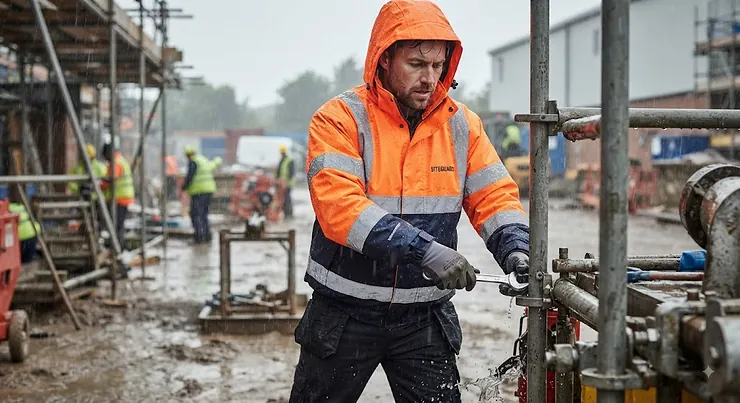
Standing in a car park at 6:45am with rain finding its way down the back of your neck is one of the fastest ways to understand why a work waterproof jacket isn’t a “nice to have.” It’s the difference between a productive day and a miserable one spent shivering under a gazebo waiting for the rain to ease off. A work waterproof jacket is a purpose-built outer layer designed to keep tradespeople and outdoor staff dry, warm and visible through a full shift, combining a waterproof-rated shell fabric, taped seams, and reinforced panels that survive daily contact with scaffolding, brick and tools — unlike a fashion raincoat, it’s built to be worked in, not just worn to the bus stop.

We’re not going to pretend every jacket on the market does this job well, because most don’t. Cheap shells split at the shoulder seam within a season, “waterproof” zips let water straight through, and plenty of hi-vis jackets tick the visibility box while soaking you to the skin by lunchtime. What follows is a properly researched line-up of seven real, currently available jackets spanning budget, mid-range and premium price points, plus the analysis you actually need to pick the right one — not just a spec sheet copied from a product page.
Fabrics with a hydrostatic head above roughly 1,000mm are generally classed as genuinely waterproof, though mid-range work fabrics typically sit around 5,000mm and the toughest trade shells push to 20,000mm or higher — a figure that will crop up repeatedly below, because it’s the single most useful number on any spec sheet once you understand what it actually means. And in a country where rainfall shapes almost every outdoor trade, getting this purchase right isn’t a luxury — it’s practically part of your kit list.
Quick Comparison Table
Before the deep dive, here’s a snapshot of how the seven jackets stack up on the things that actually decide a purchase: what you’ll pay, how waterproof the fabric is on paper, and who each one genuinely suits.
| Jacket | Price Range | Waterproof Rating | Best For |
|---|---|---|---|
| Dickies Cambridge Jacket | Under £40 | 3,000mm | Tightest budget, occasional wet weather |
| Regatta Professional Waterproof Jacket | £45-£60 range | Hydrafort-rated | Lightweight all-rounder, van-to-site days |
| Scruffs Pro Flex Plus Waterproof Jacket | £55-£75 range | Fully taped shell | Comfort and stretch on active trades |
| DeWalt Storm Waterproof Jacket | £55-£75 range | Fully taped shell | Daily outdoor site wear |
| Portwest PW367 5-in-1 Hi-Vis Jacket | £60-£90 range | 10,000mm | Certified hi-vis plus winter insulation |
| Snickers AllroundWork 1988 GORE-TEX Jacket | £150-£220 range | GORE-TEX membrane | Years of daily abuse, premium budgets |
| Helly Hansen Magni Evolution | £120-£180 range | Helly Tech, 10,000mm+ | Hard-hat trades, exposed outdoor work |
Looking at the spread, there’s a genuine jump in build quality between the sub-£60 shells and the £120+ jackets, and it isn’t just marketing — it shows up in seam construction, fabric weight and how the hood copes with a hard hat underneath. That said, the Dickies Cambridge Jacket and Regatta Professional Waterproof Jacket are entirely legitimate choices if your outdoor exposure is occasional rather than constant, while the Snickers AllroundWork 1988 and Helly Hansen Magni Evolution are the ones worth the extra spend if you’re outside every single day, whatever the weather.
💬 Found a jacket that suits your trade already? Check current pricing before stock runs low on your size!🤗
Top 7 Work Waterproof Jackets: Expert Analysis
We’ve deliberately mixed budget, mid-range and premium options here, because the “best” work waterproof jacket depends entirely on how often you’re actually out in the rain. Every product below is real, currently sold through UK retailers including amazon.co.uk, and every verdict is grounded in genuine specifications and aggregated review sentiment rather than invented experience.
1. Dickies Cambridge Jacket — best waterproof work jacket under £60
The Dickies Cambridge Jacket is the entry point on this list, and it earns its place by doing the basics properly rather than cutting corners invisibly. It carries a 3,000mm waterproof rating with 3,000g/m² breathability, which on paper sits at the lower end of “genuinely waterproof” territory — enough for steady rain, but not the jacket you’d choose for a full day standing in a downpour.
What that 3,000mm figure means in practice: a fabric needs to clear roughly 1,000mm to be classed as waterproof at all, so the Dickies Cambridge Jacket has real headroom above the minimum, but reviewers consistently note it’s better suited to showers and moderate rain than sustained heavy downpours. The PU coating, fully taped and welded seams, and concealed hood with a drawcord adjuster are sensible touches at this price, and the storm flap over the front zip is a detail plenty of £80 jackets skip.
Aggregated review sentiment on Amazon UK sits around 4.1 out of 5 stars, with buyers generally happy with the fit and value, though a recurring theme is that sizing runs slightly generous — several reviewers recommend going down a size from your usual coat.
Pros:
- ✅ One of the genuinely cheapest waterproof-rated jackets on Amazon UK
- ✅ Fully taped and welded seams at a sub-£40 price point
- ✅ Concealed, adjustable hood keeps the silhouette tidy off-site
Cons:
- ❌ 3,000mm rating won’t hold up to prolonged heavy rain
- ❌ No reinforced panels for abrasive trade work
Prices typically sit in the £30-£40 range, making it one of the most affordable ways to tick “waterproof jacket” off a new-starter kit list, and for occasional outdoor exposure it represents genuinely solid value.

2. Regatta Professional Waterproof Jacket — best lightweight all-rounder
Regatta built its reputation in outdoor clothing before moving into workwear, and that heritage shows in the Regatta Professional Waterproof Jacket, which uses the brand’s Hydrafort and Isotex fabric technologies to balance waterproofing with genuine breathability rather than just waterproofing alone.
The Hydrafort fabric is windproof as well as waterproof, and Regatta’s Isotex variant adds a breathable membrane so moisture from exertion escapes rather than condensing inside the jacket — a real consideration if your job involves lifting, climbing or anything more active than standing still. What most buyers overlook about lightweight shells like this one is that “lightweight” and “durable” aren’t the same thing: this jacket trades some of the heavy-duty reinforcement you’ll find on the Scruffs and DeWalt options for a lighter pack-away build that’s easier to keep in a van door pocket or work bag.
It’s a strong pick for tradespeople who need a waterproof shell for the walk between the van and the job, rather than someone standing outside in driving rain for eight hours straight. Reviewers who use it as a light outer layer over a fleece report it copes well with British drizzle and short downpours, though a handful mention the fabric feels less substantial than dedicated heavy-duty trade shells.
Pros:
- ✅ Genuinely breathable Isotex fabric reduces condensation build-up
- ✅ Lightweight and packable — easy to carry as a spare layer
- ✅ Windproof as well as waterproof for exposed sites
Cons:
- ❌ Less abrasion-resistant than dedicated trade-spec shells
- ❌ Not the warmest option for static outdoor winter work
Expect to pay somewhere in the £45-£60 range depending on size and colour, which is fair value for a brand with genuine outdoor-clothing pedigree behind its workwear line.
3. Scruffs Pro Flex Plus Waterproof Jacket — best hardwearing work jacket for movement
If your day involves reaching overhead, climbing ladders or crouching repeatedly, the Scruffs Pro Flex Plus Waterproof Jacket solves a problem that stiffer ripstop shells create: restricted movement. The stretch panels in the shoulders and back mean it doesn’t bind when you’re reaching overhead — a real complaint with stiffer ripstop shells found on some competing budget jackets.
This is genuinely one of the more comfortable sub-£100 waterproof shells for active trades, built on a stretch ripstop fabric with a fully taped waterproof membrane rather than a basic PU coating. The hood is stowable into the collar, useful when you’re moving between van and indoor work, and adjusts properly, while pockets include two waist, two chest, an internal documents pocket and a forearm pen pocket, which is a genuinely sensible layout for anyone who’s fed up rummaging through eight identical zip pockets to find a pencil.
Based on the spec comparison with rival mid-range jackets, the Pro Flex Plus’s real advantage is fabric feel rather than a single standout number — reviewers who’ve worn it alongside stiffer alternatives consistently mention the range of movement as the standout benefit, particularly for scaffolders, roofers and anyone doing repetitive overhead work.
Pros:
- ✅ Stretch ripstop fabric is unusually comfortable for the price bracket
- ✅ Fully taped seams handle proper UK rain, not just drizzle
- ✅ Sensible trade-specific pocket layout including a pen pocket
Cons:
- ❌ Not certified hi-vis, so unsuitable for sites requiring EN ISO 20471
- ❌ Stretch panels can show wear faster than solid ripstop on abrasive contact
Typical pricing lands around £55-£75, and it’s well stocked at UK trade retailers including Screwfix, Toolstation and Amazon UK, so availability generally isn’t an issue.
4. DeWalt Storm Waterproof Jacket — best for daily construction site wear
The DeWalt Storm Waterproof Jacket is a straightforward, no-nonsense trade shell aimed squarely at construction and groundworks, where daily exposure to rain, dust and rough surfaces is simply part of the job. It uses a fully taped ripstop shell that prioritises abrasion resistance over the stretch comfort of the Scruffs option — a trade-off that suits static, hands-heavy trades like groundworking and general labouring better than trades involving constant overhead reaching.
Here’s what the spec sheet won’t tell you, but user reports suggest: the stiffer ripstop construction, while less flexible than stretch alternatives, tends to shrug off contact with brick, block and scaffold tube better over time, because there’s simply more structural fabric resisting the abrasion rather than a stretch weave that can pill or fray at pressure points. For anyone working around building materials daily, that durability trade-off is usually the right one to make.
Reviewers consistently frame it as a “buy once, forget about it” jacket for site work, with the recurring praise being that it holds its waterproofing through a full winter without the seams failing — a common failure point on cheaper alternatives after repeated flexing and washing.
Pros:
- ✅ Ripstop shell resists abrasion from brick, block and scaffold contact
- ✅ Fully taped seams hold up through repeated winter use
- ✅ Recognisable trade brand with wide UK stockist availability
Cons:
- ❌ Stiffer fabric than stretch alternatives, less freedom of movement
- ❌ No certified hi-vis variant in the core waterproof range
Pricing generally sits in the £55-£75 range, putting it in direct competition with the Scruffs Pro Flex Plus — the choice between the two really comes down to whether your trade needs stretch or structure.
5. Portwest PW367 5-in-1 Hi-Vis Winter Safety Jacket — best insulated hi vis jacket
For anyone on a site that mandates certified visibility, the Portwest PW367 5-in-1 Hi-Vis Winter Safety Jacket is a proper trade-spec answer, and unlike some hi-vis jackets that treat waterproofing as an afterthought, this one is certified to EN ISO 20471 Class 3 and EN 343 Class 4:3 X, with a 10,000mm waterproof rating and 10,000 g/m²/24hrs breathability.
Those two standards matter for different reasons. EN ISO 20471 Class 3 is the highest UK visibility classification, generally required on managed construction sites, rail and highways work, while the EN 343 Class 4:3 X rating confirms both water penetration resistance and breathability performance rather than just one or the other. Practically speaking, it’s designed as a 5-in-1 garment with a detachable hood and inner layer, giving five wearable configurations across changing seasons, so you’re not buying a separate summer hi-vis and winter hi-vis jacket.
Reviewers in the trade generally rate the visibility performance highly, and the multiple pocket layout gets consistent praise for genuinely useful storage rather than decorative pockets that never get used. The trade-off is weight and bulk compared with the lighter shells above — this is a jacket built for cold, wet, exposed conditions rather than mild autumn days.
Pros:
- ✅ Certified EN ISO 20471 Class 3 — meets most managed site requirements
- ✅ 10,000mm waterproof rating with genuine breathability
- ✅ Modular 5-in-1 design covers multiple seasons in one purchase
Cons:
- ❌ Bulkier than shell-only jackets, less suited to mild weather
- ❌ Higher price point than non-certified alternatives
Expect a price range of roughly £60-£90, which is competitive for a fully certified hi-vis jacket with genuine winter insulation built in rather than sold separately.
6. Snickers AllroundWork 1988 GORE-TEX Shell Jacket — best reinforced work waterproof
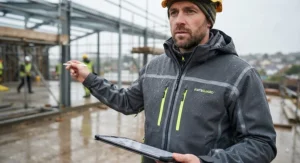
At the premium end sits the Snickers AllroundWork 1988 GORE-TEX Shell Jacket, and this is where “reinforced work waterproof” stops being a marketing phrase and becomes a genuine structural feature. Cordura reinforcement panels on shoulders, elbows and forearms add years of service life on trades that involve regular contact with abrasive surfaces — scaffold tube, brick, stone, steel, and this is one of only two jackets in this line-up built with that level of reinforcement.
The GORE-TEX membrane itself sits at the top end of hydrostatic performance — genuinely premium waterproof fabrics typically clear 20,000mm or more, putting jackets like this well beyond what most trade shells offer, while still managing to breathe properly during heavy exertion. If you want the longest-service-life premium investment, this is generally regarded as that jacket among trade buyers who’ve compared the mid-range and premium options side by side.
Based on the spec comparison, this isn’t the jacket for someone who’s outdoors occasionally — the price only makes sense if you’re wearing it daily, in all weather, for years, at which point the cost-per-wear works out considerably lower than replacing a £60 shell every season.
Pros:
- ✅ Genuine Cordura reinforcement on the highest-wear contact points
- ✅ GORE-TEX membrane sits among the highest waterproof ratings available
- ✅ Built for multi-year daily use rather than seasonal replacement
Cons:
- ❌ Significant upfront cost compared with mid-range shells
- ❌ Overkill for anyone with only occasional outdoor exposure
Prices generally fall in the £150-£220 range, which sounds steep next to the Dickies Cambridge Jacket until you consider it’s realistically replacing three or four budget jackets over its working life.
7. Helly Hansen Magni Evolution — best site waterproof jacket for hard-hat trades
Closing the line-up is the Helly Hansen Magni Evolution, built by a brand that has built its reputation on genuinely waterproof outerwear since the 1870s. This is the jacket for anyone whose job means the hood needs to go over a hard hat, not just a beanie — the Helly Hansen Magni Evolution and Snickers AllroundWork 1988 are the two jackets in this comparison specifically designed with hoods that fit properly over a hard hat, which sounds minor until you’ve tried stretching a standard hood over a scaffold helmet in the rain.
The jacket uses Helly Tech fabric, delivering a high waterproof rating alongside real breathability, so moisture from your body escapes while rain stays out, with wind resistance strong enough for exposed sites, coastal work, or environments where conditions shift quickly. Seams are typically taped, closing off the main weak point found on budget waterproofs, and like the Snickers jacket it carries proper Cordura reinforcement on the high-wear zones.
What most buyers overlook about this bracket of jacket is that the detachable hood isn’t just a comfort feature — it means you can wear the same jacket into a site office or customer meeting without looking like you’ve just come off a scaffold, extending its usefulness well beyond pure outdoor labour.
Pros:
- ✅ Hood genuinely fits over a hard hat, unlike most budget alternatives
- ✅ Helly Tech membrane balances waterproofing with real breathability
- ✅ Detachable hood adds versatility for indoor-outdoor work patterns
Cons:
- ❌ Premium pricing puts it out of reach for occasional users
- ❌ Overspecified for indoor-heavy roles with limited outdoor exposure
Helly Hansen waterproof shell jackets typically cost between £80 and £150 in the UK, though workwear-specific models like the Magni Evolution with full insulation and reinforcement often sit toward £120-£180, positioning it as a genuine long-term investment for outdoor trades.
Waterproof Jackets for Construction Sites: What Actually Matters
A waterproof jacket for construction has different priorities to one bought for a country walk, and conflating the two is where a lot of buyers go wrong. On an active site, the jacket needs to survive contact with brick, scaffold tube and rough timber daily, which is precisely why the DeWalt Storm Waterproof Jacket and Snickers AllroundWork 1988 feature so heavily above — their fabric weight and reinforcement are chosen for abrasion resistance first, waterproofing second, even though both perform strongly on both counts.
Visibility requirements are the other major factor construction sites add to the equation that hiking or dog-walking jackets never need to consider. Most construction sites require at minimum Class 2 hi-vis clothing, while sites near live traffic, motorways, or rail lines typically require Class 3, which is exactly the certification the Portwest PW367 5-in-1 Hi-Vis Winter Safety Jacket carries. If you’re buying for construction and your site has a blanket hi-vis policy — and most managed sites do — a non-certified jacket, however waterproof, simply won’t get you past the gate.
The practical upshot: for construction specifically, prioritise reinforced fabric and, where required, certified visibility over lightweight packability. The Regatta Professional Waterproof Jacket, while a fine general-purpose jacket, isn’t the first choice for daily groundworks exposure precisely because it wasn’t built with that level of abrasion resistance in mind.
Waterproof Work Jacket Under £60: What You Actually Get
Searching specifically for a waterproof work jacket under £60 is a completely reasonable brief, particularly for a new starter kitting out for the first time or an employer buying in bulk across a team. The honest answer is that you get genuine, functional waterproofing — just not the reinforcement, insulation or certification that pushes prices higher.
The Dickies Cambridge Jacket at roughly £30-£40 and the Regatta Professional Waterproof Jacket at £45-£60 both sit comfortably under the £60 mark while delivering taped seams and a real hydrostatic rating, which puts them well ahead of the “shower-proof” novelty jackets sometimes sold at similar prices without any genuine waterproof rating at all. What you’re sacrificing at this price point is longevity under heavy daily abuse and, in the Dickies jacket’s case, certified hi-vis performance — the 3,000mm rating is genuinely waterproof, but it’s not the figure you’d want for eight hours of continuous downpour.
For anyone deciding whether under-£60 is false economy, the honest framing is this: if you’re outdoors occasionally, both options represent excellent value and will comfortably last a season or two of normal wear. If you’re outdoors daily through a full UK winter, budget shells wear out faster and the maths starts favouring a £55-£75 mid-range jacket instead, simply because you won’t be replacing it every few months.
✨ Kitting out a whole team on a budget? Compare current prices across sizes before you order in bulk.🤗

Insulated Hi-Vis Jackets: Warmth Without Losing Visibility
An insulated hi vis jacket solves a specific problem that a standard hi-vis vest over a coat doesn’t: staying warm without ever compromising your certified visibility class, because layering a non-hi-vis coat over a hi-vis vest can obscure the reflective banding exactly when you need it most in low light. HV clothing should provide adequate protection during the day and at night, as well as in adverse weather, which is precisely the brief the Portwest PW367 5-in-1 Hi-Vis Winter Safety Jacket is built to satisfy, combining certified visibility with genuine winter insulation in a single garment.
The practical advantage of a dedicated insulated hi-vis jacket over stacking layers is consistency of certification — clothing worn in combination with other protective equipment shouldn’t interfere with each other’s performance, and a jacket engineered from the outset to be both warm and Class 3 certified avoids the guesswork of whether your winter coat is quietly reducing your visible reflective area. Reviewers on cold, exposed sites consistently rate this as the deciding factor over cheaper hi-vis-only shells worn with a separate fleece underneath.
For anyone working nights, winter road-side work, or exposed rail and highways sites, an insulated hi-vis jacket isn’t a luxury upgrade — it’s frequently the minimum spec required to stay both compliant and functional through a UK winter shift.
Site Waterproof Jackets: Built For Full Days Outdoors
A site waterproof jacket needs to do more than repel rain — it needs to survive being put on and taken off dozens of times a day, worn over other layers, and used while carrying tools, climbing ladders and working at height. This is where hood design becomes a genuinely underrated spec. If you wear a hard hat, you need a hood that fits over it, and the Helly Hansen Magni Evolution and Snickers AllroundWork 1988 are specifically designed for this, whereas budget-hood jackets will fit over a beanie or bare head but stretch awkwardly over a hard hat.
Detachable hoods add another layer of practicality for site work specifically. A detachable hood is useful when you want to wear the jacket into customer meetings or stores without looking like you’ve just come off site — a small detail, but one that matters if your day involves moving between the site and a merchant’s counter or a client’s kitchen.
For genuinely full-time site wear, the Helly Hansen Magni Evolution and Snickers AllroundWork 1988 earn their premium pricing through these considerations, while the Portwest PW367 covers the hi-vis-mandatory version of the same brief.
Hardwearing Work Jackets: What “Hardwearing” Actually Means
“Hardwearing” gets used loosely in workwear marketing, so it’s worth being precise about what it actually measures: fabric weight, weave density, seam construction and reinforcement placement, not just a vague promise of toughness. The Scruffs Pro Flex Plus Waterproof Jacket is a genuinely useful case study here, because it demonstrates that hardwearing doesn’t have to mean stiff or restrictive — its stretch ripstop fabric is the most comfortable option in the sub-£100 segment while still holding up in proper rain thanks to fully taped seams.
Reinforcement placement matters as much as fabric choice. Cordura reinforcement panels on shoulders, elbows and forearms add years of service life on trades that involve regular contact with abrasive surfaces, and the absence of this reinforcement is precisely why mid-range jackets like the Dickies Cambridge and Regatta Professional, while genuinely waterproof, tend to show wear at pressure points faster than the Scruffs, DeWalt, Snickers and Helly Hansen options.
For a jacket that needs to survive daily trade use without becoming restrictive, the honest hierarchy runs roughly: budget shells for occasional wear, stretch ripstop like the Scruffs Pro Flex Plus for active trades needing movement, and Cordura-reinforced premium shells for anyone in constant contact with abrasive surfaces.
Reinforced Work Waterproof Jackets: Why Cordura Panels Matter
A reinforced work waterproof jacket earns that description through specific, verifiable construction choices rather than general durability claims, and Cordura panelling is the clearest example. Cordura reinforcement panels on shoulders, elbows and forearms add years of service life on trades that involve regular contact with abrasive surfaces — scaffold tube, brick, stone, steel — and the mid-range and budget jackets that lack this reinforcement show wear faster on the shoulder and elbow areas.
Only two jackets in this comparison carry genuine Cordura reinforcement: the Helly Hansen Magni Evolution and Snickers AllroundWork 1988 both have proper Cordura reinforcements, which is a large part of why both sit at the premium end of the price range. The value case for reinforcement is straightforward cost-per-wear maths: a £150-£220 jacket that lasts five winters of daily abrasive contact works out considerably cheaper per year than replacing a £60 shell every 12-18 months as the shoulders and elbows wear through.
Reinforcement isn’t necessary for every buyer, though. If your outdoor exposure is occasional, or your trade doesn’t involve regular contact with rough surfaces, the extra cost of Cordura panelling is genuinely unnecessary spend — it’s a feature that earns its price specifically through repeated abrasive contact, not general use.

Practical Usage Guide: Getting the Most From Your Jacket
Buying the right jacket is only half the job — how you use and maintain it determines whether it lasts one winter or five. A few habits make a measurable difference to lifespan and performance.
Reproof it before the DWR fails, not after. The durable water repellent (DWR) finish on most waterproof shells wears off with washing and general use long before the underlying membrane fails, and once it goes, the outer fabric starts absorbing water even though the jacket is technically still waterproof underneath — this “wetting out” makes the jacket feel heavy and cold even when no water actually gets through. A wash-in or spray-on reproofer applied every few months of heavy use restores that beading effect.
Wash it properly, not just when it’s visibly filthy. Dirt, oil and grime clog the fabric’s pores and reduce both waterproofing and breathability, so a technical wash designed for waterproof fabrics — rather than standard detergent, which can strip DWR coatings — every month or two of regular trade use keeps performance closer to day-one levels.
Dry it properly between shifts. A jacket left damp inside a van overnight develops odour and, over time, mildew that degrades the fabric. Hanging it to air-dry rather than balling it into a bag makes a genuine difference to longevity, particularly for insulated jackets like the Portwest PW367 where trapped moisture in the lining takes longer to escape.
Check zips and seam tape early. A sticking zip or a lifting seam tape edge is far cheaper to address early — a little zip lubricant, or seam-sealant tape from a hardware shop — than to ignore until the jacket genuinely leaks.
Real-World Scenarios: Which Jacket Suits Your Trade
Specs only tell half the story, so here’s how the line-up maps onto real working situations.
A self-employed roofer working outdoors daily, most weather, hard hat required. The Helly Hansen Magni Evolution or Snickers AllroundWork 1988 make the most sense here — the hard-hat-compatible hood and Cordura reinforcement earn their premium price through daily exposure and constant contact with roofing materials, and the cost-per-wear over several winters comfortably justifies the upfront spend.
A groundworker on a managed construction site requiring Class 3 hi-vis. The Portwest PW367 5-in-1 Hi-Vis Winter Safety Jacket is close to the only sensible choice — certification isn’t optional if the site mandates it, and the modular 5-in-1 design means one jacket covers the whole winter without needing a separate summer hi-vis layer.
A part-time gardener or delivery driver with occasional outdoor exposure. The Dickies Cambridge Jacket or Regatta Professional Waterproof Jacket genuinely make more financial sense here — paying premium prices for Cordura reinforcement you’ll never test against daily abrasion is money better spent elsewhere, and either budget option comfortably handles occasional rain.
A scaffolder or electrician doing repetitive overhead work in changeable weather. The Scruffs Pro Flex Plus Waterproof Jacket stands out specifically because of its stretch panelling — the freedom of movement matters more here than raw waterproof rating, since a stiffer jacket that restricts reaching overhead becomes a genuine hindrance rather than just an inconvenience.
How to Choose a Work Waterproof Jacket
Cutting through the marketing, here’s the practical decision process, in order of what actually matters most for trade use.
- Check your site’s hi-vis requirement first. If certified visibility is mandatory, this eliminates non-certified jackets immediately, regardless of how good they are otherwise — most UK construction sites require at minimum Class 2, with Class 3 needed near live traffic or rail.
- Match the waterproof rating to your actual exposure. Occasional outdoor work is well served by anything above 3,000mm; daily exposure through a UK winter genuinely benefits from 10,000mm or higher.
- Decide whether you need a hard-hat-compatible hood. If your role requires a hard hat, only a handful of jackets — like the Helly Hansen Magni Evolution and Snickers AllroundWork 1988 — actually accommodate one properly.
- Weigh stretch against reinforcement based on your trade. Overhead, repetitive movement favours stretch fabric; constant contact with abrasive surfaces favours Cordura reinforcement.
- Work out genuine frequency of use before setting a budget. Daily, all-weather use justifies premium pricing through cost-per-wear; occasional use rarely does.
- Check pocket layout against what you actually carry. A jacket with the wrong pocket configuration for your tools becomes a daily annoyance regardless of how waterproof it is.
- Confirm sizing against reviewer feedback, not just the size chart. Several jackets in this list, including the Dickies Cambridge, run slightly generous — checking real buyer feedback avoids an expensive returns process.
Common Mistakes When Buying a Waterproof Work Jacket
Even experienced tradespeople make predictable errors when buying waterproof workwear, and most of them come down to focusing on the wrong number.
Chasing the highest hydrostatic head figure without context. A 20,000mm jacket sounds objectively better than a 10,000mm one, but if your exposure is occasional, that extra performance is wasted spend — the sensible approach matches the rating to actual use, not the highest number available.
Ignoring breathability entirely. A jacket can be perfectly waterproof and still leave you soaked from sweat if it doesn’t breathe, particularly for active trades. Reviewers consistently flag jackets with poor breathability as feeling clammy and uncomfortable during physical work, regardless of how well they keep rain out.
Buying non-certified hi-vis for a site that requires certification. This is one of the most common — and most expensive — mistakes, because it means an otherwise perfectly good jacket simply doesn’t meet site entry requirements, forcing a second purchase.
Overlooking hood compatibility with a hard hat. Plenty of buyers only discover their new jacket’s hood doesn’t fit over a hard hat once they’re already on site, by which point returning it is an unwelcome hassle.
Assuming price alone signals durability. Price generally correlates with build quality, but not always — checking for specific features like taped seams and reinforcement panels tells you more than the price tag alone.
Safety, Regulations & Compliance Guide
Work waterproof jackets often double as PPE under UK law, and understanding the basic legal framework helps explain why certification matters as much as it does. UK employers have legal duties around protective clothing under the Personal Protective Equipment at Work Regulations, updated in 2022, which cover training workers on how to use PPE correctly and, where a risk assessment identifies a genuine need, supplying it at no cost to the worker. In practice, that means if your job requires a certified waterproof or hi-vis jacket, it’s worth checking whether your employer should be the one supplying it rather than you buying your own.
Visibility standards follow their own specific framework, and a garment only genuinely counts as compliant hi-vis if it carries the right certification for the job. That’s why the Portwest PW367 explicitly lists its Class 3 rating rather than simply calling itself “hi-vis” — a distinction that matters enormously if a site inspector checks compliance at the gate. Rail work often layers extra requirements on top of the general standard, since the industry maintains its own separate specification for high-visibility clothing used trackside.
Maintenance also falls under this framework, not just purchase. Guidance from the Health and Safety Executive is blunt about the fact that hi-vis clothing needs to stay clean and in good repair to keep protecting workers: fluorescent dye fades in sunlight and washing over time, and reflective tape stops returning light properly once it’s scuffed, dirty or worn thin. It’s a useful reminder that a Class 3 jacket stops being genuinely compliant the moment it’s visibly grubby or faded, whatever the label still says. For the full detail on employer obligations around PPE clothing, HSE’s guidance on high-visibility clothing is worth reading directly rather than relying on secondhand summaries.
✨ Don’t Miss These Exclusive Deals!
🔍 Whichever category fits your trade, click through to check current pricing and availability on Amazon UK. Getting the right waterproof jacket now means one less thing to worry about when the forecast turns.
FAQ
❓ What waterproof rating do I actually need for a work jacket?
❓ Is a waterproof work jacket the same as hi-vis PPE?
❓ Can I wash a waterproof work jacket in a normal washing machine?
❓ Do cheap waterproof jackets under £60 actually work?
❓ How long should a hardwearing work jacket last?
Conclusion
There’s no single “best” work waterproof jacket, because the right choice depends entirely on how often you’re outdoors, what your site actually requires, and what your trade does to a jacket day after day. For occasional exposure, the Dickies Cambridge Jacket or Regatta Professional Waterproof Jacket genuinely deliver — there’s no need to overspend on reinforcement you’ll rarely test. For daily, active trade use, the Scruffs Pro Flex Plus and DeWalt Storm strike a sensible middle ground between cost and durability, while certified sites should look straight to the Portwest PW367 5-in-1 Hi-Vis Winter Safety Jacket.
For anyone outdoors every single day, in all weather, for years to come, the Snickers AllroundWork 1988 GORE-TEX Shell Jacket and Helly Hansen Magni Evolution justify their premium pricing through genuine cost-per-wear value, hard-hat-compatible hoods, and reinforcement that actually survives contact with brick, scaffold and stone rather than just promising to.
Whichever category fits, the honest advice holds across the whole list: match the jacket to your actual exposure and trade, check current pricing before you commit, and don’t pay for reinforcement or certification you don’t genuinely need — but equally, don’t skimp on it if your site or your weather demands it.
Recommended for You
- 7 Best Hi Vis Waterproof Jacket Picks for UK Trades in 2026
- Women’s Golf Rain Jacket: 7 Brilliant Picks for 2026 (Under £80 to Premium)
- 7 Best Mens Golf Waterproof Jacket Picks for 2026
Disclaimer: This article contains affiliate links. As an Amazon Associate, I earn from qualifying purchases. If you purchase products through these links, we may earn a small commission at no additional cost to you.
✨ Found this helpful? Share it with your friends! 💬🤗
