In This Article
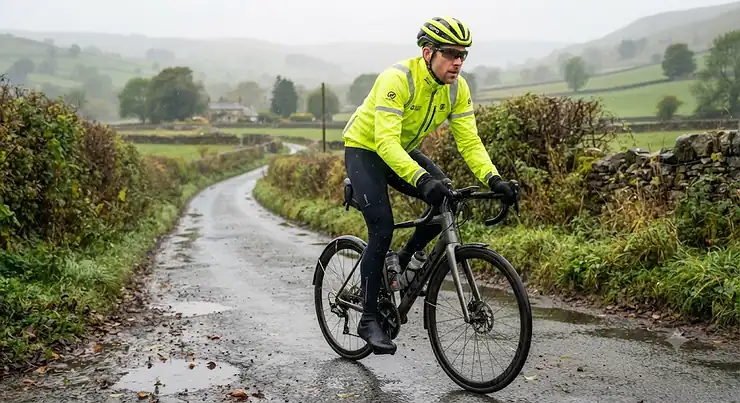
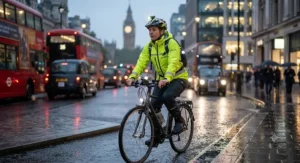
Picture this: it’s 7:40am, the sky over the ring road has gone the colour of wet slate, and every driver on your route is squinting through a windscreen smeared with condensation and drizzle. This is the exact moment a hi-vis cycling rain jacket earns its keep. It isn’t just about looking like a highlighter pen on wheels — it’s about buying yourself those extra two or three seconds of reaction time from a driver who might otherwise be scanning for anything but a cyclist. A genuinely good hi-vis cycling rain jacket does two jobs at once: it keeps British drizzle off your back, and it throws your silhouette into sharp relief against grey tarmac and greyer skies.
What is a hi-vis cycling rain jacket? It’s a waterproof cycling shell built from fluorescent or reflective fabric (often tested to EN ISO 20471) that keeps you dry in wet weather while making you significantly easier for drivers to spot in low light, fog, or heavy rain.
This guide skips the marketing fluff and gets into the real specs, genuine review sentiment, and honest trade-offs of seven jackets and gilets you can actually buy in the UK right now — from budget-friendly shells under £30 to fully certified, three-season workhorses. Whether you’re commuting eight miles each way through a British winter or just want something to throw on for the school run, there’s a pick here that fits your riding, your budget, and your tolerance for standing out in a crowd.
Quick Comparison Table
| Jacket | Type | Waterproof Rating | Price Range | Best For |
|---|---|---|---|---|
| Proviz Reflect360+ | Full jacket | ~10,000mm | £120-£150 range | All-round technical commuting |
| Altura Nightvision Nevis | Full jacket | 10k/10k | Under £80 | Best value everyday commuter |
| Altura Nightvision Storm Thermal Gilet | Gilet | 10k/10k | £55-£75 range | Cold mornings, layering |
| BTR Reflective & Hi-Vis Jacket | Full jacket | Basic waterproof | Under £30 | Tight budgets, new cyclists |
| Altura Nightvision Unisex Cycling Vest | Gilet/overshirt | Water-resistant | Under £30 | Lightweight extra visibility |
Looking at the table, there’s a clear split between certified, fully waterproof shells like the Proviz Reflect360+ and lighter, more affordable layers like the Altura Nightvision Unisex Cycling Vest that prioritise visibility over heavy-duty weatherproofing. If your commute is short and mostly urban, a budget pick under £30 will probably do the job; if you’re out in proper downpours for 40 minutes or more, it’s worth stretching toward the 10,000mm-rated options.
💬 Already got a favourite in mind? A quick click below helps you compare current pricing before you commit.
Top 7 Hi-Vis Cycling Rain Jackets: Expert Analysis
Coverage below spans budget, mid-range, and premium options, plus dedicated gilets, so there’s a genuine choice here rather than seven variations on the same £150 jacket.
1. Proviz Reflect360+ — most advanced reflective technology on test
The standout feature here is the upgraded film fabric, which Proviz says bumps breathability to roughly 10,000g/m²/24hr while keeping the full 360-degree reflective coverage that made the original Reflect360 famous. In daylight the Proviz Reflect360+ reads as a modest silver-grey; the moment headlights hit it, the whole jacket lights up, front and back. That’s a genuinely different visibility profile to a jacket that only has reflective strips on the arms.
On specs, this is a tailored-fit jacket with raglan sleeves for shoulder movement, taped seams, and dual-purpose front pockets that double as sealed storage when zipped shut in wet weather. Based on the spec comparison with the rest of this list, the Proviz Reflect360+ sits at the technical end — its fabric is CE EN 20471 certified, which very few cycling jackets at any price bother to pursue. That certification matters most to riders doing longer commutes on faster, unlit roads where being seen from further away genuinely changes the odds.
Reviewers consistently report that the reflectivity is startling in person — cycling media has described the effect as “astonishing” when lit by vehicle headlights — and owners frequently mention the jacket runs a close, athletic fit rather than a baggy commuter cut. A recurring theme in aggregated feedback is that sizing runs slightly snug, so buyers are often advised to size up if layering underneath in winter.
Pros:
- ✅ Full 360-degree CE EN 20471 certified reflectivity
- ✅ Raglan sleeve design improves range of motion
- ✅ Ventilation zips prevent overheating on climbs
Cons:
- ❌ Tailored fit runs snug for heavy winter layering
- ❌ Sits at the premium end of this list on price
At around £120-£150, the Proviz Reflect360+ is priced for riders who see visibility as a non-negotiable rather than a nice-to-have, and on the evidence here it earns that premium.
2. Proviz Apex Men’s 100% Reflective Cycling Jacket — EN ISO 20471 certified all-rounder
The standout feature is coverage: this jacket uses a fully reflective outer shell rather than reflective panels stitched onto a coloured base, and it’s one of the few cycling jackets on the market independently confirmed as CE EN ISO 20471 certified. That’s a meaningful distinction from jackets that simply use the phrase “hi-vis” as a colour description.
Specification-wise, expect a waterproof, windproof shell with sealed seams and a soft inner lining designed to stop the fabric feeling clammy against skin — a common complaint levelled at cheaper PU-coated shells. What most buyers overlook about this model is that full reflective coverage, rather than partial strips, is what actually delivers the 360-degree “seen from any angle” benefit that hi-vis marketing promises but doesn’t always deliver.
Aggregated reviewer sentiment for the wider Proviz Apex range echoes the Reflect360+ experience: strong praise for genuine nighttime visibility, alongside occasional notes that the busier reflective print reads as more utilitarian than some riders want for off-bike wear. If you want a jacket that looks like a purpose-built safety garment rather than a discreet commuter shell, that’s arguably the point rather than a flaw.
Pros:
- ✅ Independently certified to EN ISO 20471
- ✅ 100% reflective shell, not just accent panels
- ✅ Soft inner lining reduces clamminess in mild rain
Cons:
- ❌ Bold reflective look isn’t discreet off the bike
- ❌ Premium pricing similar to the Reflect360+ range
Priced in a similar £100-£150 range, the Proviz Apex Men’s 100% Reflective Cycling Jacket is the pick for anyone who wants certification on the label, not just a fluorescent colourway.
3. Altura Nightvision Nevis Men’s Waterproof Cycling Jacket — best all-round commuter under £80
The standout feature is the 10k/10k rating packed into a jacket that typically retails around £75 — genuinely competitive waterproofing and breathability for the price bracket. Altura describes this as designed with the everyday commuter in mind, and the spec sheet backs that up: fully taped seams, a relaxed cut for layering, and a PFC-free DWR coating that keeps the fabric’s water-repellency going without the “forever chemicals” older waterproof treatments relied on.
In practice, a 10,000mm hydrostatic head handles sustained rain rather than just light drizzle, and matching 10,000g breathability means you’re less likely to arrive at your desk feeling like you’ve been riding in a bin bag. Based on the spec comparison, this puts the Altura Nightvision Nevis roughly on par with jackets costing £20-£40 more, which is exactly why road-cycling media has flagged it as strong value against pricier alternatives like the Rapha Commuter range.
Reviewers note the arm length runs generously — good for cycling position, slightly long for walking — and that reflective detailing sits on the cuffs and lower back rather than covering the whole garment, so it’s more subtle than the two Proviz jackets above. A common theme in owner feedback is praise for the relaxed fit accommodating a jumper underneath without feeling restrictive.
Pros:
- ✅ 10,000mm waterproofing at a sub-£80 price point
- ✅ PFC-free DWR coating is more environmentally responsible
- ✅ Relaxed fit works well for layering in winter
Cons:
- ❌ Reflective detailing is modest, not full-coverage
- ❌ Sleeve length can feel long off the bike
At around £70-£80, the Altura Nightvision Nevis Men’s Waterproof Cycling Jacket is the jacket to buy if you want serious waterproofing without breaking into three figures.
4. Altura Nightvision Storm Waterproof Jacket — best for genuinely changeable UK weather
The standout feature is a slightly heavier-duty build than the Nevis, aimed at riders who want one jacket to handle everything from a light shower to a proper downpour. The Altura Nightvision Storm carries the same Nightvision reflective print system Altura has used across its range for over a decade, plus a fleece-lined collar that’s a small but noticeable comfort upgrade on cold, wet mornings.
On paper this means a jacket that trades a touch of breathability for extra protective bulk — independent testing has noted the Storm runs slightly warmer and less ventilated than Altura’s lighter Typhoon model during faster-paced efforts, which tracks with its heavier fabric weight. What this means in practice is that the Altura Nightvision Storm suits steady-paced commuting and errands better than it suits hard interval sessions in the rain.
Reviewers consistently rate this as strong value against similarly priced rivals — one detailed comparison found it beat a competitor at almost the same price on weatherproofing alone — while flagging that the armpit zips need to be opened proactively on milder days to avoid overheating. It’s a jacket that rewards a bit of active temperature management rather than being fully “set and forget.”
Pros:
- ✅ Fleece-lined collar adds real comfort in cold rain
- ✅ Reflective print detailing across shoulders and cuffs
- ✅ Strong value against similarly priced competitors
Cons:
- ❌ Breathability trails Altura’s lighter Typhoon model
- ❌ Needs active venting on milder or faster-paced rides
Typically priced in the £65-£80 range, the Altura Nightvision Storm Waterproof Jacket is the sensible middle-ground pick for riders who don’t want to think too hard about which jacket to grab on an unpredictable morning.
5. Altura Nightvision Storm Thermal Gilet — best waterproof cycling gilet for cold, dry-ish mornings
The standout feature is the combination of a 10k/10k waterproof outer with a thermal grid lining across the chest and sides — effectively a three-season gilet built for the gap between “too warm for a full jacket” and “too cold for just a jersey.” This is one of the more complete waterproof cycling gilet options on the market, rather than a simple windproof vest with a coating sprayed on top.
Specification-wise, expect taped seams, a chest pocket, a lower back pocket, and a reflective light loop for attaching a rear light directly to the garment — a small but genuinely useful detail for anyone who’s fumbled with a saddle-bag light mount in the dark. Here’s what to weigh: a gilet by definition leaves your arms exposed, so this suits riders who run warm on the bike or who layer arm warmers underneath, rather than anyone wanting head-to-wrist coverage.
Independent testing has been broadly positive about the weatherproofing and the cosy lining, while flagging that the reflective dot-pattern panels are less eye-catching than Altura’s older “Tron-style” reflective strips, and that the rear pocket can be fiddly to access on the move. It’s a jacket that does the fundamentals well without quite topping the reflectivity leaderboard.
Pros:
- ✅ Genuine 10k/10k waterproof and breathable rating
- ✅ Thermal grid lining adds real warmth without bulk
- ✅ Built-in light loop for easy rear-light attachment
Cons:
- ❌ Reflective panels less bold than Altura’s older designs
- ❌ Rear pocket access can be fiddly mid-ride
Priced around £55-£75, the Altura Nightvision Storm Thermal Gilet is arguably the best waterproof cycling gilet here for anyone whose commute swings between damp and properly cold.
6. BTR Reflective & Hi-Vis Cycling Jacket — best budget pick under £30
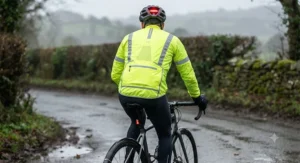
The standout feature is doing two visibility jobs in one £20-ish jacket: fluorescent yellow panels for daytime pop, and separate reflective silver panels that light up under headlights at night. Most single-technology budget jackets pick one or the other; the BTR Reflective & Hi-Vis Cycling Jacket covers both, which is a genuinely useful spec for anyone riding across dawn, daylight, and dusk on the same commute.
On the numbers, this is a mesh-lined waterproof shell with four pockets and a unisex fit spanning S to XL, aimed squarely at new cyclists and budget-conscious commuters rather than serious all-weather touring. Reviewers consistently note it undercuts most rivals offering the same combined hi-vis-plus-reflective approach, with the nearest low-cost alternative typically offering colour but no genuine reflective print.
The honest trade-off: at this price, the fabric and waterproof rating won’t match the 10,000mm shells further up this list, so expect it to handle showers and short exposure well rather than sustained, heavy rain over a long ride. A common theme in feedback is that it’s viewed as strong value for occasional commuters and anyone testing whether hi-vis riding gear suits them before spending more.
Pros:
- ✅ Combines daytime hi-vis colour with night reflective panels
- ✅ Genuinely low price point for new or occasional cyclists
- ✅ Unisex sizing from S to XL keeps it accessible
Cons:
- ❌ Waterproofing not built for sustained heavy rain
- ❌ Basic mesh lining, not a technical breathable membrane
At under £30, the BTR Reflective & Hi-Vis Cycling Jacket is the easiest low-risk way to try hi-vis cycling gear without committing to a three-figure spend.
7. Altura Nightvision Unisex Cycling Vest — lightest budget layer, doubles as a reflective overshirt
The standout feature is sheer packability: this is a lightweight gilet that folds down small enough to disappear into a jersey pocket, seat pack, or pannier, and it’s regularly praised for being the layer riders actually keep in their bag rather than leave at home. Functioning much like a reflective overshirt cycling layer, it’s designed to go over an existing jersey or jacket for a quick visibility boost rather than to serve as standalone weatherproofing.
Spec-wise, expect a simple, unlined reflective/hi-vis vest rather than a fully waterproof, taped-seam garment — this is about being seen, not staying bone dry in a downpour. What most buyers overlook is that a garment like this earns its keep precisely because it’s so easy to actually put on; a heavier jacket left at home does nothing, while a gilet that lives permanently in your bag gets worn.
Independent testing rated it as a solid mid-range vest for milder days when just a little extra protection and visibility is needed, describing it as doing exactly what’s required without over-promising. That’s a fair summary: it’s not the jacket for a three-hour downpour, but as an always-there reflective overshirt layer for shoulder-season commuting, it earns its place in this list.
Pros:
- ✅ Packs down small enough for a jersey pocket or pannier
- ✅ Genuinely affordable entry point around £20
- ✅ Works as a reflective overshirt over existing kit
Cons:
- ❌ Not built for sustained heavy rain
- ❌ No taped seams or technical waterproof membrane
At around £20, the Altura Nightvision Unisex Cycling Vest is the jacket-adjacent pick for riders who want a permanent, no-excuses visibility layer rather than another full jacket in the wardrobe.
Practical Usage Guide: Getting the Most From Your Hi-Vis Cycling Rain Jacket
A hi-vis cycling rain jacket only works as well as its setup allows. First, get the fit right before you get the fabric wet: try it on over the layers you’ll actually wear, checking that raised-arm mobility (the position you’ll hold on the bars) doesn’t ride the hem up your back. Second, in the first 30 days, resist the urge to wash it on a hot cycle — most waterproof membranes and DWR coatings specify a cold 30°C wash with no fabric softener, since softener residue is one of the most common causes of a jacket “wetting out” (soaking through on the surface) within months.
Maintenance-wise, a tumble-dry-free routine matters more than people expect: gentle heat can occasionally reactivate a DWR coating, but high heat degrades taped seams over time. If you notice water starting to bead less effectively after a season, a wash-in waterproofing reproofer is far cheaper than a new jacket and takes ten minutes. Common first-month mistakes include over-zipping vents in mild weather (leading to overheating and the classic “wet from sweat, not rain” complaint), and storing a damp jacket balled up in a bag, which encourages mildew on the inner lining.
One optimisation trick rarely mentioned on Amazon listings: attach a rear light directly to a jacket’s built-in loop or pocket flap rather than the saddle alone, since it raises the light closer to a driver’s natural eyeline and won’t get obscured by panniers.
Real-World Scenarios: Which Rider Are You?
If you’re commuting five miles each way on mostly residential streets and want one jacket that handles rain, wind, and low light without fuss, the Altura Nightvision Nevis Men’s Waterproof Cycling Jacket is the sensible default — proper waterproofing, a relaxed cut for work clothes underneath, and a price that doesn’t sting if it gets scuffed on a rack.
If you’re a longer-distance commuter doing 10-plus miles on faster, unlit rural or A-road stretches, the certified reflectivity of the Proviz Apex Men’s 100% Reflective Cycling Jacket earns its higher price through the extra seconds of driver reaction time that full 360-degree coverage provides on roads where speed differentials are higher and street lighting is patchier.
If you’re a budget-conscious student or new commuter testing whether cycling to work suits you at all, the BTR Reflective & Hi-Vis Cycling Jacket removes the financial barrier to entry, while the Altura Nightvision Unisex Cycling Vest is worth keeping in a bag as a lightweight backup even after you’ve bought a full jacket.
How to Choose a Hi-Vis Cycling Rain Jacket
- Decide waterproofing versus reflectivity priority. If your main risk is heavy rain, prioritise a hydrostatic head of 10,000mm or above; if your main risk is low-light visibility, prioritise EN ISO 20471 certification or full reflective coverage.
- Match the cut to your riding position. A dropped tail and articulated sleeves suit a forward-leaning road position; a relaxed, boxier cut suits upright commuting and layering over work clothes.
- Check the breathability rating, not just waterproofing. A jacket rated 10,000mm/10,000g is far more comfortable on a sweaty commute than one rated 10,000mm waterproof but with no stated breathability figure.
- Look for taped seams. Untaped seams leak at every stitch line in sustained rain, regardless of how waterproof the main fabric claims to be.
- Consider pocket placement and access. A pocket you can reach while riding beats a beautifully designed one you can only use standing still.
- Factor in your actual season mix. A gilet like the Altura Nightvision Storm Thermal Gilet suits milder, drier cold better than a full jacket; a full shell suits sustained wet weather.
- Budget for washing and reproofing, not just the purchase price. A £30 jacket reproofed regularly can outlast a £150 jacket left to wet out and get binned.
Mens Cycling Waterproof Jacket Hi-Vis: What Fit and Cut Actually Mean
Searching for a mens cycling waterproof jacket hi-vis usually turns up two very different cuts marketed under the same description, and the difference matters more than colour choice. A close, athletic fit — like the tailored cut on the Proviz Reflect360+ — reduces wind flap at speed and suits riders in a lower, more aggressive position. A relaxed, boxier fit — closer to the Altura Nightvision Nevis and Altura Nightvision Storm Waterproof Jacket — sacrifices a little aerodynamic efficiency but comfortably accommodates a jumper, work shirt, or thermal base layer underneath, which matters enormously for anyone cycling straight into an office.
What most buyers overlook is that arm length interacts with fit choice: a longer-armed relaxed cut, common on Altura’s Nightvision range, is designed for a hands-on-the-bars cycling position and can feel oddly long when standing upright at a bus stop or in a meeting. Reviewers of the men’s Nightvision range have specifically praised this generous arm length for cycling comfort while noting it isn’t ideal for double-duty as a normal outdoor coat. If you want one jacket to do both jobs — commuting and casual daily wear — a mid-relaxed cut, rather than the most extreme version of either style, tends to satisfy both use cases best.
Cycling Jacket Under £80: Best Value Without Compromise
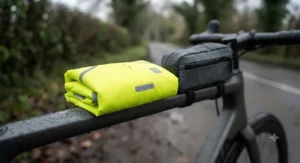
A genuinely capable cycling jacket under £80 needs to hit three things: a waterproof rating that actually copes with UK rain (not just “shower resistant”), taped seams, and enough breathability to avoid the sweaty-plastic-bag effect. On this list, the Altura Nightvision Nevis Men’s Waterproof Cycling Jacket, typically priced around £75, is the clearest example — its 10k/10k rating matches or beats jackets costing considerably more, and independent comparisons have specifically flagged it as better value than pricier commuter jackets offering weaker weatherproofing at a similar price.
If your budget sits closer to £30 rather than £80, the BTR Reflective & Hi-Vis Cycling Jacket is the honest alternative: it won’t match the Nevis on sustained heavy-rain performance, but it delivers genuine combined hi-vis-and-reflective visibility at a fraction of the cost, which makes it a sound starting point rather than a compromise for anyone unsure how much cycling gear they’ll actually use.
Waterproof Cycling Gilet: Best Waterproof Cycling Gilet Picks
A waterproof cycling gilet earns its place in a wardrobe precisely because it solves a problem full jackets don’t: regulating temperature on rides where your core needs protection but your arms would overheat inside sleeves. Among the options here, the Altura Nightvision Storm Thermal Gilet stands out as arguably the best waterproof cycling gilet for genuinely cold, damp mornings, thanks to its matched 10k/10k waterproof-and-breathable rating and thermal grid lining across the chest.
For milder days, or as a packable backup rather than a primary garment, the Altura Nightvision Unisex Cycling Vest offers a lighter, more affordable route into the same concept, trading full waterproofing for pure packability and a lower price point. Between the two, the deciding factor is simple: choose the thermal gilet if cold is your main enemy, and the lighter vest if visibility and portability matter more than weatherproofing.
Reflective Overshirt Cycling: The Lightweight Layering Option
A reflective overshirt cycling layer is designed to go over whatever you’re already wearing rather than replace your main jacket — think of it as a quick-access visibility boost for the last mile of a commute when the light starts to fail. The Altura Nightvision Unisex Cycling Vest effectively fills this role: it’s light enough to carry permanently, quick to pull on over a jumper or jacket, and its packability means it’s genuinely more likely to be used than left in a drawer.
The trade-off, as with any overshirt-style layer, is that it isn’t built for sustained rain exposure — it’s a visibility supplement, not a weatherproofing solution. For riders who already own a solid waterproof jacket like the Altura Nightvision Nevis Men’s Waterproof Cycling Jacket but want an extra reflective boost for darker months without buying an entirely new coat, a lightweight reflective overshirt is the more sensible add-on than upgrading the whole jacket.
EN ISO 20471 Cycling Jacket: Safety, Regulations & Compliance Guide
EN ISO 20471 is the European standard for high-visibility clothing, originally built for workwear but increasingly referenced in cycling gear marketing because it’s one of the few objective, third-party-verifiable measures of visibility performance. The standard defines three classes based on the minimum area of fluorescent background material and retroreflective tape a garment must carry, with higher classes required for higher-speed, higher-risk environments — full details are set out in the official EN ISO 20471 documentation.
It’s worth being clear-eyed here: there’s no UK legal requirement for cyclists to wear hi-vis or reflective clothing at any time, day or night, though front and rear lights are a legal requirement after dark. The government’s own cycling guidance in the Highway Code recommends light-coloured or reflective clothing to help other road users see you, particularly in poor light, without mandating it. That distinction matters for buyers: a jacket described loosely as “hi-vis” isn’t necessarily tested to any standard at all, whereas an EN ISO 20471 cycling jacket, like the Proviz Reflect360+ and Proviz Apex Men’s 100% Reflective Cycling Jacket on this list, has been independently assessed against defined fluorescent-area and reflective-tape requirements.
For riders regularly cycling on unlit rural roads or dual carriageways, prioritising genuine certification over marketing language is the more defensible safety decision, even at a higher purchase price.
Common Mistakes When Buying a Hi-Vis Cycling Rain Jacket
A frequent mistake is assuming any brightly coloured jacket automatically delivers strong nighttime visibility — fluorescent colour only works using available daylight, and fades to a dull grey once the sun goes down, which is exactly why reflective material (not just colour) does the heavy lifting after dusk. Riders who buy on colour alone often end up disappointed by their jacket’s after-dark performance and wrongly conclude “hi-vis doesn’t work,” when really they bought a daytime-only garment.
Another common error is prioritising price over waterproof rating for anyone doing regular commutes rather than occasional fair-weather rides — a £25 jacket without taped seams will leak in sustained rain no matter how bright it looks. Buyers also frequently overlook sizing guidance specific to cycling jackets, which are often cut for a forward-leaning position; ordering true-to-normal-clothing-size can leave the jacket riding up at the back exactly where reflective panels matter most. Finally, many people skip checking breathability figures entirely, ending up with a jacket that’s technically waterproof but leaves them as damp from sweat as they would have been from rain.
Hi-Vis vs Reflective: What They Actually Do Differently
Hi-vis and reflective aren’t interchangeable terms, even though cycling retailers frequently use them together or, worse, as synonyms. Hi-vis refers to fluorescent colour — typically yellow, orange, or red — that stands out strongly against natural backgrounds in daylight by converting UV light into visible light. Reflective material works on a completely different principle: it bounces a direct light source, such as a car’s headlights, straight back toward its origin, which is what makes a cyclist suddenly “light up” in a driver’s field of vision at night.
The practical implication is that a jacket like the BTR Reflective & Hi-Vis Cycling Jacket, which deliberately combines both technologies in a 50/50 panel design, covers a wider range of lighting conditions than a jacket using only one approach. On paper, this means riders whose commute spans both daylight and darkness — the overwhelming majority of UK commuters through autumn and winter — get more consistent visibility from a combination jacket than from a single-technology garment, even if that combination jacket doesn’t top the leaderboard on pure waterproofing.
What to Expect: Real-World Performance in UK Weather
Specs on a label only tell part of the story. In everyday UK conditions — persistent drizzle rather than tropical downpours — a jacket rated 10,000mm, like the Altura Nightvision Nevis or Altura Nightvision Storm Waterproof Jacket, comfortably handles an hour-long commute without wetting through, provided the DWR coating hasn’t degraded. What the spec sheet won’t tell you, but reviewers note, is that breathability differences become far more obvious on faster-paced rides than on gentle commutes; a jacket that feels perfectly comfortable at a leisurely 12mph can feel clammy at a spirited 18-20mph.
Reflective performance also behaves differently in practice than marketing photography suggests. Full-coverage reflective jackets like the Proviz Reflect360+ genuinely do “light up” in vehicle headlights from a considerable distance, but on overcast winter days without direct headlight exposure, subtler reflective detailing — like the cuff strips on the Altura Nightvision Nevis — can appear almost invisible until dusk properly sets in. That’s a useful reason to combine any reflective jacket with proper front and rear lights rather than relying on reflectivity alone.
Long-Term Cost & Maintenance: Getting Years Out of Your Jacket
A £150 jacket that lasts five winters works out cheaper per season than a £30 jacket replaced every year — but only if it’s actually looked after. Reproofing spray or wash-in treatments, typically £8-£12 a bottle, restore beading performance roughly once or twice a season and are far more cost-effective than premature replacement. Taped seams are the other long-term cost factor: cheaper jackets sometimes use partially taped or untaped construction, which tends to fail years before the main fabric does, effectively capping the garment’s useful lifespan regardless of purchase price.
Total cost of ownership also depends on how a jacket is used day-to-day. A packable gilet like the Altura Nightvision Unisex Cycling Vest, kept permanently in a bag rather than at home, delivers ongoing value simply through being available when needed — a £150 jacket left on a hook because it’s “too nice for a quick errand” delivers considerably less real-world value per pound spent than its price tag suggests.
Features That Actually Matter (And Those That Don’t)
Taped seams, a genuine hydrostatic head rating, and independently verified reflective certification are the features worth prioritising and paying more for — they directly affect whether you stay dry and whether drivers actually see you. Adjustable waist hems and cuffs matter more than they sound; they stop draughts and rain ingress at exactly the points a jacket is most likely to leak.
Features that matter considerably less than marketing suggests include elaborate multi-pocket configurations beyond two or three useful, accessible pockets, and branding claims like “military-grade” or “extreme weather” fabric without an accompanying hydrostatic head figure. A jacket that lists a specific number — 10,000mm, EN ISO 20471 Class 2, and so on — is giving you something testable; a jacket that only offers adjectives is asking you to take its performance on faith.
FAQ
❓ What is the best hi-vis cycling rain jacket for commuting?
❓ Is hi-vis cycling clothing a legal requirement in the UK?
❓ What does EN ISO 20471 mean on a cycling jacket?
❓ Is a waterproof cycling gilet warm enough for winter?
❓ How much should I spend on a hi-vis cycling rain jacket?
Conclusion
Choosing between these seven options really comes down to which single factor matters most on your actual commute: certified, full-coverage visibility from the Proviz Reflect360+ and Proviz Apex Men’s 100% Reflective Cycling Jacket; dependable, sub-£80 all-round waterproofing from the Altura Nightvision Nevis Men’s Waterproof Cycling Jacket and Altura Nightvision Storm Waterproof Jacket; cold-morning comfort from the Altura Nightvision Storm Thermal Gilet; or a genuinely low-cost way into hi-vis riding gear via the BTR Reflective & Hi-Vis Cycling Jacket and Altura Nightvision Unisex Cycling Vest.
None of these are the “wrong” choice — they’re built for different priorities, and the honest answer for most riders is to match the jacket to the specific roads, distances, and seasons of their actual commute rather than chasing the single “best” option on a spec sheet. For further independent reading on choosing waterproof cycling kit, road.cc’s buyer’s guide to hi-vis cycling jackets is a useful additional resource, as is Cycling UK’s clothing and kit reviews for ongoing, independently tested opinions on new releases.
Whichever you choose, pairing it with proper front and rear lights remains the single biggest visibility upgrade available to any cyclist, hi-vis jacket or not.
✨ Don’t Miss These Exclusive Deals!
🔍 Take your commute to the next level with these carefully selected jackets and gilets. Click on any highlighted item to check current pricing and availability. These picks will help you stay dry, stay visible, and actually enjoy riding through a British winter!
Recommended for You
- Best Cycling Rain Jacket 2026: 7 Tested Picks That Actually Work
- Womens Packable Rain Jacket: 7 Tested Picks for 2026
- Mens Packable Rain Jacket: 7 Best Picks Tested for 2026
Disclaimer: This article contains affiliate links. As an Amazon Associate, I earn from qualifying purchases. If you purchase products through these links, we may earn a small commission at no additional cost to you.
✨ Found this helpful? Share it with your friends! 💬🤗
