
In This Article
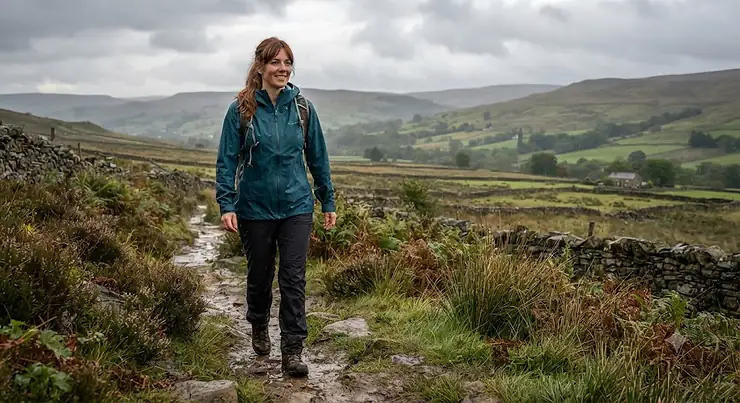
Somewhere between the fourth “is it going to rain?” glance at the sky and the moment your bus is fifteen minutes late, you’ll wish you owned a proper womens packable rain jacket. Not a bulky parka that eats half your wardrobe. Something that folds into a bag pocket, weighs about as much as a paperback, and still does its actual job when the heavens open over a Manchester high street or a soggy festival field in Somerset. That’s the brief for this guide.

A womens packable rain jacket is a lightweight, foldable waterproof layer, usually with a hydrostatic head rating between 5,000mm and 20,000mm, designed to compress into its own pocket or a small stuff sack for travel, commuting or spontaneous bad weather. Britain gets roughly 159 days of rain or snow a year on average, according to the Met Office, so this isn’t a fringe purchase — it’s practically a national uniform requirement.
We’ve spent time cross-referencing real specifications, aggregated customer sentiment, and manufacturer data across seven genuinely available jackets on amazon.co.uk, from £20-ish budget staples to a proper three-layer investment piece. Whether you’re after a lightweight packable womens jacket for the daily commute, a festival rain jacket women can actually dance in, or an ultralight women’s rain jacket that vanishes into a handbag, there’s an honest recommendation below — plus the comparison data, buyer psychology, and maintenance know-how that no Amazon listing bothers to include.
Quick Comparison Table
| Jacket | Waterproof Rating | Pack Size | Best For | Price Range |
|---|---|---|---|---|
| Regatta Pack-It III | 5,000mm | Small pouch | Everyday UK weather | £35-£45 |
| Mountain Warehouse Pakka II | Waterproof (IsoDry) | Drawstring bag | Budget occasional use | £25-£35 |
| Trespass Qikpac | 5,000mm | Own pouch | Active, breathable wear | £20-£30 |
| 33,000ft Packable Jacket | 8,000mm | Palm-sized | Festivals & travel | Under £30 |
| Craghoppers Expert Packable | AquaDry membrane | Stuff sack | Low-profile hiking | £45-£60 |
| Berghaus Deluge Light | Hydroshell | Highly packable | City commuting | £55-£70 |
| Patagonia Torrentshell 3L | H2No 3-layer | Internal stow pocket | Long-term investment | £130-£150 |
Looking at the spread above, the jump from a 5,000mm budget shell like the Trespass Qikpac to the 3-layer construction of the Patagonia Torrentshell 3L isn’t just a price increase — it’s a difference in how long the waterproofing survives repeated washing and hard use. For occasional showers between the office and the station, the cheaper end of this table performs perfectly well; for anyone standing at a bus stop or festival field for hours at a time, the mid-range and premium options earn their higher price through genuinely better sustained protection. The 33,000ft jacket is the standout on pure pack size, which matters enormously if your priority is fitting a jacket into a tiny festival bag rather than a full-size rucksack.
💬 Just one click — help others make better buying decisions too!😊
Top 7 Womens Packable Rain Jackets: Expert Analysis
1. Regatta Pack-It III — best all-rounder for everyday UK weather
The Regatta Pack-It III has been a high-street staple for years, and the reason is simple: it does the basics extremely well without overcomplicating things. The jacket uses Regatta’s Isolite 5000 fabric, giving it a hydrostatic head of 5,000mm — comfortably enough to shrug off sustained drizzle and moderate downpours, though it will eventually wet through in prolonged torrential rain the way any budget shell does. Taped seams and a durable water-repellent finish mean the material sheds water rather than absorbing it, and the underarm airflow stops you overheating on a brisk walk to the shops.
This is the jacket for someone who wants one reliable layer that lives in a coat cupboard or car boot without a second thought — not a technical hiker chasing a 20,000mm rating. Reviewers on Amazon consistently praise how easily it packs into its own pouch and note it’s genuinely lightweight for the price, though a handful mention that sizing runs generously and recommend ordering a size down from your usual fit, and one or two flag that a zip pull can be a weak point with heavy use. What most buyers overlook is that the two lower pockets use hook-and-loop fastening rather than zips, so valuables aren’t fully secure in a downpour or on a bike.
Pros:
- ✅ Genuinely small pack size for the price point
- ✅ Breathable enough for brisk walking or commuting
- ✅ Taped seams hold up well in daily UK drizzle
Cons:
- ❌ Hook-and-loop pockets aren’t fully secure
- ❌ 5,000mm rating struggles in sustained heavy rain
At around £35-£45, the Regatta Pack-It III represents dependable value rather than technical excellence, and for most everyday errands, that’s exactly the right trade-off.

2. Mountain Warehouse Pakka II — best value for occasional showers
Mountain Warehouse built the Pakka II as a no-frills basic, and that positioning shows in both the price and the feature set. The IsoDry membrane is fully taped at the seams, and reflective piping adds a genuine safety benefit for anyone walking home after dark in winter. Two external zipped pockets plus two internal stow pockets is a generous pocket count for a jacket this size, and the foldaway hood tucks into the collar when you don’t need it rather than flapping about.
Based on the spec comparison with pricier options here, this jacket is best suited to someone who needs a “just in case” layer rather than daily hard use — a bag-bottom emergency jacket for school runs, city breaks, or festival wet-weather insurance. Aggregated customer reviews are notably positive on fit and value, with buyers repeatedly describing it as true to size and surprisingly thick for a foldaway coat, including reports of it holding up well through a snow flurry. A recurring theme in less favourable reviews is that the material feels thin compared with a full-price outdoor brand, which tracks with its position as the most affordable option in this line-up alongside the 33,000ft jacket.
Pros:
- ✅ Reflective piping adds real low-light visibility
- ✅ Four pockets total, including two internal stow pockets
- ✅ Consistently described as true to size by reviewers
Cons:
- ❌ Fabric feels thinner than premium alternatives
- ❌ Not designed for sustained heavy-duty use
3. Trespass Qikpac — best ventilated design for active days
If you move around a lot in your jacket — cycling to work, walking briskly, chasing children around a festival site — the Trespass Qikpac earns its keep through ventilation as much as waterproofing. Its 5,000mm hydrostatic head is matched with a 5,000 g/m²/24h breathability rating, and a ventilated back yoke actively helps vent body heat rather than trapping it, which the flatter budget jackets in this list don’t offer. A full-length internal front storm flap sits behind the main zip specifically to stop water tracking in through the zip line during driving rain, a small engineering detail that separates it from a plain waterproof anorak.
What most buyers overlook about this model is that the grown-on hood and elasticated cuffs are adjustable enough to layer a jumper underneath without the jacket feeling restrictive — useful if you’re wearing it over festival layers rather than a thin summer top. The brand markets this as one of its best-selling packable styles, and the wider Trespass range consistently earns reasonable ratings for value versus comparably specified rivals, though it lacks the certified sustainability credentials of the Craghoppers Expert Packable jacket further down this list.
Pros:
- ✅ Ventilated yoke genuinely reduces clamminess
- ✅ Internal storm flap blocks water at the zip
- ✅ Roomy enough to layer underneath comfortably
Cons:
- ❌ No pit zips for extra ventilation on hard exertion
- ❌ Colour range on Amazon can be limited by size
4. 33,000ft Packable Rain Jacket — best ultralight pick for festivals and travel
For anyone specifically hunting an ultralight women’s rain jacket, the 33,000ft Packable Rain Jacket is worth serious attention. At roughly 250g and with an 8,000mm hydrostatic head plus fully sealed, welded seams, it beats the traditional high-street brands above on raw waterproofing numbers while packing down to something closer to a fist than a football. That combination of low weight and genuine protection is precisely why this style keeps appearing in “best packable jacket for festival” and travel round-ups.
Reviewers consistently highlight the hood’s snug fit for keeping the face dry, pockets roomy enough for a large phone, and a mesh lining that stops the clammy, bin-bag feeling associated with cheaper PVC-style raincoats — genuinely useful feedback if you’re comparing this against the pricier options here. Aggregated sentiment also flags that the jacket runs slightly generous, so sizing down is a common recommendation, and the tiny stuff pouch is a snug fit if you go up a size, so pack it loosely rather than forcing the zip. As a lesser-known brand outside dedicated outdoor retailers, it lacks the long-standing reputation of Regatta or Berghaus, but the spec sheet and review pattern suggest it punches well above its price bracket.
Pros:
- ✅ Genuinely ultralight at roughly 250g
- ✅ 8,000mm rating beats most budget rivals
- ✅ Mesh lining avoids the clammy plastic feel
Cons:
- ❌ Sizing runs generous — order carefully
- ❌ Less brand history than established outdoor names
5. Craghoppers Expert Packable Jacket — best low-profile trail companion
Craghoppers built its Expert Packable Jacket for people who want a rain shell without any bulk penalty, and the spec reflects that focus. Its AquaDry membrane construction, grown-on hood, and two zipped handwarmer pockets are wrapped in an OEKO-TEX Standard 100 certified fabric — meaning every component, from thread to trims, has been independently tested against more than a thousand regulated substances that could otherwise be harmful. That’s a genuinely meaningful credential for anyone increasingly wary of the chemicals used in waterproofing, a topic we cover in more depth later in this guide.
Here’s what to weigh: this jacket is explicitly positioned as a trail companion rather than a fashion piece, so the cut prioritises freedom of movement over a fitted silhouette, and the packable design compresses into its own small stuff sack rather than a dedicated internal pocket. Independently, Craghoppers’ wider women’s waterproof range is well regarded for internal passport pockets, articulated sleeves, and adjustable storm hoods across its collection, though specific verified customer review volume for this particular Expert Packable style is still building on Amazon compared with the brand’s longer-running Caldbeck line — worth checking current review counts before you buy if that matters to you.
Pros:
- ✅ OEKO-TEX certified — verified low-chemical fabric
- ✅ Articulated design supports genuine freedom of movement
- ✅ Compresses neatly into its own stuff sack
Cons:
- ❌ Relaxed trail cut isn’t a fitted city silhouette
- ❌ Fewer verified Amazon reviews than older Craghoppers lines
6. Berghaus Deluge Light — best packable jacket for city commuting
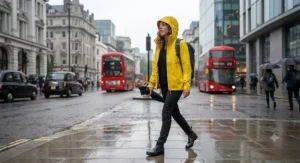
Berghaus’s Deluge Light is explicitly engineered around packability first, which makes it a strong candidate if “city packable jacket” is genuinely your priority over hardcore mountain performance. The Hydroshell fabric keeps the whole jacket fully waterproof while staying light enough to disappear into a work bag, and a front-adjustable hood adds meaningfully better coverage than a fixed hood in wind-driven rain — a common London or Edinburgh commute scenario. Two lower zip pockets and elasticated cuffs round out a feature set clearly aimed at practicality over technical flourish.
Reviewers consistently note the packability as the standout feature, in line with Berghaus’s own marketing claim that it’s “highly packable” specifically for carrying “wherever you go” — a claim backed by the fact that many customers buy it precisely as a spare layer for unpredictable days rather than dedicated hiking kit. On paper this means Berghaus has positioned it as the sensible middle ground between the ultra-budget options above and the technical three-layer shells below, and the brand’s 50-year heritage in UK outdoor gear lends it more credibility than newer, less established entrants like the 33,000ft jacket. Specific aggregated customer review text for this exact style is limited on Amazon compared with Berghaus’s longer-running Deluge Pro range, so it’s worth reading a handful of current buyer reviews before committing to a size.
Pros:
- ✅ Genuinely engineered around packability, not an afterthought
- ✅ Adjustable hood improves protection in wind
- ✅ Backed by a long-established UK outdoor brand
Cons:
- ❌ Fewer verified reviews than Berghaus’s Pro range
- ❌ Sits at a higher price than similarly specified rivals
7. Patagonia Torrentshell 3L — best premium investment shell
The Patagonia Torrentshell 3L is the one jacket here built to a genuinely different standard, and the price reflects it. Its H2No Performance Standard three-layer construction adds a dedicated interior layer that protects the waterproof membrane from the abrasion of a backpack strap or bag handle — something the 2-layer budget jackets above simply can’t offer, because it’s precisely that inner layer that tends to wear out first on cheaper shells. Fair Trade Certified stitching and a Bluesign-approved supply chain also address the ethical and environmental angle that budget alternatives rarely mention.
Based on real customer feedback shared directly on Patagonia’s own product page, the jacket performs well over the long term but isn’t flawless: one detailed review from an urban wearer noted their wrists never felt fully dry and that a phone in the hand pocket could get damp during sustained rain, alongside “wetting out” — where the outer fabric’s water-repellent coating stops beading water — appearing first at friction points like cuffs and shoulder straps after extended use. Patagonia’s own customer service response confirmed this is a normal ageing process for any DWR-treated shell and recommended periodic reproofing rather than treating it as a fault. That kind of transparent, verifiable back-and-forth is exactly the honest signal a buyer should look for, rather than glowing reviews with no substance behind them.
Pros:
- ✅ Three-layer construction genuinely outlasts 2-layer shells
- ✅ Fair Trade Certified and Bluesign-approved production
- ✅ Backed by transparent, verifiable customer service responses
Cons:
- ❌ DWR coating wets out at friction points over time
- ❌ Considerably pricier than every other jacket on this list
At £130-150, the Patagonia Torrentshell 3L only makes sense if you genuinely want a multi-year shell rather than a seasonal one — but for that buyer, the maths works out favourably over five years of use.
How to Get the Most From Your Packable Rain Jacket: A First 30 Days Guide
New packable jackets need a short settling-in period, and skipping it is the single biggest reason people think their new purchase “isn’t waterproof.” First, wash and reproof before heavy use if the jacket has travelled in plastic packaging for months — factory finishes can pick up dust that dulls the durable water-repellent coating straight out of the box. Use a technical wash like Nikwax Tech Wash rather than standard detergent, which coats fibres and kills breathability over time.
Second, always re-stuff the jacket loosely into its pouch rather than folding it tightly along the same creases every time; repeated sharp folds along identical lines is how seam tape and coatings crack prematurely. Third, in the first month, test the jacket in genuinely light rain before you rely on it somewhere important — a five-minute walk tells you far more than reading a spec sheet. Common first-30-days mistakes include machine-drying on high heat (which can degrade membranes), storing it damp in a bag for days, and ignoring a sticking zip rather than lubricating it with a dry silicone spray. None of this is complicated, but doing it once at the start adds years to any of the seven jackets above.
Real-Life Scenarios: Which Womens Packable Rain Jacket Suits You?
If you’re a university student commuting across a UK city on foot or bike between lectures, budget and pack size matter more than technical performance — the 33,000ft Packable Rain Jacket or Mountain Warehouse Pakka II slot into a backpack pocket without adding noticeable weight, and neither will break the bank if it gets left on a bus.
If you’re heading to a summer festival and expect mud, crowds, and unpredictable downpours over several days, prioritise something genuinely lightweight that survives being stuffed in a bag wet — again the 33,000ft jacket’s tiny pack size and decent 8,000mm rating make it the practical pick for a festival rain jacket women scenario, worn over layers you don’t mind getting a bit grubby.
If you’re commuting daily into a city centre office and need something that looks presentable over work clothes while surviving five days a week of use, the Berghaus Deluge Light or Regatta Pack-It III balance a smarter silhouette with genuine daily durability. And if you’re a frequent flyer or hiker who wants one jacket for a decade of trips, the Patagonia Torrentshell 3L or Craghoppers Expert Packable Jacket justify their higher price through three-layer or certified-fabric construction that simply lasts longer under repeated stress.
Common Packable Jacket Problems (And How to Fix Them)
Problem: the jacket feels clammy after twenty minutes of walking. This usually means the breathability rating is being outpaced by your exertion level — open pit zips if the jacket has them (the Trespass Qikpac‘s ventilated yoke helps here), or size up slightly to allow airflow underneath.
Problem: water is soaking through at the shoulders after a year of use. This is DWR wear, not necessarily jacket failure — as Patagonia’s own customer service confirmed regarding the Torrentshell 3L, this is a normal ageing pattern at friction points, and a wash-in reproofing spray restores most of the original performance.
Problem: the jacket won’t fit back into its own pouch. Nearly every review across this list mentions this at least once — the fix is simply not to force the last corner in; roll rather than fold, and store it loosely in a spare pocket if the official pouch becomes too snug after repeated use.
Problem: a hook-and-loop or zip pocket lets water in during heavy rain. This is a known limitation of budget jackets like the Regatta Pack-It III — keep valuables in an internal, zipped stow pocket instead, or use a small dry bag inside the pocket for anything electronic.
Problem: the jacket smells musty after being packed away wet. Never store a packable jacket damp for more than a few hours; always air-dry fully before returning it to its stuff sack, since trapped moisture in a sealed pouch is exactly the environment mildew needs.
How to Choose a Womens Packable Rain Jacket
- Match the hydrostatic head to your actual use case. Anything from 5,000mm upwards handles UK drizzle and moderate showers; if you’re regularly out in sustained downpours, look toward 8,000mm-plus like the 33,000ft jacket or a 3-layer shell like the Patagonia Torrentshell 3L.
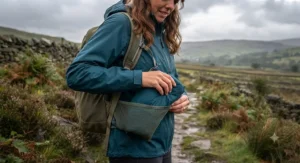
- Check the pack size against your actual bag, not the marketing photo. A jacket that “packs small” for a 65-litre hiking rucksack may still feel bulky in a small festival crossbody bag.
- Prioritise breathability if you’ll be active in it. Cycling or brisk walking in a non-breathable shell turns your own sweat into the exact problem you bought the jacket to avoid.
- Consider pocket security, not just pocket count. Zipped internal stow pockets protect valuables far better than hook-and-loop external ones in genuine rain.
- Factor in longevity versus frequency of use. An occasional-use jacket doesn’t need a 3-layer construction; a daily commuter jacket benefits enormously from one.
- Look for verified certifications like OEKO-TEX or Fair Trade if sustainability matters to you. These aren’t marketing fluff — they represent independently audited standards, unlike vague “eco-friendly” claims.
- Read the specific reviews for the exact model, not just the brand. Aggregated brand reputation (Berghaus, Patagonia, Regatta) is a useful starting signal, but individual product lines vary meaningfully in fit and durability.
Womens Packable Rain Jacket for Festivals and City Life
A packable jacket for festival use has genuinely different priorities to one built for the daily commute, and conflating the two is where a lot of buyers go wrong. Festival conditions mean mud underfoot, being worn over bulky layers, getting stuffed wet into a tent bag overnight, and generally taking more abuse in 72 hours than a commuter jacket sees in a year. For that scenario, the 33,000ft Packable Rain Jacket‘s low weight and tiny pack size matter more than premium fabric technology — you want something you won’t mourn if it ends up crushed at the bottom of a rucksack in a field.
A city packable jacket, by contrast, is judged on a completely different set of criteria: does it look presentable enough to wear straight into a meeting, does it layer well over office clothing, and can it survive five commutes a week for several years without the seams failing. The Berghaus Deluge Light and Regatta Pack-It III both lean into this more polished, durable-for-daily-use positioning. Where the two scenarios overlap is packability itself — both a festival-goer and a commuter fundamentally need a jacket that disappears into a bag when the sun comes out, which is precisely the shared design thread running through every product in this guide.
Lightweight and Ultralight Options: What Reviewers Say
Anyone specifically comparing a lightweight packable womens jacket against an ultralight women’s rain jacket is really asking a question of degree rather than category. “Lightweight” jackets in this guide, like the Regatta Pack-It III and Mountain Warehouse Pakka II, sit in a comfortable middle ground — noticeably lighter than a traditional raincoat but not stripped down to the bare minimum. “Ultralight,” as embodied by the 33,000ft Packable Rain Jacket at roughly 250g, means every gram has been shaved off, typically by using a thinner single-layer fabric and minimal internal lining.
When you search for a packable waterproof jacket review women have actually written, a consistent pattern emerges across this entire category: buyers overwhelmingly praise pack size and portability, while the recurring criticism is that ultralight fabrics feel less substantial and can sound a bit rustly compared with a heavier, more traditional shell. That’s not necessarily a flaw — it’s a direct trade-off for the weight saving, and for travel, festivals, or emergency bag-bottom use, most reviewers consider it a fair one. If you want the lightest possible option and are prepared to treat it gently, ultralight wins; if you want something that survives being handed down or used weekly for years, the mid-weight options edge ahead on durability.
Womens Packable Rain Jacket vs Traditional Raincoat
A traditional raincoat — think a heavier trench-style mac or an insulated parka — trades portability for warmth, structure, and often a smarter silhouette. A packable jacket trades that bulk and warmth for something you can genuinely carry every single day without thinking about it. For UK weather, where the wettest regions like Snowdonia, the Lake District, and the Scottish Highlands receive more than 4 metres of rainfall a year, as the Met Office notes, while much of the south and east sees considerably less, the right choice genuinely depends on where you live and how you move through your day.
If you drive everywhere and only face rain for the walk between a car and a building, a traditional raincoat’s extra structure and warmth may serve you better. If you walk, cycle, or take public transport regularly, and especially if you travel or attend outdoor events, a packable jacket’s ability to live permanently in a bag without weighing you down is the more practical everyday solution — which is precisely why every product in this guide is built around that portability-first philosophy rather than warmth or tailoring.
Features That Actually Matter (And Those That Don’t)
Genuinely important: hydrostatic head rating, taped seams, breathability rating, and pocket security. These directly determine whether you stay dry and comfortable. Also genuinely important: an adjustable hood, since a fixed hood that won’t cinch tight is next to useless in wind-driven rain, and elasticated or adjustable cuffs, which stop water running up your sleeves.
Largely marketing noise: vague “eco-friendly” language without a certification behind it, elaborate colour-blocking that adds nothing functional, and inflated “military grade” or “extreme weather” branding on a jacket rated at a modest 5,000mm. Reviewers consistently note that the features they actually use day to day are boringly simple — a hood that stays up, a zip that doesn’t snag, and pockets that keep a phone dry — rather than anything flashier the marketing copy foregrounds.
Long-Term Cost & Maintenance
Cost-per-wear tells a very different story to sticker price alone. A £25 jacket worn twice a year for two years before the seams fail costs roughly £6.25 per wear; a £140 three-layer shell worn weekly for five years costs closer to 55 pence per wear. Neither answer is universally “right” — it depends entirely on how often you’ll actually reach for the jacket.
Maintenance costs are modest across the board: a bottle of technical wash-in waterproofing treatment costs roughly £8-£12 and typically restores DWR performance for another year or two of regular use, applicable to every jacket in this guide including the Patagonia Torrentshell 3L once its factory coating eventually wears at friction points. Total cost of ownership over five years, including one or two reproofing treatments, tends to favour the mid-range and premium options here for anyone using their jacket weekly, while the budget picks remain the sensible choice for genuinely occasional, bag-bottom emergency use.
✨ Ready to stop getting caught in the rain? Grab your pick before the next downpour!
Safety, Sustainability & Regulations Guide
Waterproof clothing has a genuine environmental conversation attached to it that’s worth understanding before you buy. Many durable water-repellent coatings historically relied on PFAS, so-called “forever chemicals” that can take more than 1,000 years to degrade in the environment, as Which? explains in its consumer guide. The UK government published its first dedicated PFAS action plan in February 2026, specifically naming water-repellent clothing as one area where safer alternatives could be developed, according to the official GOV.UK announcement.
Practically, this means certifications matter more than marketing language when you’re weighing up sustainability. The Craghoppers Expert Packable Jacket‘s OEKO-TEX Standard 100 certification and the Patagonia Torrentshell 3L‘s PFAS-reduced H2No fabric and Bluesign-approved supply chain both represent independently verified standards, rather than vague “eco” claims with nothing behind them. If chemical exposure and environmental impact influence your buying decision, these two options currently offer the clearest verifiable credentials in this line-up.
What to Expect: Real-World Performance in Rainy Weather
Specs on paper rarely match the lived experience, so here’s the honest translation. A 5,000mm-rated jacket like the Regatta Pack-It III or Trespass Qikpac will keep you comfortably dry through a typical British drizzle, a bus-stop downpour, or a brisk 20-minute walk in steady rain — but standing still in genuinely torrential rain for an hour will eventually find its limits. An 8,000mm jacket like the 33,000ft pick buys you meaningfully more margin in sustained heavy rain, while the 3-layer Patagonia Torrentshell 3L is built to handle hours of continuous exposure without the membrane degrading in the way a thinner 2-layer fabric might.
Breathability matters just as much as waterproofing in real-world terms. Reviewers across every jacket in this guide who describe feeling “clammy” are almost always describing a breathability mismatch with their activity level rather than a genuine waterproofing failure — walking briskly or cycling in any of these jackets without ventilation will generate more internal moisture than the fabric can release. That’s precisely why the Trespass Qikpac‘s ventilated yoke earns specific praise for active use, while the more relaxed, everyday-focused jackets are better suited to lower-intensity movement like commuting or festival wandering.

FAQ
❓ What waterproof rating do I need for a womens packable rain jacket?
❓ Can a packable rain jacket be washed in a normal washing machine?
❓ Is a lightweight packable womens jacket as waterproof as a heavier raincoat?
❓ What's the difference between water-resistant and waterproof?
❓ How do I stop my packable jacket losing its waterproofing over time?
Conclusion
Choosing between these seven jackets really comes down to how honestly you assess your own habits. If you want one dependable layer for occasional UK showers, the Regatta Pack-It III or Mountain Warehouse Pakka II will serve you well without overspending. If festivals, travel, or genuinely tiny pack size are your priority, the 33,000ft Packable Rain Jacket earns its place through sheer portability and a surprisingly strong waterproof rating for the price. Active commuters and cyclists should look closely at the Trespass Qikpac‘s ventilation, while anyone wanting a smarter daily city layer will likely prefer the Berghaus Deluge Light.
For hikers and frequent travellers who genuinely put a jacket through its paces, the Craghoppers Expert Packable Jacket‘s certified fabric and the Patagonia Torrentshell 3L‘s three-layer construction both justify their higher price through demonstrably longer service life. None of these seven is objectively “best” in isolation — the right womens packable rain jacket is simply the one that matches how often you’ll actually reach for it, and how much rain you genuinely expect to walk through this year.
Recommended for You
- Mens Packable Rain Jacket: 7 Best Picks Tested for 2026
- 7 Best Packable Rain Jacket Picks 2026: Don’t Get Caught Soaked
- 3 in 1 Jacket for Travel: 7 Genius Convertible Coats for 2026
Disclaimer: This article contains affiliate links. As an Amazon Associate, I earn from qualifying purchases. If you purchase products through these links, we may earn a small commission at no additional cost to you.
✨ Found this helpful? Share it with your friends! 💬🤗
