
In This Article
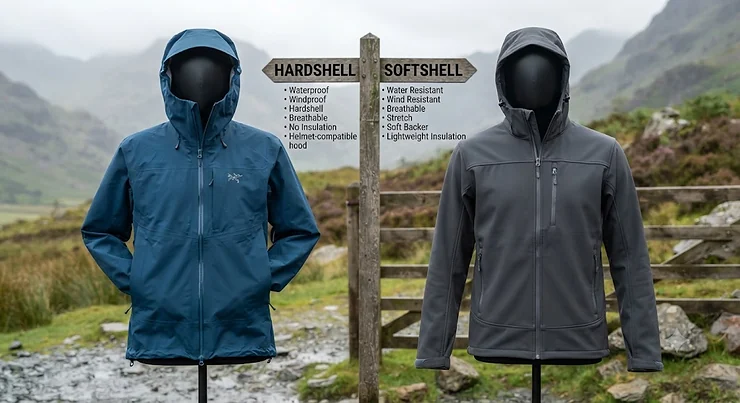
Stand at the bottom of any British hill car park on a drizzly Saturday and you’ll see the whole hardshell vs softshell jacket debate playing out in real time: half the group zipped into stiff, crinkly shells that sound like a crisp packet with every stride, the other half moving quietly in stretchy, close-fitting softshells that look suspiciously comfortable. Neither group is wrong, exactly — they’re just solving different problems. A hardshell jacket is a waterproof, windproof outer layer built from a membrane laminated to a tough face fabric, designed to keep 100% of the weather out. A softshell trades some of that outright waterproofing for stretch, breathability and quiet comfort, making it better suited to high-output movement in changeable conditions. Both have a place in a UK hillwalker’s kit bag, and which one earns space in yours depends on where you’re headed, how hard you’re working, and how much punishment the weather is likely to dish out.
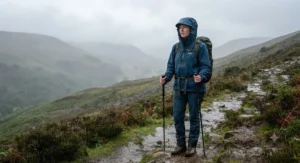
This guide breaks down seven genuinely available jackets, from a £20 packable rain shell to a £600-plus mountaineering workhorse, and explains — with real specs and aggregated review sentiment rather than marketing fluff — what each one actually does well. Whether you’re chasing a waterproof hardshell jacket under £150, hunting for the best hardshell jacket for mountains, or trying to work out what eVent fabric even means, you’ll find a straight answer here. We’ll also unpack hardshell jacket waterproof rating numbers, explain 2.5 layer construction versus 3-layer builds, and point you towards the right alpine climbing jacket if that’s your goal. No invented reviews, no inflated claims — just honest analysis grounded in the specs and the reviewers who’ve actually worn this stuff up British hills.
Quick Comparison Table
| Jacket | Type | Membrane | Best For | Price Range |
|---|---|---|---|---|
| Regatta Pack-It III | Hardshell (packable) | Isolite polyamide | Budget rain cover, travel | Under £30 |
| Berghaus Paclite 2.0 | Hardshell | GORE-TEX Paclite | Everyday hillwalking on a budget | Around £150-£180 |
| Rab Kinetic 2.0 | Softshell hybrid | Proflex (hydrophilic) | High-output hiking, trail running | £180-£210 range |
| Rab Kinetic Alpine 2.0 | Softshell/hardshell hybrid | Proflex (stretch-knit) | Climbing, ski touring, all-day wear | £220-£250 range |
| Rab Latok Alpine | Hardshell | eVent 3-layer | Winter climbing, alpine routes | £220-£260 range |
| Montane Phase XT | Hardshell | GORE-TEX Pro | Serious mountaineering, ski touring | £350-£410 range |
| Arc’teryx Beta AR | Hardshell | GORE-TEX Pro ePE | All-round mountain use, skiing, alpinism | Around £600-£650 |
Looking at the spread above, the real story isn’t “hardshell beats softshell” or vice versa — it’s that price and membrane type track closely with intended use. The Regatta and Berghaus sit at the accessible end and will handle three-season UK walking without complaint, but neither is built for the abrasion and sustained downpours of proper mountaineering. Step up to the Rab Kinetic pairing and you’re paying for comfort and breathability during hard, sweaty movement rather than outright bombproof protection. The Latok Alpine, Phase XT and Beta AR occupy a different world entirely: eVent and Gore-Tex Pro fabrics, harness-compatible zips and reinforced high-wear zones that justify their price for anyone actually climbing or winter mountaineering, but represent serious overkill for a Sunday stroll along the Thames Path.
💬 Found a jacket that fits your budget already? Jump straight to the full reviews below — help other readers by sharing this comparison too!😊
Top 7 Hardshell and Softshell Jackets: Expert Analysis
1. Regatta Pack-It III — best budget packable hardshell under £30
The Pack-It III opens the list by proving you don’t need to spend three figures to get genuinely useful rain protection. Regatta’s Isolite fabric is a straightforward waterproof/breathable polyamide with taped seams, and while it’s a modest 2-layer-style construction rather than the sandwich build of a premium 3-layer shell, it does the fundamental job that most people actually need from a rain jacket.
At this price point you’re not getting a technical alpine hardshell, but the fabric is genuinely sealed and windproof, the hood is adjustable, and the whole thing stuffs into its own pocket-sized bag — handy for chucking in a daysack “just in case.” Reviewers on Amazon UK have taken this jacket up Ben Nevis and reported staying dry, which says more about sensible layering than the fabric being cutting-edge, but it’s a fair result for the money. Based on the spec comparison with the rest of this list, the Pack-It III is best understood as insurance rather than a serious mountain tool: buy it for commuting, festivals, dog walks and lowland trails, not for a winter Munro round.
Aggregated customer sentiment on Amazon UK is consistently positive on value and packability, with dozens of reviewers specifically praising how compact it folds and how it held up in sustained Scottish showers. A minority of reviews mention breathability struggling during faster-paced exertion, which lines up with what you’d expect from a budget 2-layer build — sweat has fewer places to escape than in a laminated 3-layer fabric.
Pros:
✅ Genuinely waterproof for the price with taped seams
✅ Packs into its own stuff sack for travel or a daysack
✅ Consistently praised for value in real customer reviews
Cons:
❌ Breathability lags behind laminated hardshells during exertion
❌ Not built for sustained mountain abrasion or winter conditions
At under £30, this is impulse-buy money for genuinely useful protection — check current price on Amazon UK, and treat it as your grab-and-go layer rather than your only waterproof.

2. Berghaus Paclite 2.0 — best true hardshell for hillwalking on a budget
If the Pack-It III is insurance, the Paclite 2.0 is a proper hardshell for people who actually spend weekends on British hills. Berghaus was the first European brand to put Gore-Tex into its jackets back in 1977, and the Paclite fabric — a 2.5-layer construction where a protective print replaces the usual mesh inner lining — keeps weight down to a genuinely useful sub-350g while retaining a full Gore-Tex waterproof membrane.
What that 2.5-layer build means in practice is a jacket that packs smaller and weighs less than a 3-layer equivalent, at the cost of slightly reduced breathability and a less plush feel against the skin — you’ll notice it more on a warm, humid day than in driving Highland rain. Reviewers consistently note the Paclite keeps them properly dry over multi-hour outings, including one long-term Amazon UK reviewer who reported a six-hour rainstorm with zero leakage after other “waterproof” gear had already let them down. That’s a meaningful data point: this jacket earns its keep specifically in the conditions it’s designed for.
The honest trade-off, based on aggregated feedback, is a fairly basic feature set — decent pockets, an adequate but not class-leading hood, and wide sleeves built for layering rather than an athletic cut. For hillwalkers who want reliable Gore-Tex protection without paying mountaineering prices, that’s a sensible compromise rather than a shortcoming.
Pros:
✅ Genuine GORE-TEX membrane at a relatively accessible price
✅ Lightweight 2.5-layer build packs down small for a daysack
✅ Reviewers report multi-hour heavy rain resistance holds up
Cons:
❌ Breathability noticeably behind premium 3-layer fabrics
❌ Basic hood and pocket design compared to mountaineering shells
Prices tend to sit in the mid-£100s to around £180 depending on colourway and retailer — check current price, as Berghaus regularly rotates stock across sizes.
3. Rab Kinetic 2.0 — best softshell for high-output hiking and trail running
The Kinetic 2.0 is where this list properly crosses into softshell territory, and it’s a genuinely clever piece of engineering. Rab’s Proflex fabric uses a hydrophilic membrane — meaning it actively draws moisture away from your skin rather than simply letting vapour pass through, the way a standard Gore-Tex laminate does. The result, based on independent lab and field testing, is a jacket that resists light-to-moderate rain and wind while breathing noticeably better than any hardshell on this list.
What most buyers overlook about hybrid softshells is that they’re not trying to replace a hardshell — they’re solving a different problem: staying comfortable during sustained, sweaty effort where a hardshell would leave you clammy. Independent testers measured the Kinetic 2.0 among the most water-resistant softshells available while still outperforming rival softshells on breathability during a 45-minute cardio test, a combination that’s genuinely hard to find. The stretch-knit construction also means far better freedom of movement than any hardshell can offer, which matters on scrambly terrain or when you’re using trekking poles all day.
Aggregated reviewer sentiment flags one consistent caveat: this is not a jacket for a proper downpour. It wets out faster than a dedicated hardshell once rain becomes sustained and heavy, so most experienced users pack a lightweight hardshell as backup for genuinely foul weather rather than relying on the Kinetic alone.
Pros:
✅ Exceptional breathability for a genuinely water-resistant softshell
✅ Stretch-knit fabric gives hardshell-beating freedom of movement
✅ Independent testing rates it top-tier for weather resistance in its class
Cons:
❌ Wets out faster than a hardshell in sustained heavy rain
❌ No chest pocket, which some reviewers find limiting
Expect to pay in the £180-£210 range on Amazon UK — genuinely good value for a technical softshell that replaces two lighter layers in one.
4. Rab Kinetic Alpine 2.0 — best hybrid for climbers who want softshell comfort
Take the Kinetic concept and reinforce it for technical terrain, and you get the Kinetic Alpine 2.0 — a jacket Rab itself describes as a “hard shell fabric that feels like a soft shell,” and independent reviewers largely agree. The 20-denier stretch-knit Proflex face fabric is thin enough to feel closer to a softshell against the skin, but the 3-layer construction with a genuine waterproof membrane pushes it firmly into hardshell waterproofing territory, at least on paper.
Here’s what the spec sheet won’t tell you outright: field testers who took this jacket to Patagonia found it excelled in breathability and wind resistance but fell short of dedicated hardshells for outright wet-weather protection during sustained downpours — “waterproof is a spectrum,” as one reviewer put it, and the Kinetic Alpine sits toward the breathable end of that spectrum rather than the bombproof end. For UK winter climbing specifically, several forum-based user reports mention the closer fit and quieter fabric being genuinely appreciated under a harness and rucksack, where a stiffer hardshell can feel bulky and noisy.
Reinforcements across the hips, arms, shoulders and hood add durability exactly where climbers need it, and the helmet-compatible hood with front and rear adjustment is consistently rated as a highlight. This is the jacket for someone who spends more days moving hard on technical ground than standing still in a downpour.
Pros:
✅ Reinforced high-wear zones built specifically for climbing movement
✅ Genuinely close, quiet fit that layers well under a harness
✅ Helmet-compatible hood rated highly across independent reviews
Cons:
❌ Less bombproof in sustained heavy rain than a true 3-layer hardshell
❌ Lacks pit zips, limiting active ventilation options
Typically priced in the £220-£250 range, this sits at the upper end of the softshell-hardshell hybrid category — check current price, as Rab periodically updates the colourway lineup.
5. Rab Latok Alpine — best eVent fabric jacket for winter climbing
For anyone specifically searching for an eVent fabric jacket, the Latok Alpine is one of the most established options on the UK market. eVent is Gore-Tex’s main rival in the waterproof-breathable membrane space, using a 3-layer ePTFE construction that many independent testers and users rate as more breathable than standard Gore-Tex, at the cost of slightly reduced long-term durability and a greater sensitivity to dirt build-up affecting performance.
What that means practically: the Latok Alpine breathes exceptionally well during hard uphill effort — UK forum users repeatedly describe it as “extremely hot” even with vents open, which sounds like a complaint but is actually evidence of genuinely high breathability doing its job. The trade-off, based on honest long-term user reports rather than manufacturer claims, is that eVent fabric needs more attentive care than Gore-Tex; several experienced users note that reproofing and regular washing are essential to maintain waterproof performance, and that skipping this maintenance leads to premature wetting-out.
Independent lab testing rated the Latok Alpine’s full-length arm venting zips as best-in-class for cooling during high exertion, a genuinely unique feature that beats standard pit zips for airflow. Reviewers who’ve owned the jacket for years generally rate it highly for winter Scottish conditions, though a handful report the main zip’s long-term waterproofness becoming a concern after several seasons of hard use — a fair caveat for a jacket that’s likely to see genuinely brutal treatment.
Pros:
✅ eVent 3-layer membrane rated exceptionally breathable by independent testers
✅ Unique full-arm venting zips outperform standard pit zips for airflow
✅ Long-term UK winter climbers report it performs reliably for years
Cons:
❌ Requires more frequent reproofing than Gore-Tex to maintain waterproofing
❌ Main zip durability flagged as a concern by some long-term owners
Prices generally sit in the £220-£260 range — reasonable value for genuine 3-layer eVent construction, and a jacket that’s earned real credibility in UK climbing forums over more than a decade.
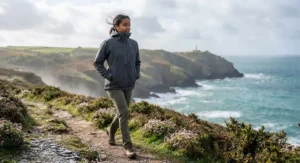
6. Montane Phase XT — best alpine climbing jacket for serious mountaineering
Montane built the Phase XT specifically around the needs of mountaineers, climbers and ski tourers, and the spec sheet reflects that focus rather than general hillwalking. A 70-denier GORE-TEX Performance fabric brings genuine abrasion resistance for scrambling across rock and ice, while a full-length 2-way YKK Aquaguard Vislon zip is designed to be operated while wearing a harness and belaying — a detail that matters enormously if you’re actually climbing rather than just walking uphill.
The “Mountain Fit” cut is deliberately roomier than a hillwalking jacket, built to accommodate a belay jacket or heavy insulation underneath during cold mountain conditions, which is exactly what most buyers overlook when comparing this against lighter, slimmer-cut alternatives — it’s not meant to be worn as your only layer. Underarm pit zips add ventilation options during the approach, before conditions demand the jacket goes fully buttoned-down higher up.
Based on the spec comparison with the Latok Alpine and Beta AR, the Phase XT sits as a genuine middle-ground mountaineering shell: more technical and durable than a hillwalking hardshell, but priced meaningfully below the very top tier. Real-world user reviews are mixed on the specific GORE-TEX ePE variant used in the current Phase line, with some praising reliable performance through mixed Scottish spring conditions and at least one detailed review describing a disappointing wet-out during heavy driving rain — a reminder that even premium membranes can be affected by fit, seam quality on a specific unit, or DWR wear over time.
Pros:
✅ Harness-compatible 2-way zip built for genuine climbing use
✅ 70D fabric offers strong abrasion resistance for rock and ice
✅ Mountain Fit cut allows serious layering in cold conditions
Cons:
❌ At least one detailed review reports wet-out in sustained heavy rain
❌ Roomier cut means it’s not the most flattering for lowland hillwalking
Expect to pay in the £350-£410 range — this is where “hardshell jacket waterproof rating” numbers genuinely start to matter, since GORE-TEX Performance fabric typically tests well above 20,000mm hydrostatic head.
7. Arc’teryx Beta AR — best overall hardshell for mountains
If there’s a single jacket that independent gear-testing outlets keep crowning best overall, it’s the Beta AR, and the reasoning holds up under scrutiny. It uses GORE-TEX Pro ePE — the current non-PFAS evolution of Gore’s top-tier membrane — combined with 80-denier body fabric and 100-denier reinforcement in high-wear zones, giving it a genuinely versatile balance of protection, weight and durability that’s hard to match anywhere else on this list.
Here’s what the spec sheet doesn’t fully capture: independent testers who’ve used the Beta AR across skiing, climbing and mountaineering consistently rate its fit and mobility as best-in-class, with articulated arms that don’t ride up when reaching overhead — a genuinely important detail for anyone climbing or skiing rather than just walking. The regular-fit cut sits closer to the body than the roomier Alpha SV from the same brand, making it the more versatile choice for buyers who want one jacket for multiple mountain disciplines rather than a dedicated expedition shell.
Reviewers do flag one honest trade-off worth knowing before you spend this much: the switch to non-PFAS DWR finishes across the industry, Arc’teryx included, means the water-beading effect wears off faster than older chemical treatments, requiring more frequent reproofing to maintain peak performance. That’s an industry-wide shift driven by environmental regulation rather than an Arc’teryx-specific flaw, but it’s worth budgeting reproofing spray into your ongoing costs regardless of which premium jacket you choose.
Pros:
✅ GORE-TEX Pro ePE membrane rated class-leading for durability and waterproofing
✅ Independent testers consistently rate fit and mobility as best-in-class
✅ Versatile enough for skiing, climbing and general mountaineering alike
Cons:
❌ Significant price premium over every other jacket on this list
❌ Non-PFAS DWR requires more frequent reproofing than older formulations
Sitting around £600-£650, this is a genuine investment piece — check current price, and weigh it against how many days a year you’ll actually be in the mountains before committing.
✨ Don’t Miss These Exclusive Deals!
🔍 Take your outdoor kit to the next level with the picks above. Click through on any highlighted jacket to check current pricing and availability on Amazon UK — the right shell will keep you moving comfortably through whatever British weather throws at you next.
Practical Usage Guide: Getting the Most From Your Waterproof Jacket
Buying the right jacket is only half the job — how you use and maintain it determines whether it performs on day one hundred the way it did on day one. Start by seam-checking a new hardshell before its first serious outing: run a hand along the internal tape to check nothing’s peeling, since manufacturing defects are rare but do happen and are far easier to sort under warranty before you’re relying on the jacket in genuinely bad weather.
DWR (durable water repellent) coating is the single most commonly misunderstood part of jacket maintenance. When water stops beading on the outer fabric and instead soaks in — even though the jacket is still technically waterproof underneath — that’s DWR wearing off, not the membrane failing. Wash your hardshell every few months using a technical cleaner rather than standard detergent (which clogs the membrane’s pores), then either tumble-dry on low heat or apply direct heat with an iron on a protective cloth to reactivate the DWR. Reapply a spray-on or wash-in reproofer roughly once or twice a season depending on use, more often for eVent fabrics based on the maintenance patterns UK climbers report.
A common first-30-days mistake is over-layering underneath a hardshell, which traps moisture against the skin and makes even a genuinely waterproof jacket feel like it’s leaking. Match your base and mid-layers to activity level, not just the forecast temperature, and use pit zips or venting zippers proactively rather than waiting until you’re already overheating. Store jackets loosely hung rather than stuffed in a compression sack long-term, since prolonged compression can eventually affect membrane performance.
Real-World Scenarios: Which Jacket Actually Suits You
Picture three very different Saturday mornings. First, a university student heading out for occasional weekend walks around the Peak District on a tight budget, wanting something that’ll survive a surprise shower without breaking the bank — the Regatta Pack-It III or Berghaus Paclite 2.0 covers this comfortably, and there’s genuinely no reason to spend more until the hobby sticks.
Second, a fell runner and fast-hiking enthusiast who’s out most weekends covering serious distance and generating serious heat, for whom breathability matters more than absolute bombproof waterproofing — this is precisely the buyer the Rab Kinetic 2.0 was designed around, paired with a packable emergency hardshell for when conditions properly turn.
Third, a Scottish winter climber tackling grade II-III routes most months from December through March, who needs a jacket that survives ice tool swings, rope work and hours of standing still at a belay in horizontal sleet — here the Latok Alpine’s eVent breathability and reinforced fabric, or the Phase XT’s harness-compatible zip and Mountain Fit cut, both make far more sense than anything lighter. Match your actual weekend, not your aspirational one, and the right jacket becomes an easy call.
Buyer’s Decision Framework
If you’re mostly walking on maintained lowland trails and want backup protection rather than a primary technical layer, choose a budget packable hardshell because the occasional shower doesn’t demand membrane-level performance. If you’re regularly active and generating significant body heat during exercise, choose a softshell or hybrid because breathability will keep you more comfortable than outright waterproofing. If you’re spending serious time above 600 metres in the UK hills through autumn and winter, choose a mid-range 3-layer hardshell because sustained exposure eventually finds the weak points in cheaper fabrics.
If you’re climbing, scrambling or mountaineering on technical terrain, choose a jacket with a harness-compatible zip and reinforced high-wear zones, since a standard hillwalking cut will fight against your movement. And if budget genuinely isn’t the deciding factor and you want one jacket that covers skiing, climbing and hillwalking equally well, the premium all-rounder category — think Beta AR — earns its price through sheer versatility rather than any single standout feature.
What Is a Hardshell vs Softshell Jacket?
A hardshell jacket is a fully waterproof, windproof outer layer built from a membrane (such as Gore-Tex or eVent) bonded to a durable face fabric, designed to block 100% of external moisture. A softshell jacket uses a stretchy, more breathable fabric that resists wind and light rain but isn’t fully waterproof, prioritising comfort and mobility during active movement over absolute weather protection.
How to Choose Between a Hardshell and Softshell Jacket
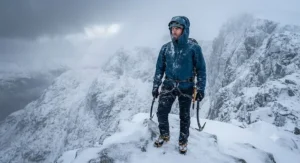
- Assess your typical weather exposure. If you regularly face sustained UK rain above the tree line, prioritise a hardshell; occasional showers suit a softshell fine.
- Consider your activity intensity. High-output activities like fell running or ski touring generate heat faster than a hardshell can vent, favouring a softshell or hybrid.
- Factor in terrain and abrasion risk. Scrambling, climbing and off-path routes wear through fabric faster, so prioritise higher-denier, reinforced hardshells.
- Check the waterproof rating. Anything below 10,000mm hydrostatic head is genuinely marginal for sustained UK mountain weather; 20,000mm-plus is the premium benchmark.
- Weigh packability against durability. Lighter 2.5-layer hardshells pack smaller but generally sacrifice some long-term robustness compared with 3-layer builds.
- Think about layering needs. If you’ll wear insulation underneath in winter, choose a roomier “Mountain Fit” cut rather than an athletic one.
- Match your budget to your actual usage frequency. A jacket used fifty days a year justifies a bigger spend than one worn five days a year.
Hardshell vs Softshell Jacket: The Detailed Comparison
The core distinction comes down to a simple trade-off: waterproofing versus breathability, with almost every design decision flowing from where a jacket sits on that spectrum. A true hardshell like the Beta AR or Phase XT uses a fully sealed membrane that blocks water regardless of how long you’re exposed, but that same sealed structure limits how quickly sweat vapour can escape, particularly during hard uphill effort. A softshell like the Rab Kinetic 2.0 flips that priority, using a more air-permeable or hydrophilic construction that breathes dramatically better but will eventually let sustained heavy rain through.
In practice, this isn’t really a competition — it’s a toolkit decision. Which walking club members in wetter regions like Snowdonia or the Lake District, per The Great Outdoors magazine’s own gear testing guidance, generally recommend a lighter softshell for fast-and-light movement and a more durable 3-layer hardshell for winter mountaineering where pockets, adjustment and sheer weatherproofing matter more than packed weight. Many experienced UK hillwalkers end up owning both: a softshell or hybrid for active days with a realistic forecast, and a dedicated hardshell reserved for genuinely committing mountain days where a wetted-out layer isn’t just uncomfortable but potentially dangerous.
Hardshell Jacket Waterproof Ratings Explained
Waterproof ratings are measured using a hydrostatic head test, where a column of water is applied to a fixed area of fabric under increasing pressure until it begins to leak; the resulting figure, in millimetres, becomes the jacket’s quoted rating. In the UK, a fabric legally needs a rating above 1,500mm to be marketed as “waterproof,” but that figure is genuinely marginal for real mountain use — it merely reflects the weight of a person leaning against wet fabric, not sustained driving rain with a rucksack’s straps compressing the shoulders.
For genuine three-season UK hillwalking, aim for 10,000mm-15,000mm as a sensible minimum, and for serious mountain or winter use, 20,000mm or higher is the benchmark most premium hardshells on this list meet or exceed. It’s worth noting that Gore-Tex famously declines to publish hydrostatic head figures for its own fabrics, preferring its own internal testing standards and a “guaranteed to keep you dry” promise instead — which is exactly why a jacket like the Berghaus Paclite 2.0 or Arc’teryx Beta AR won’t list a specific mm rating on the label, even though independent testing consistently rates Gore-Tex fabrics at the very top end of the scale. Rating alone doesn’t guarantee a dry day out, either: seam taping quality, zip design and hood construction all meaningfully affect real-world performance regardless of what the fabric itself is rated to withstand.
eVent Fabric, 2.5-Layer & 3-Layer Construction Compared
Layer construction refers to how a jacket’s waterproof membrane is bonded to its face fabric and lining, and it directly affects weight, packability and comfort. A 2-layer jacket bonds the membrane only to the outer fabric, with a separate hanging liner inside — durable but bulkier. A 2.5-layer build, used in the Berghaus Paclite 2.0, replaces that liner with a thin printed protective coating directly on the membrane, cutting weight and pack size at a modest cost to breathability and next-to-skin comfort. A 3-layer construction, found in the Latok Alpine, Phase XT and Beta AR, bonds a full inner lining directly to the membrane, creating the most durable and generally most breathable sandwich, at the cost of extra weight and price.
Within that 3-layer category, the choice of membrane matters as much as the layer count. eVent uses a genuinely air-permeable ePTFE construction that many independent testers rate as more breathable than standard Gore-Tex, because it transfers moisture vapour directly rather than relying purely on a diffusion process — but that same open structure makes it more sensitive to contamination from body oils and dirt, meaning eVent jackets like the Latok Alpine genuinely do need more frequent washing and reproofing to maintain peak performance, a maintenance reality confirmed repeatedly by long-term UK climbing forum users rather than marketing copy.
The Best Hardshell Jacket for Mountains and Alpine Climbing
For anyone specifically searching out the best hardshell jacket for mountains, the honest answer depends on which mountains and what discipline. For general UK hillwalking above 600 metres through autumn, winter and spring, the Berghaus Paclite 2.0 or a similarly specced mid-range 3-layer shell covers the vast majority of realistic conditions without unnecessary expense. For genuine alpine climbing — think roped movement, ice axe and crampon use, technical mixed ground — the calculus changes significantly: you need a harness-compatible zip, a helmet-compatible hood, reinforced high-wear zones and a cut that won’t bunch up under a climbing harness.
That narrows the field to the Latok Alpine, Phase XT and Beta AR on this list, each representing a slightly different balance of breathability, durability and price within that alpine climbing jacket category. Based on the spec comparison, the eVent-based Latok Alpine edges ahead on breathability for hard aerobic climbing days, the Phase XT’s 70D fabric and Mountain Fit cut suit expedition-style layering in sustained cold, and the Beta AR’s GORE-TEX Pro ePE membrane and refined fit make it the most versatile single choice if you’re also skiing or general mountaineering rather than climbing exclusively.
Waterproof Hardshell Jackets Under £150: What You Actually Get
Searching specifically for a waterproof hardshell jacket under £150 is entirely reasonable for anyone who isn’t climbing technical routes, and both the Regatta Pack-It III and — depending on sales and sizing — the Berghaus Paclite 2.0 can land within or close to that budget. What you’re genuinely getting at this price point is a sealed, taped-seam waterproof membrane that will keep sustained UK rain out during a normal day’s walking; what you’re not getting is the abrasion resistance, harness compatibility or premium breathability of a £300-plus mountaineering shell.
For most UK hillwalkers doing weekend routes on maintained paths, that trade-off is entirely sensible — the extra spend on a premium shell buys durability and breathability margins that simply aren’t needed unless you’re regularly out in genuinely committing conditions. The honest advice, based on aggregated reviewer sentiment across this price bracket, is to prioritise a genuine taped-seam membrane over marketing claims, since some ultra-budget rainwear below this range skips seam taping entirely, undermining waterproofing regardless of the base fabric’s rating.
Common Mistakes When Buying a Hardshell or Softshell Jacket
The single most common mistake is buying based on waterproof rating alone while ignoring breathability, resulting in a jacket that keeps rain out but traps sweat in — genuinely miserable on a hard uphill slog. A close second is sizing too tight, leaving no room for a midlayer or insulation underneath during colder months; most UK hardshells are designed to be sized with layering in mind, so trying one on over your typical winter layers before buying is worth the effort.
Buyers also frequently overlook hood design, assuming all adjustable hoods perform equally, when in reality wired peaks and helmet compatibility vary hugely between budget and premium options. Finally, many people skip maintenance entirely, assuming “waterproof” is a permanent, set-and-forget property rather than a coating that wears down and needs periodic reproofing — a mistake that turns even a premium Gore-Tex Pro jacket into a disappointing, wetting-out layer within a couple of seasons.
Long-Term Cost & Maintenance
Total cost of ownership rarely stops at the sticker price. Budget on roughly one reproofing treatment per season for standard use, more frequently for eVent fabrics based on maintenance patterns reported by long-term owners, at a modest ongoing cost for wash-in or spray-on treatments. Factor in that cheaper 2-layer and 2.5-layer jackets typically need full replacement sooner — reviewers commonly report five to eight years of hard use from a well-maintained 3-layer hardshell versus a shorter realistic lifespan for entry-level packable shells used frequently.
Cost-per-wear tells a more useful story than sticker price alone: a £600 Beta AR worn fifty days a year for eight years works out to roughly £1.50 per use, cheaper in real terms than a £25 budget jacket replaced annually by someone hillwalking every weekend. For occasional users, the maths flips entirely — the budget option wins comfortably. Match spend to genuine frequency of use rather than aspiration, and the long-term value proposition becomes far clearer.
Safety, Regulations & Mountain Weather Compliance
Getting caught out in UK hills without adequate waterproofing isn’t just uncomfortable — it’s a genuine safety issue. Heavy and persistent rain or snow, combined with poor visibility and exposure to strong winds, can create difficult and dangerous conditions with a real risk of hypothermia, according to official Met Office mountain safety guidance, which specifically recommends checking dedicated mountain forecasts and carrying appropriate waterproof clothing with spare layers before heading into upland terrain. Wind exposure compounds the risk significantly, since battling into strong gusts is energy-sapping and accelerates heat loss, a factor Mountaineering Scotland’s safety guidance highlights as a major contributor to hypothermia onset independent of temperature alone.
Practically, this means treating your jacket choice as a safety decision rather than purely a comfort one once you’re heading above 300-400 metres in the UK, particularly outside summer months. Always check a dedicated mountain forecast rather than a general town forecast before committing to a route, carry a spare insulating layer regardless of how reliable your hardshell’s rating is, and remember that even a premium 20,000mm-rated jacket depends on intact DWR, sealed seams and a well-fitted hood to perform as designed in genuinely severe conditions.
Frequently Asked Questions
❓ Is a hardshell or softshell jacket better for hiking?
❓ What waterproof rating do I need for a hardshell jacket UK?
❓ Is eVent better than Gore-Tex for waterproof jackets?
❓ What does 2.5 layer construction mean on a jacket?
❓ Can I wear a softshell jacket in heavy rain?
Recommended for You
- Best Hardshell Jacket UK 2026: 7 Top Gore-Tex Picks Tested
- Best Girls Waterproof Jacket UK 2026: 7 Top Picks for Rainy Days
- Best Boys Waterproof Jacket UK 2026: 7 Top Picks That Actually Work
Disclaimer: This article contains affiliate links. As an Amazon Associate, I earn from qualifying purchases. If you purchase products through these links, we may earn a small commission at no additional cost to you. Prices mentioned are approximate ranges at the time of research and may vary — always check the current price on Amazon before purchasing.
✨ Found this helpful? Share it with your friends! 💬🤗
