
In This Article
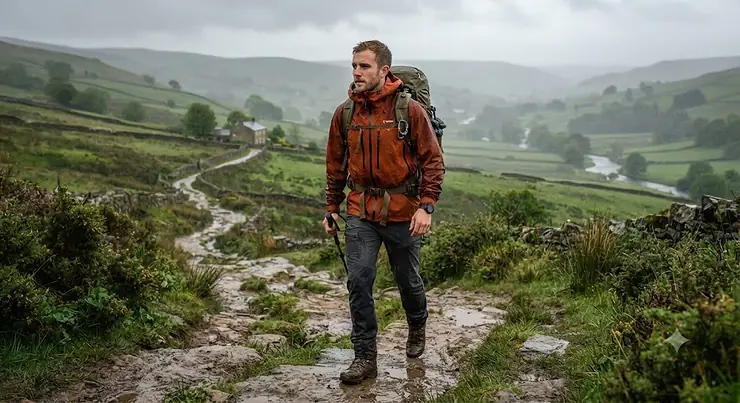
A mens walking jacket is, put simply, a waterproof and breathable outer layer designed to keep rain, wind and sweat where they belong — outside your base layer, not soaking through it. That’s the 40-second version. The longer version is a lot more interesting, because the gap between a jacket that merely looks the part on the school run and one that’ll actually survive four hours of sideways rain on Scafell Pike is enormous, and it rarely shows up in the marketing photos.
I’ve spent the past few weeks pulling apart the spec sheets, aggregated review data and real-world testing notes on seven genuinely good options, from budget packaway shells through to the sort of Gore-Tex hardware that mountain leaders reach for without thinking twice. Whether you’re after a mens walking jacket for muddy Sunday strolls or something tougher for proper hill days, the goal here is the same: match the jacket to the walking you actually do, not the walking you imagine you might do one day. According to Which?’s survey of waterproof jacket owners, satisfaction hinges far more on fit-for-purpose choice than on brand name alone — a theme that comes up again and again in this guide.
Mens Walking Jacket: Quick Comparison Table
Before the deep dive, here’s the shortlist. Prices are indicative ranges only, since retailer pricing shifts constantly.
| Jacket | Price Range | Waterproofing | Best For |
|---|---|---|---|
| Regatta Pack-It III | under £60 | Isolite 5,000–15,000mm | Absolute beginners, occasional walkers |
| Columbia Ampli-Dry II | £100–£155 | Omni-Tech, PFC-free | Casual day hikes, dog walks |
| Berghaus Deluge Pro 3.0 | £70–£100 | Hydroshell, ~11,880mm HH | Budget hillwalking, commuting |
| Rohan Ventus | £200–£220 range | Barricade, 20,000mm HH | Regular walkers wanting UK-designed kit |
| Páramo Velez Adventure Light | around £250 | Nikwax Analogy (non-membrane) | Mountain Leader-style all-day comfort |
| Mountain Equipment Makalu | £300–£330 range | Gore-Tex ePE, 28,000mm HH | Serious hillwalking, mountain days |
| Arc’teryx Beta | £350–£380 range | Gore-Tex ePE, C-KNIT backer | Premium buyers wanting the best build quality |
Looking at the spread above, there’s a clear pattern: waterproof rating and price track each other fairly closely, but not perfectly — the Rohan Ventus, for instance, matches the hydrostatic head of jackets costing £100 more. Budget doesn’t have to mean “will let you down on the first proper downpour,” but it usually means fewer features and a shorter design lifespan. If you only walk a handful of times a year, that trade-off is entirely reasonable; if you’re heading into Eryri or the Lakes most weekends, it starts to matter a lot more.
💬 Found a jacket you like the look of already? Check today’s price before it changes.😊
Top 7 Mens Walking Jackets: Expert Analysis
1. Regatta Pack-It III — best ultra-packable budget buy
The Regatta Pack-It III is the jacket you buy so you never again get caught out without one — it folds into its own stuff sack roughly the size of a grapefruit. Regatta uses its own Isolite fabric here, with a waterproof rating that Regatta itself confirms varies between 5,000mm and 15,000mm depending on the batch and colourway, plus taped seams and an adjustable shockcord hood. In practice, that means it’ll comfortably shrug off drizzle and moderate rain, but it isn’t the jacket for a static, hours-long soaking on an exposed ridge. Based on the spec comparison, this is squarely a “get you home” shell rather than a technical mountain layer, and that’s exactly what it’s designed to be. Aggregated retailer reviews consistently describe it as generously cut, easy to layer a fleece underneath, and surprisingly good value for the price point, though several reviewers note the thin fabric offers next to no warmth on its own.
Pros:
- ✅ Packs down small enough for any daypack pocket
- ✅ Taped seams keep the build genuinely waterproof
- ✅ Among the cheapest genuinely functional options around
Cons:
- ❌ Waterproof rating varies noticeably between batches
- ❌ Thin, unlined fabric offers little warmth alone
At under £60, the Regatta Pack-It III is hard to beat as an emergency layer or first-ever walking jacket, and it’s a sound choice if your walking is mostly low-level and close to home.
2. Columbia Ampli-Dry II — best value for casual day walks
The Columbia Ampli-Dry II leans on Columbia’s proprietary Omni-Tech membrane rather than Gore-Tex, and the four-way stretch fabric is the standout feature here — it moves with you far more than a stiffer budget hardshell would. Columbia lists the jacket at around 320g with fully taped seams and pit zips for extra venting, and reviewers testing it in Scotland and the Lake District have reported it copes well with sustained rain, provided you’re not working hard uphill. What most buyers overlook about this model is that Omni-Tech’s breathability lags noticeably behind pricier laminates, so it suits gentler walking pace better than a brisk uphill push. Aggregated reviewer sentiment is broadly positive on value, with the fabric’s PFC-free construction praised as a genuine environmental upgrade over the outgoing model, though a few testers flagged condensation build-up on sustained, sweaty climbs.
Pros:
- ✅ Four-way stretch fabric aids freedom of movement
- ✅ PFC-free Omni-Tech membrane, a genuine eco upgrade
- ✅ Pit zips help dump heat on steeper sections
Cons:
- ❌ Breathability trails behind pricier laminated fabrics
- ❌ Membrane can cling slightly to damp base layers
Sitting in the £100–£155 range depending on colourway and sales, the Columbia Ampli-Dry II is a smart pick for anyone doing regular but unhurried day walks rather than serious hill mileage.
3. Berghaus Deluge Pro 3.0 — best all-rounder under £100
Berghaus’s own figures put the Berghaus Deluge Pro 3.0 at a genuinely lightweight 340g, with a Hydroshell fabric hydrostatic head of 11,880mm and a breathability rating of 20,641g/m²/24hrs — numbers that are, frankly, excellent for a jacket usually available well under £100. Here’s what to weigh: that 2-layer Hydroshell construction won’t match a 3-layer Gore-Tex shell for long-term durability under a heavy rucksack, but for the price it delivers a very respectable balance of dryness and sweat management. The jacket also uses over 75% recycled content, meeting Berghaus’s own sustainability benchmark. Reviewers consistently note the fixed hood and half-elasticated cuffs work well in practice, though several mention that two zipped hand pockets (with no chest pocket) feels a little sparse for longer days out.
Pros:
- ✅ Genuinely lightweight at around 340g
- ✅ Over 75% recycled fabric content
- ✅ Strong hydrostatic head for a sub-£100 jacket
Cons:
- ❌ Only two hand pockets, no chest pocket
- ❌ Fixed hood offers just single-point adjustment
The Berghaus Deluge Pro 3.0 is arguably the best-value jacket in this entire guide — proof that “budget” doesn’t have to mean compromised waterproofing.
4. Rohan Ventus — best British-made technical shell
The Rohan Ventus uses Rohan’s own Barricade fabric in a 3-layer bonded construction, and reviewers are near-unanimous on one point: it’s noticeably softer and quieter than Gore-Tex Pro, without the stiff rustle that puts some walkers off technical shells altogether. Rohan states a hydrostatic head and breathability figure of 20,000mm/20,000 MVTR, numbers that sit comfortably alongside Gore-Tex and Patagonia’s H2No. What the spec sheet won’t tell you, but reviewers note, is how well the roomy mid-chest pockets work in practice — they sit above a hipbelt line and comfortably swallow an OS map. At 485g it isn’t the lightest shell around, and testers have flagged the underarm pit-zips as stiff and fiddly to operate one-handed. Aggregated review sentiment from British hillwalking publications is consistently strong, with several reviewers noting Rohan deserves far more recognition alongside Arc’teryx and Mountain Equipment.
Pros:
- ✅ Soft, quiet fabric with none of the Gore-Tex rustle
- ✅ Excellent 20,000mm hydrostatic head and breathability
- ✅ Roomy chest pockets comfortably hold an OS map
Cons:
- ❌ Limited colour range compared with rivals
- ❌ Underarm pit-zips are stiff to use one-handed
At around £200–£220, the Rohan Ventus rewards walkers who want genuinely technical performance from a British brand that doesn’t shout about itself.
5. Páramo Velez Adventure Light — favourite among Mountain Leader instructors
The Páramo Velez Adventure Light does things differently: instead of a waterproof membrane, it uses Páramo’s Nikwax Analogy system — a DWR-treated outer paired with a “pump liner” that actively moves liquid water and vapour away from your skin. On paper this means no membrane to eventually fail or delaminate, and reviewers testing it in Snowdonia and the Scottish Highlands consistently praise how warm and comfortable it feels against bare skin in genuinely foul weather. One detail worth flagging honestly: a UK climbing forum discussion notes the jacket has been recommended by instructors on Mountain Leader training courses, which says a lot about its reputation among people who wear waterproofs professionally. The catch, and it is a real one, is maintenance — the Analogy system needs regular Nikwax reproofing to keep performing, and the jacket runs heavier and bulkier than a laminated shell of similar warmth.
Pros:
- ✅ No membrane to delaminate or wear out over time
- ✅ Genuinely warm and comfortable in cold, wet conditions
- ✅ Lifetime guarantee plus a garment repair service
Cons:
- ❌ Needs regular Nikwax reproofing to perform properly
- ❌ Heavier and bulkier than an equivalent laminated shell
Priced around £250, the Páramo Velez Adventure Light suits walkers who spend long days out in genuinely miserable weather and don’t mind a bit of extra care in return for all-day comfort.
6. Mountain Equipment Makalu — best Gore-Tex ePE for mountain days
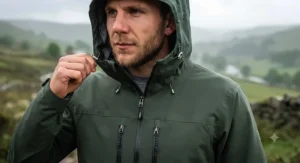
The Mountain Equipment Makalu was one of the first jackets on the market to use Gore-Tex’s newer ePE membrane, which ditches the PFC-based chemistry of older Gore-Tex while, according to independent testing, matching its waterproofing and breathability. Mountain Equipment’s own figures list a 28,000mm hydrostatic head and a tough 75-denier face fabric, built for what the brand calls its “Alpine Fit” — a touch trimmer than their general Mountain Fit. Based on the spec comparison, that heavier-denier fabric is what separates this from lighter shells like the Ventus: it shrugs off scrambling over rock and heavy pack straps far better, at the cost of some stretch and roughly 520g of weight. Reviewers testing the Makalu through Scottish Highland autumn conditions and Pacific Northwest ski touring both report the jacket performed flawlessly for waterproofing, with the main criticism being that it isn’t the most breathable option on hard, sustained climbs.
Pros:
- ✅ Gore-Tex ePE membrane cuts PFC use significantly
- ✅ Tough 75D fabric shrugs off scrambling and pack wear
- ✅ Three generous pockets including a useful chest stash
Cons:
- ❌ No fabric stretch, unlike some rivals
- ❌ At around 520g, not the lightest in its class
At £300–£330, the Mountain Equipment Makalu sits at least £200 below comparable Gore-Tex Pro shells, making it the sensible “proper mountain jacket” pick for serious walkers who don’t need Pro-grade toughness.
7. Arc’teryx Beta — best premium shell for serious hillwalkers
The entry point into Arc’teryx’s famous Beta family, the Arc’teryx Beta uses an 80-denier, 3-layer Gore-Tex ePE construction with a Gore C-KNIT backer, and independent lab-style testing has found its DWR coating resists “wetting out” for longer than most rivals — a detail that matters more on a genuinely long wet day than most spec sheets let on. Reviewers consistently describe the fit as roomy without feeling baggy, which makes it easy to layer over a fleece or light insulated jacket in colder months, and the build quality is repeatedly singled out as best-in-class. What most buyers overlook about this model is that, unlike the pricier Beta AR or Beta SL, the standard Beta skips pit zips entirely, so ventilation relies on the main zip and cuffs alone. You are, honestly, also paying a premium for the name — Arc’teryx openly positions this as its “entry-level,” everyday-oriented Beta, yet it still costs noticeably more than jackets with near-identical technical specs.
Pros:
- ✅ DWR coating resists wetting out longer than most rivals
- ✅ Roomy, comfortable fit that layers easily
- ✅ Renowned build quality and finish throughout
Cons:
- ❌ Price reflects branding as much as raw performance
- ❌ No pit zips, unlike the pricier Beta AR or SL
Around £350–£380, the Arc’teryx Beta is the jacket for buyers who want the best available build quality and are happy to pay for it.
Practical Usage Guide: Getting the Most From Your Walking Jacket
A new mens walking jacket performs best when it’s looked after properly from day one, and this is the bit most product pages simply skip. First, wash it — factory finishes and packaging residue can actually reduce a fresh DWR coating’s performance, so run it through a gentle synthetic wash cycle using a technical cleaner rather than standard detergent, which clogs the membrane’s pores. Second, reproof regularly: even laminated shells like the Mountain Equipment Makalu or Arc’teryx Beta rely on a DWR (durable water repellent) top coating that wears off with UV exposure and abrasion, typically needing a wash-in or spray-on reproofer every few months of regular use. Non-membrane jackets like the Páramo Velez Adventure Light need this even more frequently, since the entire waterproofing system depends on it.
In the first 30 days, the most common mistake is over-layering underneath, which traps sweat and makes even a genuinely breathable jacket feel clammy — a lightweight base layer plus a light fleece is usually enough for UK walking temperatures. Also check your hood adjustment cords and hem drawstrings before you need them in a downpour, not during one. Dry your jacket fully open and away from direct heat after every wet outing, and store it loosely rather than stuffed permanently in its stuff sack, which can crease and weaken seam tape over years of use.
Real-World Scenarios: Which Walking Jacket Actually Suits You?
Picture three different walkers. First, a university student commuting three miles across a rainy campus and doing the occasional weekend countryside walk with friends — budget matters, packability matters, and hardcore mountain performance doesn’t. For them, the Regatta Pack-It III or Columbia Ampli-Dry II covers everything they’ll realistically need, without wasting money on features they’ll never use.
Second, a family walker in their forties who does the Lake District or Peak District most months, sometimes in changeable weather, and wants one jacket to last several years without letting them down. This is squarely Berghaus Deluge Pro 3.0 or Rohan Ventus territory — enough genuine technical performance for real hill weather, at a price that doesn’t feel reckless.
Third, someone working towards a Mountain Leader qualification or already leading groups on Snowdonia’s ridges in all seasons, where jacket failure genuinely matters for safety, not just comfort. Here, the Páramo Velez Adventure Light, Mountain Equipment Makalu or Arc’teryx Beta earn their higher price tags through sustained performance and durability that lower-tier jackets simply aren’t built for.
Problem → Solution: Common Walking Jacket Complaints Solved
Reviewers and forum posts repeatedly raise the same handful of frustrations, so let’s tackle them directly. Jacket feels clammy inside despite being “breathable”? The fix is usually layering, not the jacket — swap a cotton t-shirt for a wicking base layer, and unzip pit vents where fitted, such as on the Columbia Ampli-Dry II. Rain soaking through at the shoulders under a rucksack? That’s abrasion wearing down the DWR finish exactly where straps rub, solved with a targeted reproofing spray rather than a full jacket wash. Hood won’t stay put in wind? Check both the face drawcords and the separate volume adjuster, a common miss on jackets like the Páramo Velez Adventure Light that offer three-way hood adjustment most buyers never fully use. Zip sticking or difficult to operate one-handed, as testers noted with the Rohan Ventus‘s underarm vents? A light application of zip lubricant (not household oil) usually resolves this in seconds. Jacket feels too warm on milder days? This is where venting features and fabric weight matter more than waterproof rating, making a lighter shell like the Berghaus Deluge Pro 3.0 more comfortable than a heavier mountain jacket for three-season use.
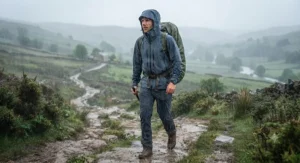
How to Choose a Mens Walking Jacket
Choosing well comes down to matching a handful of criteria to how you actually walk, not how you’d like to imagine you walk.
- Match hydrostatic head to your terrain. A 5,000–10,000mm rating suits gentle countryside walks; serious hill days call for 20,000mm or more, as found on the Rohan Ventus and Mountain Equipment Makalu.
- Prioritise breathability over waterproofing alone. A jacket that’s bone dry outside but soaking inside from sweat hasn’t done its job — check MVTR figures where brands publish them.
- Weigh up membrane versus non-membrane systems. Traditional laminates like Gore-Tex are lighter; Páramo’s Analogy system trades weight for genuinely different comfort in sustained rain.
- Consider pocket placement, not just count. Chest pockets sit above a rucksack hipbelt and stay accessible; low hand pockets often don’t once a pack is loaded.
- Check hood adjustment points. Three-way adjustable hoods track head movement far better than single-point fixed designs.
- Factor in weight against durability. Lighter fabrics pack smaller but wear faster under repeated pack-strap abrasion.
- Set a genuine budget band first, then look at what each price tier actually delivers — the jump from £60 to £150 buys meaningfully more than £300 to £380 typically does.
Best Jacket for Lake District Walks
Lake District weather is famously changeable — often four seasons in an afternoon, with rain arriving off the Irish Sea with little warning. For fell walking around Helvellyn, Scafell or the Langdale Pikes, a jacket needs a genuinely high hydrostatic head and reliable hood coverage, since exposed ridgelines see driving, horizontal rain rather than gentle drizzle. The Mountain Equipment Makalu and Rohan Ventus both handle this well, with hydrostatic heads well above the 15,000mm threshold generally considered the practical minimum for serious hillwalking. For lower-level lakeside and valley walks, though, the Berghaus Deluge Pro 3.0 is genuinely sufficient and considerably lighter to carry. Local weather can turn quickly enough that checking a live forecast before setting out is worth the two minutes it takes, and it’s one of the simplest ways to avoid getting caught badly underdressed.
Best Jacket for Snowdonia
Snowdonia — now officially Eryri National Park — throws up some of Wales’s wettest and windiest conditions, and its higher routes up Snowdon (Yr Wyddfa) and the Glyderau see genuinely severe weather even in summer. This is where the case for a proper mountain-grade shell is strongest: the Arc’teryx Beta and Mountain Equipment Makalu both offer the durability and sustained waterproof performance that repeated exposure on rocky, scrambly terrain demands. Interestingly, it’s exactly this kind of environment where the Páramo Velez Adventure Light earns its reputation, since its non-membrane system keeps performing consistently through hours of continuous rain without the “wetting out” some laminated shells eventually suffer. Whichever jacket you choose, Snowdonia’s terrain rewards a helmet-compatible hood and a slightly longer hem, both features worth checking before you commit.
Waterproof Breathable Walking Jacket: What the Numbers Actually Mean
Every jacket on this list claims to be waterproof and breathable, but the numbers behind those claims vary hugely, and they’re worth understanding rather than skimming past. Hydrostatic head measures how much water pressure a fabric withstands before leaking, expressed in millimetres; UK regulations classify anything above 1,500mm as technically waterproof, though that figure is far too low for genuine hill use. Breathability, usually given as a moisture vapour transmission rate (MVTR) in grams per square metre per 24 hours, measures how effectively sweat vapour escapes. A jacket can excel at one and fail at the other — a cheap PVC mac might be bone dry outside but leave you drenched in your own sweat within the hour. Independent testers reviewing dozens of shells each year, such as those behind Countryfile’s annual waterproof jacket tests, consistently note that real-world performance depends as much on fit, venting and layering as on the headline numbers alone. Gore-Tex fabrics carry a minimum 28,000mm hydrostatic head rating, a benchmark confirmed by Live For The Outdoors’ hillwalking jacket testing, which explains why jackets like the Mountain Equipment Makalu command higher prices than budget alternatives using proprietary membranes.
Mountain Leader Jacket: What the Professionals Actually Wear
“Mountain Leader jacket” isn’t an official product category, but it’s shorthand for the kind of shell that qualified hill and mountain leaders actually choose to wear on multi-day courses and assessments, where jacket failure has real safety consequences rather than just discomfort. Based on aggregated forum and reviewer sentiment, this tends to favour jackets proven over years of hard use rather than the newest release: the Páramo Velez Adventure Light is repeatedly namechecked by Mountain Leader training instructors for its all-day comfort and reliability in sustained Welsh and Scottish rain, while the Mountain Equipment Makalu and Arc’teryx Beta cover the harder-wearing, more technical end of that same reputation. What most casual buyers overlook is that professionals prioritise consistency over lightness — a jacket that performs identically on hour eight as it did on hour one matters more to them than shaving off 100g.
Technical Walking Shell vs Everyday Waterproof: What’s the Difference
A technical walking shell and an “everyday waterproof” jacket might look superficially similar hanging in a shop, but the differences run deep. Technical shells like the Rohan Ventus and Arc’teryx Beta use laminated, seam-taped multi-layer membranes engineered specifically for sustained rain and exertion, with reinforced high-wear zones, helmet-compatible hoods and pit zips for active venting. Everyday waterproofs, by contrast, are built more for short exposure — walking to the shops, a school run, or waiting at a bus stop — and prioritise style, warmth from a lining, or a smarter cut over raw technical performance. The Regatta Pack-It III sits somewhere in between: technical enough for genuine walking use, without the price or bulk of a true mountain shell. The practical upshot: if you’re regularly out for three-plus hours in changeable weather, a technical shell earns its keep quickly; if you’re mostly walking the dog around the block, you’re very likely paying for performance you’ll never actually test.
Mens Hiking Jacket Under £150: Best Value Picks
If your budget caps out around £150, three jackets in this guide genuinely deliver. The Regatta Pack-It III wins on sheer packability and price, ideal as a first jacket or an emergency spare. The Berghaus Deluge Pro 3.0 offers the best technical spec-to-price ratio here, with a genuinely useful hydrostatic head that outperforms its price tag. The Columbia Ampli-Dry II, meanwhile, often dips under £150 during sales and brings genuinely useful stretch and venting that neither of the other two match. Here’s what to weigh: at this price point you’re trading some long-term durability and a chest pocket or two for a jacket that will still keep you dry through most UK walking conditions, which for the vast majority of casual and even regular walkers represents excellent value rather than a compromise.
Common Mistakes When Buying a Mens Walking Jacket
The most common mistake, by a distance, is buying on hydrostatic head number alone without checking breathability, resulting in a jacket that’s technically waterproof but miserable to wear on any uphill section. A close second is sizing too tight to fit a mid-layer underneath — walking jackets need room for a fleece or light insulated layer in colder months, and a snug fit that looks good in the shop often becomes genuinely uncomfortable on the hill. Buyers also frequently skip checking hood adjustment before purchase, only discovering in a proper storm that a fixed, single-point hood won’t track their head movement. Another overlooked detail: pocket placement relative to rucksack hipbelts, which renders low hand pockets useless once a pack is loaded and cinched. Finally, many buyers assume “waterproof” and “showerproof” mean the same thing — they don’t, and checking the actual hydrostatic head figure rather than trusting marketing language avoids a nasty surprise on your first proper wet walk.
Long-Term Cost & Maintenance
A cheaper jacket bought twice within three years can easily cost more than a single durable jacket bought once, so it’s worth thinking in total cost of ownership rather than sticker price alone. The Regatta Pack-It III, at under £60, may need replacing within a couple of seasons of regular use as its DWR finish and thin fabric wear down, while a Mountain Equipment Makalu or Arc’teryx Beta, properly reproofed every few months, can realistically last five to ten years of regular hillwalking. Reproofing products typically cost under £15 and take twenty minutes, a small recurring cost against a jacket’s total lifespan. The Páramo Velez Adventure Light sits in an interesting middle ground here: its Nikwax-dependent system needs more frequent attention than a laminated shell, but Páramo’s lifetime guarantee and repair service genuinely extend the jacket’s useful life well beyond what the upfront price suggests. For anyone walking more than a handful of times a month, the maths increasingly favours investing once in a jacket built for repeated hard use.
Safety, Regulations & Weather Awareness for UK Walkers
No jacket, however good, substitutes for basic weather awareness and route planning on UK hills. Conditions on higher ground can differ dramatically from valley forecasts, with wind chill and rain intensity increasing sharply with altitude, particularly across exposed ranges like Snowdonia and the Lake District fells. A well-chosen mens walking jacket is one part of managing exposure risk, but staying warm and dry also depends on carrying spare layers, checking forecasts immediately before setting out, and knowing when to turn back. Prolonged exposure to cold, wet conditions can lead to hypothermia, and NHS guidance on hypothermia describes it as a dangerous drop in body temperature below 35°C requiring urgent treatment, with symptoms including shivering, pale or cold skin, slurred speech and confusion. If you’re planning routes on exposed mountain terrain, building in a working knowledge of these symptoms alongside your gear choices is genuinely sensible, not overcautious.
✨ Don’t Miss These Exclusive Deals!
🔍 Take your walking wardrobe to the next level with these carefully selected jackets. Click on any highlighted item to check current pricing and availability. These picks will help you stay properly prepared for whatever the British weather throws at you!

FAQ: Mens Walking Jacket Questions
❓ What waterproof rating do I need for a walking jacket?
❓ How much should I spend on a mens walking jacket?
❓ Can I wear a normal raincoat for hillwalking?
❓ What's the difference between a walking jacket and a hiking jacket?
❓ Do I need a Gore-Tex jacket for the Lake District?
Conclusion
Picking the right mens walking jacket really comes down to being honest about how you actually walk, rather than the walking you aspire to. The Regatta Pack-It III and Columbia Ampli-Dry II cover casual, occasional use brilliantly and cheaply. The Berghaus Deluge Pro 3.0 is arguably the smartest all-round value buy here, punching well above its price. Regular hillwalkers get genuine, lasting performance from the Rohan Ventus, while those tackling Snowdonia, the Lake District fells or working towards Mountain Leader qualifications will find the Páramo Velez Adventure Light, Mountain Equipment Makalu and Arc’teryx Beta worth every extra pound in reliability when it matters most. Whichever you choose, remember that even the best jacket only performs as well as the care and layering behind it — reproof it, size it to fit a mid-layer, and check the forecast before you rely on it.
Recommended for You
- 7 Best Walking Jacket Picks for UK Trails in 2026
- Womens Running Rain Jacket: 7 Real Picks Worth Buying in 2026
- Mens Waterproof Running Jacket: 7 Best Picks for 2026 UK
Disclaimer: This article contains affiliate links. As an Amazon Associate, I earn from qualifying purchases. If you purchase products through these links, we may earn a small commission at no additional cost to you.
✨ Found this helpful? Share it with your friends! 💬🤗
